Arts In LA
Dance in LA
Ballet Review
The Nutcracker
American Ballet Theatre at Segerstrom Center for the Arts
Reviewed by Dany Margolies

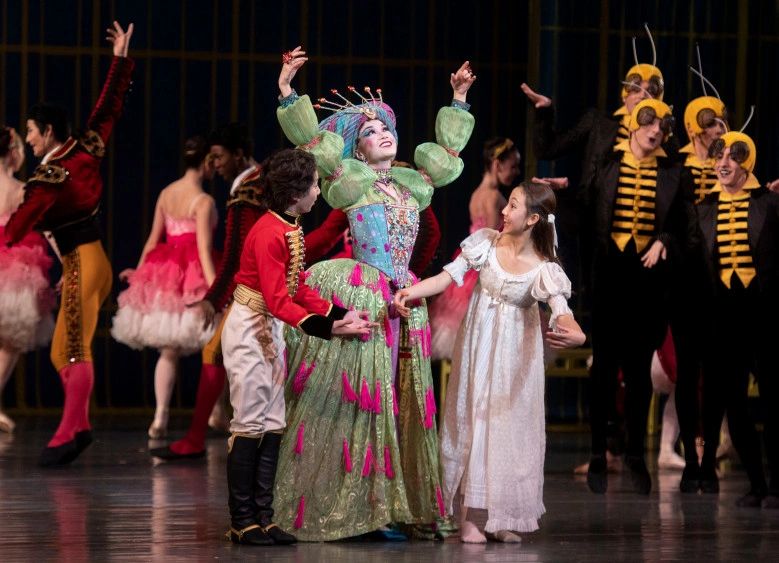
Kellan Hayag as the Nutcracker and Lani Mefford as Clara
Photo by Paul Rodriguez/Orange County Register
Though most ballet lovers love it, The Nutcracker is a confusing jumble of a ballet. In American Ballet Theatre’s current version, thankfully still set to the Tchaikovsky score, choreographer Alexei Ratmansky has done little to untangle the jumble. By its end, we know three things about Ratmansky: He has an iconoclastic streak, he’s interested in egalitarianism, and he loves soubresauts (little jumps in which the feet tuck up).
On the ballet’s opening night at Segerstrom Center for the Arts, the ABT pros looked like they had jet lag. On the other hand, the kids onstage—students from American Ballet Theatre William J. Gillespie School at Segerstrom Center for the Arts—looked like pros. This is American Ballet Theatre, for Christmas’ sake. The leads shouldn’t be hopping to finish pirouettes. The corps should stay tidily together. And all should have that star quality that says, “We are deservedly the best in the country if not in the world.”
The children, however, shone. They dance in time. They stay in line. And those lines and patterns are sophisticated and complicated even for adults. The students display beautiful carriage and épaulement (relative position of head and shoulders) while their feet work hard.
Ratmansky sets his first scene in the Stahlbaum family’s kitchen. The frantic staff tries to prepare for a party while the tiny mouse ensconced under the table is adorably defiant (danced by young Andrew Dove, who proves that physical comedians are born, not made).
The party swings into action, with swirling masses of kids and gifts and tipsy adults. Little Clara (Lani Mefford) and her obnoxious brother Fritz (Salvatore Lodi) mingle with the guests, until the apparently uninvited Drosselmeyer (Roman Zhurbin) arrives with major giftage: life-size dolls. Columbine (Cassandra Trenary) and Harlequin (Arron Scott) appear in black-and-white outfits, among the most-striking of Richard Hudson’s lavish costuming (he also designed the scenery here). Next comes the soldier Recruit (Luis Ribagorda), sometimes danced as a solo but here joined by the Canteen Keeper (Courtney Lavine), who shares the energetic choreography. Then, Drosselmeyer gives Clara a toy Nutcracker, which through stagecraft appears life-size and toy-size throughout the scene.
Clara, sad to head to bed, seems to awaken to an infestation of mice. In marches a battalion of toy soldiers (the young students again) led by the Nutcracker, who turns out to be “real” (Kellan Hayag). With help from Clara, who tosses her shoe into the fray, he slays the Mouse King (Thomas Forster).
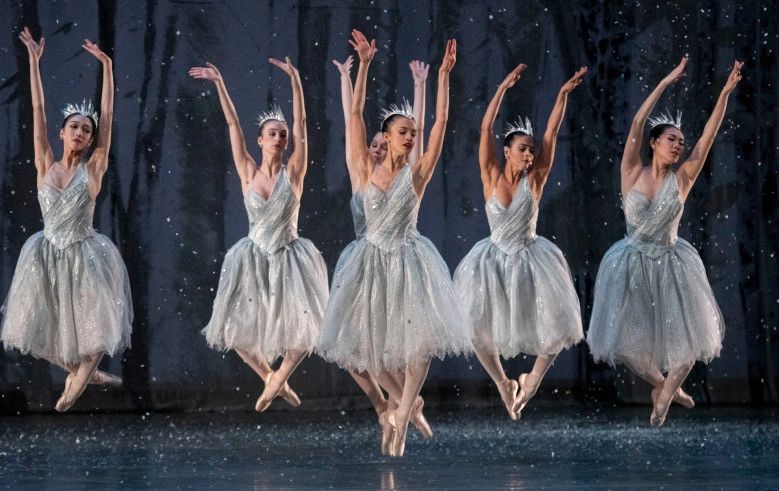
Young Clara rejects a friendly advance from the young Nutcracker. But then we see a grownup Princess Clara and her Nutcracker Prince (ABT principals Hee Seo and Cory Stearns), and they’re in love. The younger pair find themselves snowed in. The snow frightens Clara. Those bouncy soubresauts of the 24 corps de ballet Snowflakes may frighten traditionalists. Drosselmeyer sends in a sleigh to rescue the two youngsters and propel them toward Act 2.

The Snowflakes and their soubresauts
Photo by Paul Rodriguez/Orange County Register
That act begins with byplay between four boys and four girls, trying to play it cool as the boys ask the girls to dance. Then we see the Kingdom of the Sweets in rehearsal mode. Wait, are those Bees, drawn to all the sugary morsels? Four men in black velveteen tights, black frockcoats, yellow-and-black striped vests, and yellow helmets topped by deely boppers certainly attract our attention. The young Nutcracker reenacts Clara’s shoe-throwing rescue, the moment nearly lost in the busyness, or in this case buzzy-ness, surrounding the miming.
Then comes the traditional parade of international characters. The lackluster Spanish dancers are covered head to toe in bulky costuming. The usually droning Arabian dance gets a twist here, as four wives prove an unhappy fantasy for their husband (Forster). The Chinese couple is a socialist treat, as man and woman lift each other equally (Skylar Brandt, Joseph Gorak). But the three Russians are a bland Three Stooges, a waste of great music and good dancers (Alexei Agoudine, Ribagorda, Scott). The reed pipes music is given over to a quintet Ratmansky calls the Nutcracker’s Sisters. They look more like female leprechauns, in green-and-white costuming with jauntily cocked top hats. Thank goodness the kids return to the stage as Polichinelles who escaped from under the towering skirt of Mother Ginger (Duncan Lyle).
Some of this ballet’s most-beautiful music is Waltz of the Flowers. The solo portion, customarily choreographed for the Dew Drop Fairy or an equivalent, here is given to those Bees. Well, in all fairness, men finally get to dance to that glorious music. So do 16 corps members as Flowers, but they appear careless, their raised legs at different heights, their jumps not in unison.
Grown Clara and the Nutcracker Prince dance the pas de deux traditionally the realm of the Sugar Plum Fairy (hard to find here, but embodied in an Act 1 program credit). Ratmansky leaves intact some of the original 1892 Mariinsky version, including a concluding fish dive, safe and uninspired here. The two pas de deux solos seem not to go with, let alone enhance, the music. Ratmansky takes symmetrical music and makes it seem asymmetrical, which is intriguing but ultimately unsatisfying. The best to be said of maestro Ormsby Wilkins and the Pacific Symphony is that they don’t overwhelm the dancing.
Someone needs to make American Ballet Theatre great again. The company would be wise to eventually bet on some of the kids.
December 15, 2018
Published with kind permission of Orange County Register
Ballet Review
Swan Lake
Los Angeles Ballet
Reviewed by Dany Margolies

Photo by Reed Hutchinson
Swan Lake is undeniably a world-famous ballet. Ask people across the globe who know a bit about ballet to hum a few bars of the Peter Ilyich Tchaikovsky score, and they’re sure to come up with Act 2’s main theme, if not more. Or show them an image of the Swan Queen, in her white-feathered headdress and feather-flocked tutu, her arms undulating, and they’ll quickly name the ballet.
But what does it take to mount a world-class production of it? Any company, even without its own stellar prima ballerina and premier danseur, can always hire guest stars. Or, more impressively, it can lean on its own corps dancers. At the opening-night performance of Los Angeles Ballet’s Swan Lake, at Glendale’s Alex Theatre, the corps came through.
With choreography here by co-artistic directors Thordal Christensen and Colleen Neary after Marius Petipa and Lev Ivanov, the story centers on Prince Siegfried, who for his 21st birthday is given a party but told by the queen that he must choose a bride. The queen then gives him a jewel-encrusted crossbow, and he and his inebriated friends head lakeside to hunt birds.
In Act 2, Siegfried comes across a flock of women who, under a spell from the immutably evil Von Rothbart, appear in the form of white swans, led by the swan queen Odette. Siegfried falls in love with Odette and promises her his eternal fidelity, which can break the spell.
In Act 3, Siegfried is at his birthday ball the next evening where he must find a wife. But the pretty princesses from other nations can’t take his mind off Odette. Suddenly, in bursts Von Rothbart and his daughter Odile, who looks exactly like Odette but clad in black. Siegfried, deceived, asks his mother for permission to marry Odile. He then discovers his fatal breach of promise.
In Act 4, the prince returns to the lake to face the betrayed Odette.

Kenta Shimizu and Petra Conti
Photo by Reed Hutchinson
LAB’s production begins with a Jester, and Akimitsu Yahata sets the bar high, with bounding technique and comedic chops. But the male corps of six, dancing in exact unison, starts to establish the pattern of corps excellence here. The peasant trio is performed satisfyingly cleanly, if somewhat cautiously, by Laura Chachich, Jasmine Perry and Tigran Sargsyan (who also serves as Siegfried’s friend Benno). Kenta Shimizu dances the role of Prince Siegfried, and Petra Conti dances Odette and Odile. These two principals are technically clean and proficient. Neither is particularly exciting. That could be because the story is muddy here. The prince starts out as a relatively contented soul. The swan queen starts out as not particularly distressed. And so not much character arc is available to them. However, Conti certainly sizzles as Odile in Act 3. Also troubling, even in other productions, is why the queen (Neary) shows no alarm when her son’s potential father-in-law Von Rothbart (Zheng Hua Li, an excellent dancer-actor hidden here under overwhelming costuming and dim lighting) is clearly so Machiavellian.
LAB’s curtain rises on each act to reveal a different set (scenery and costumes courtesy of Oregon Ballet Theatre). And those sets are elaborate. Apparently that explains the three 20- to 30-minute intermissions between acts. No matter. This production has one stellar asset that’s rare to find and more than worth waiting for.
It takes dig-down-deep grit and hours upon hours of discipline to move in unison as the women of the swan corps did on opening night. It also takes a sharp eye and firm but not terrifying hand to coax dancers, trained in schools across the nation and the globe, into thrillingly identical musicality and lines. Los Angeles can be rightfully proud that this unison—this understanding of musicality and subjugation of individual egos, this utter presence and intelligence to fix spacing on the go without benefit of mirrors and second chances—lifts this production into world class.
March 5, 2018
Republished courtesy of Los Angeles Daily News
Ballet Review
Modern Moves
Los Angeles Ballet
Reviewed by Dany Margolies

Petra Conti, Tigran Sargsyan, and Kenta Shimizu in Les Chambres des Jacques
Photo by Reed Hutchinson
Two steps forward, one step back. That’s a dance pattern, but it’s also a pattern of history. Los Angeles Ballet titles its current production Modern Moves. The company takes two daring steps forward, staging two company premieres of contemporary pieces. Then it takes a retrospective step back, reviving a piece by the undisputed grandfather of modernist ballets, George Balanchine (1904–1983).
The evening begins with excerpts from Les Chambres des Jacques (translatable as The Rooms of the Jacks), choreographed by Aszure Barton in 2006. Perhaps the full work would have explained more, but the 25 minutes of these excerpts only hint at possible meanings. And so we watch, eyes magnetized to the stage. The choreography is as eccentric as the piece’s music—by Gilles Vigneault, Antonio Vivaldi, Les Yeux Noirs, The Cracow Klezmer Band and Alberto Iglesias. And yet it feels rooted in classical dance forms. Solos, duets and full ensembles provide the structure. From there, Barton deconstructs basic human movement, which she apparently finds endlessly interesting and inspiring. And because the company dances the work with full joyous commitment and strong technique, the audience finds it interesting and inspiring.
Clad in jacket and slacks, Clay Murray opens the show and sets a high bar with his fiendishly difficult solo. He flails, he distorts, he torques in perpetual motion. Murray soon will be stellar. He’s not there yet. Kenta Shimizu is stellar. His solo displays dancerly maturity. His movements are finished: They end purposefully, they are polished. He knows which ones to emphasize, which to make subtle. Unusual for programming, the piece closes with a solo, here by Tigran Sargsyan, who moves with velvety athleticism. When he emits a silent scream, we hear it. And here we realize perhaps the piece has been about the flirtations and frustrations of romance.
Barton creates a strange yet strangely familiar world. The men sniff the women, the women wriggle provocatively. Costume design by Robyn Clarke after Anne-Marie Veevaete’s originals puts the women in a shortened version of 19th-century undergarments, the men in various styles of outerwear. These might not be the most modern of moves. One step back.
In 2006, Alejandro Cerrudo choreographed Lickety-Split to music by Devendra Banhart. Romantic love again seems at the heart of this 20-minute piece. Cerrudo focuses more on the visuality of movement, less on conveying specific ideas to us, though, like Barton, he captures our interest, also thanks to the dancers’ intensity. Jasmine Perry and Dallas Finley enchant as a serene couple, perhaps newly attached, certainly young. Leah McCall and Joshua Brown display remarkable dynamics as a frenetic couple, McCall repeatedly wringing her hands over her head. Bianca Bulle and Sargsyan seem to be the couple who stay together through humor: Memorably, she lets him bonk his head on her bum. Though the dancing is again flawless, and though the dancers clearly relish the opportunity to break ballet rules, the piece leaves the impression of 1950s pairings and partnerings. One step back.
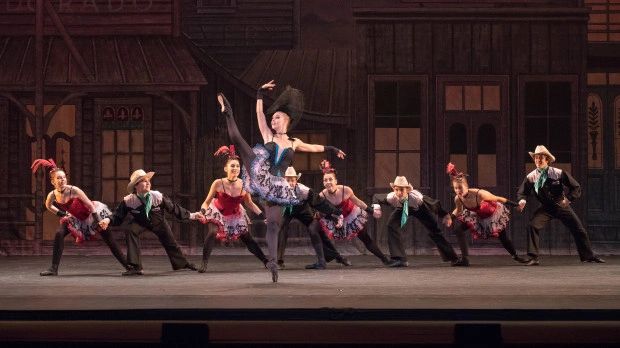
Bianca Bulle and the corps in Western Symphony
Photo by Reed Hutchinson
Perhaps Balanchine wanted a respite from his serious, abstract works, so he looked to the American West for inspiration, choreographing Western Symphony in 1954. Its music, by Hershy Kay, orchestrates familiar folk tunes, including “Red River Valley” and “Good Night Ladies.” But around the time Laura Chachich and Eris Nezha enter and she’s dressed in lilac (color-coded costuming by Laura Day “after” Balanchine’s famed artistic partner Karinska), we begin to catch on to Balanchine’s game. He balletically deconstructs French and Russian ballets, to giggle-inducing effect.
After Chachich and Nezha’s bounding “allegro” (here Balanchine names sections after musical movements) comes the wonderfully steely Petra Conti, wearing pewter, and Sargsyan, with impressive partnering, in the “adagio” that seems to gently mock Giselle and Swan Lake. The “scherzo” of the original, rarely seen since 1960, remains absent here. Bulle and Shimizu get their hilarious digs in during their “rondo,” though most notable is her Ascot-worthy hat, most of which is removed backstage before she re-emerges for her fouettés (the whipping turns on one leg), so obligatory in the classics. No wonder the humorless French and Russian critics lambasted Western Symphony when it arrived on their stages. Here, the entire evening is two steps forward and promenade home for Los Angeles Ballet.
October 18, 2018
Reprinted courtesy of Los Angeles Daily News
Ballet Review
Ballet Visionaries
Los Angeles Ballet
Reviewed by Dany Margolies
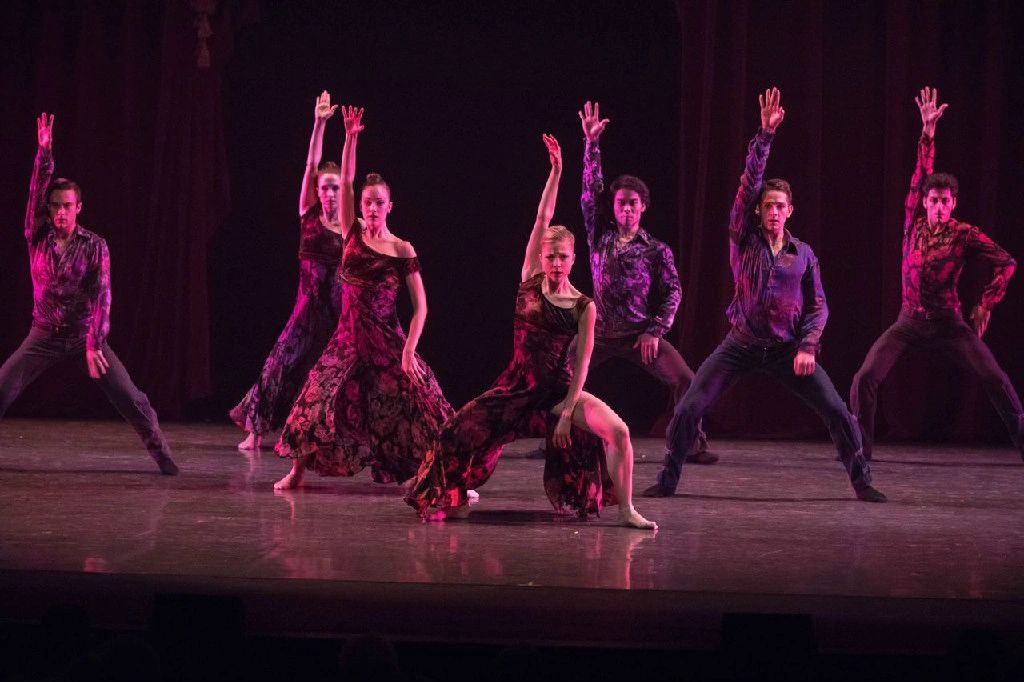
The Los Angeles Ballet in Untouched
Two iconoclastic expatriate Russians, a 19th-century Dane who dug the Italian beat, and a Canadian bending dance in new directions inspired the mixed bill Los Angeles Ballet has titled “Ballet Visionaries,” on local stages this month. But American bravery and willpower made this opening night a thrill to remember.
The evening started not with the traditional precurtain welcome from the company’s co–artistic director Colleen Neary but with a succinct announcement: The roles scheduled to be danced by Allyssa Bross, one of the company’s two principal ballerinas, were being taken on by two other dancers. (Bross reportedly bruised her ribs crashing into a fixture as she came offstage during dress rehearsal the night before opening.)
So, with one day to prepare, two women with technique, intelligence, and courage stepped in. And then, up went the curtain. No excuses, no apologies. None needed. The mixed bill begins with choreography by George Balanchine (1904–1983) to the violin concerto composed by his dear friend Igor Stravinsky (1882–1971). Both men had left their native Russia to nest in New York, changing the course of their art forms. Balanchine choreographed Stravinsky Violin Concerto the year after the composer’s death, reportedly inserting in-jokes he thought Stravinsky would have enjoyed.
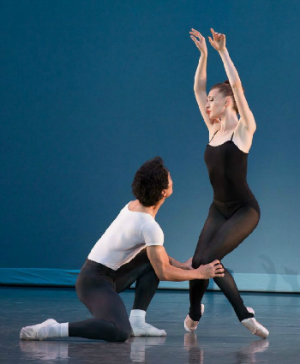 He first introduces the ensemble and two lead couples, clad in leotards and tights—considered rehearsal clothes until Balanchine put them onstage. The second movement, danced here by Elizabeth Claire Walker (for Bross) and Dustin True, features a pas de deux of detachment, of ways two dancers could be wary of, escape from and reject each other.
The third movement, with Julia Cinquemani and Kenta Shimizu, shows a more solicitous couple. Still, the man imprisons and manipulates the woman, pinning her knees together, bending her torso, then taking her forehead back until she cannot see her path. Granted, Walker and True were underrehearsed, but Cinquemani and Shimizu evidenced more thoughtfulness, more purpose, even in this abstract ballet. The finale toys with fundamentals of Russian folk dance but also gives the corps a chance to display its joyful precision.
Next, the company performed the 2010 choreography of Canadian Aszure Barton. Titled Untouched, it is even more abstract than the Balanchine. Still, Untouched is endlessly enthralling, moody, and quite beautiful, and probably even more fiendishly difficult than Violin Concerto.
To music by Njo Kong Kie, Curtis Macdonald and Lev Zhurbin, the piece begins with a striking solo by Abby Callahan, puts Shimizu in quirky struts and stage-spanning slides, and displays a flawless foursome—of Bianca Bulle and Tigran Sargsyan, Chelsea Paige Johnston and True—that brings the work to a finale in which all the shimmies, tummy rubs and torqueing walks come to a fascinating conclusion.
To vibrantly end the evening, company co–artistic director Thordal Christensen, trained with the Royal Danish Ballet, stages the quintessentially Danish Pas de Six and Tarantella from Napoli, choreographed by August Bournonville (1805–79) to music by Edvard Helsted and Holger Paulli.
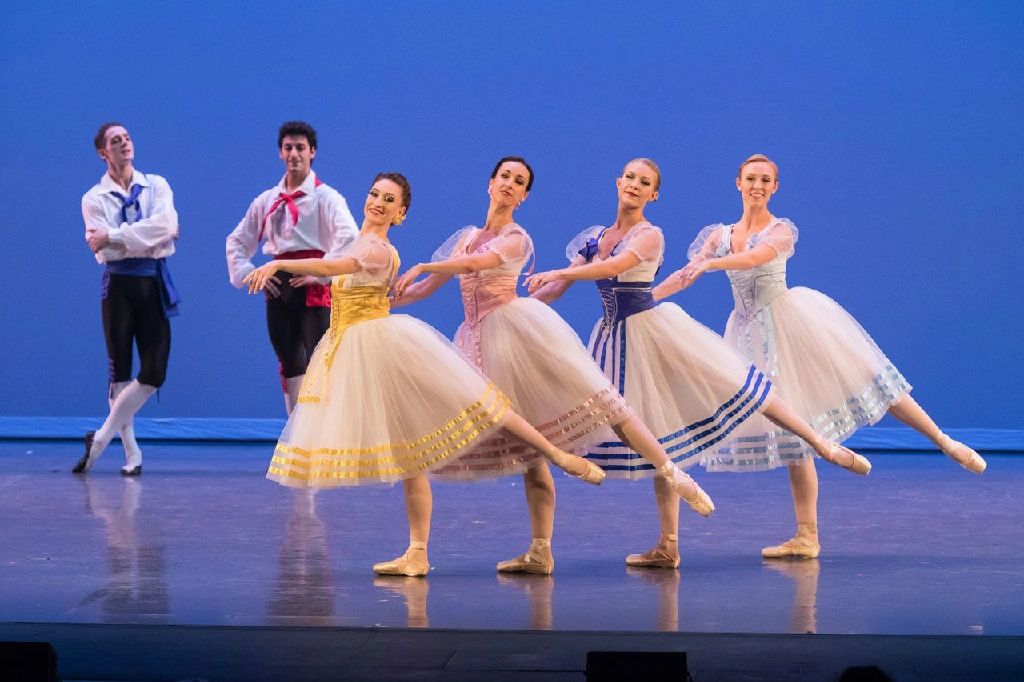
Dustin True, Tigran Sargsyan, Julia Cinquemani, Kate Highstrete, Madeline Houk, Ashley Millar in Napoli
The dancers weren’t the only brave ones here. Neary and Christensen didn’t choose a program designed solely to bring in the masses. These ballets are not famous, they’re not “accessible.” But they need to be seen and kept alive. Plotless and abstract, each piece seems to be about independence and yet collegiality. Each in its own way has an internal beauty. In this celebration of internationality, dancers and directors, whether born here or not, summoned all-American stamina and bravery for an inspirational night of ballet.
Bournonville style consists of perpetual motion—mostly small jumps (called petit allegro in ballet) seasoned with a few big jumps just when one imagines the dancers ought to be collapsing. But in addition to stamina, the dancers here show the refinement the style calls for. Arms are held low or occasionally at shoulder height, offering little help in jumping. Hands are politely relaxed, legs are rarely raised above 45 degrees, ballet is at its most gracious in an era when acrobatics seems to be valued over elegance and effortlessness.
Shimizu again shows his versatility, also creating a character—this one the jealous bridegroom—opposite the dainty Bulle. Madeline Houk, replacing Bross, not only managed the style but also dealt with a long scarf that required coordinating with her daring partner, True.
So, the show went on, thanks to the women who stepped into a breach. They were hoisted by men who had spent weeks rehearsing with Bross’s proportions and momentum. In time to the music, the replacements swiftly clasped hands with and leapt perilously near other dancers. And no one gave off the slightest hint of the impending dangers of a missed connection or a collision. This is professionalism. This is bravery.
The dancers weren’t the only brave ones here. Neary and Christensen didn’t choose a program designed solely to bring in the masses. These ballets are not famous, they’re not “accessible.” But they need to be seen and kept alive. Plotless and abstract, each piece seems to be about independence and yet collegiality. Each in its own way has an internal beauty. In this celebration of internationality, dancers and directors, whether born here or not, summoned all-American stamina and bravery for an inspirational night of ballet.
Middle photo: Kenta Shimizu and Julia Cinquemani in Stravinsky Violin Concerto. Photo © Reed Hutchinson and the Los Angeles Ballet 2016
Ballet Visionaries
Los Angeles Ballet
Reviewed by Dany Margolies

The Los Angeles Ballet in Untouched
Photo © Reed Hutchinson and the Los Angeles Ballet 2016
Two iconoclastic expatriate Russians, a 19th-century Dane who dug the Italian beat, and a Canadian bending dance in new directions inspired the mixed bill Los Angeles Ballet has titled “Ballet Visionaries,” on local stages this month. But American bravery and willpower made this opening night a thrill to remember.
The evening started not with the traditional precurtain welcome from the company’s co–artistic director Colleen Neary but with a succinct announcement: The roles scheduled to be danced by Allyssa Bross, one of the company’s two principal ballerinas, were being taken on by two other dancers. (Bross reportedly bruised her ribs crashing into a fixture as she came offstage during dress rehearsal the night before opening.)
So, with one day to prepare, two women with technique, intelligence, and courage stepped in. And then, up went the curtain. No excuses, no apologies. None needed. The mixed bill begins with choreography by George Balanchine (1904–1983) to the violin concerto composed by his dear friend Igor Stravinsky (1882–1971). Both men had left their native Russia to nest in New York, changing the course of their art forms. Balanchine choreographed Stravinsky Violin Concerto the year after the composer’s death, reportedly inserting in-jokes he thought Stravinsky would have enjoyed.
 He first introduces the ensemble and two lead couples, clad in leotards and tights—considered rehearsal clothes until Balanchine put them onstage. The second movement, danced here by Elizabeth Claire Walker (for Bross) and Dustin True, features a pas de deux of detachment, of ways two dancers could be wary of, escape from and reject each other.
The third movement, with Julia Cinquemani and Kenta Shimizu, shows a more solicitous couple. Still, the man imprisons and manipulates the woman, pinning her knees together, bending her torso, then taking her forehead back until she cannot see her path. Granted, Walker and True were underrehearsed, but Cinquemani and Shimizu evidenced more thoughtfulness, more purpose, even in this abstract ballet. The finale toys with fundamentals of Russian folk dance but also gives the corps a chance to display its joyful precision.
Next, the company performed the 2010 choreography of Canadian Aszure Barton. Titled Untouched, it is even more abstract than the Balanchine. Still, Untouched is endlessly enthralling, moody, and quite beautiful, and probably even more fiendishly difficult than Violin Concerto.
To music by Njo Kong Kie, Curtis Macdonald and Lev Zhurbin, the piece begins with a striking solo by Abby Callahan, puts Shimizu in quirky struts and stage-spanning slides, and displays a flawless foursome—of Bianca Bulle and Tigran Sargsyan, Chelsea Paige Johnston and True—that brings the work to a finale in which all the shimmies, tummy rubs and torqueing walks come to a fascinating conclusion.
To vibrantly end the evening, company co–artistic director Thordal Christensen, trained with the Royal Danish Ballet, stages the quintessentially Danish Pas de Six and Tarantella from Napoli, choreographed by August Bournonville (1805–79) to music by Edvard Helsted and Holger Paulli.

Dustin True, Tigran Sargsyan, Julia Cinquemani, Kate Highstrete, Madeline Houk, Ashley Millar in Napoli
Photo © Reed Hutchinson and the Los Angeles Ballet 2016
The dancers weren’t the only brave ones here. Neary and Christensen didn’t choose a program designed solely to bring in the masses. These ballets are not famous, they’re not “accessible.” But they need to be seen and kept alive. Plotless and abstract, each piece seems to be about independence and yet collegiality. Each in its own way has an internal beauty. In this celebration of internationality, dancers and directors, whether born here or not, summoned all-American stamina and bravery for an inspirational night of ballet.
Shimizu again shows his versatility, also creating a character—this one the jealous bridegroom—opposite the dainty Bulle. Madeline Houk, replacing Bross, not only managed the style but also dealt with a long scarf that required coordinating with her daring partner, True.
So, the show went on, thanks to the women who stepped into a breach. They were hoisted by men who had spent weeks rehearsing with Bross’s proportions and momentum. In time to the music, the replacements swiftly clasped hands with and leapt perilously near other dancers. And no one gave off the slightest hint of the impending dangers of a missed connection or a collision. This is professionalism. This is bravery.
The dancers weren’t the only brave ones here. Neary and Christensen didn’t choose a program designed solely to bring in the masses. These ballets are not famous, they’re not “accessible.” But they need to be seen and kept alive. Plotless and abstract, each piece seems to be about independence and yet collegiality. Each in its own way has an internal beauty. In this celebration of internationality, dancers and directors, whether born here or not, summoned all-American stamina and bravery for an inspirational night of ballet.
October 10, 2016
Middle photo: Kenta Shimizu and Julia Cinquemani in Stravinsky Violin Concerto. Photo © Reed Hutchinson and the Los Angeles Ballet 2016
Ballet Review
American Ballet
Theatre’s All-
Ratmansky Program
Dorothy Chandler Pavilion at The Music Center
Reviewed by Dany Margolies
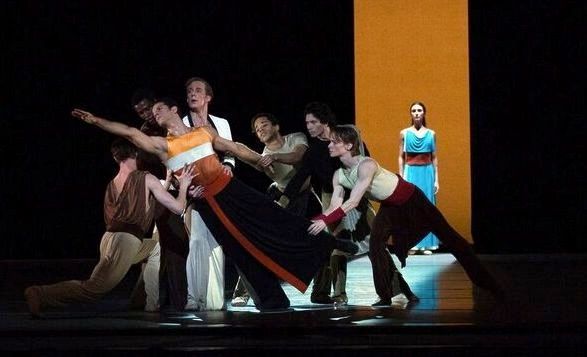
The dancers of Serenade After Plato’s Symposium
Alexei Ratmansky has been called the most gifted choreographer specializing in classical ballet today. The all-Ratmansky program of three of his works, danced by American Ballet Theatre this weekend at The Music Center, seemed to prove otherwise, except in one regard.
Ratmansky is the artist-in-residence with ABT. Formerly, he held the directorship of Moscow’s Bolshoi Ballet, so he comes with expectations of the best of training and talent in his male dancers. And that, perhaps, is how he is “gifted” here.
ABT is stocked with a deep bench of male dancers, including members of the corps de ballet who would be principals in most other companies. But Ratmansky gives them the equivalent of awkward dialogue to speak. His vocabulary is more contemporary ballet than classical, creating movement that seems to have meaning. Then, distractingly, he pops in a recognizable classical-ballet turn, such as a pirouette or tour en l’air. Or, he’ll wedge in a Russian folk-dance step or insert a hand clap.
At the Music Center, ABT’s men were shown to spectacular effect, particularly in the evening’s middle slot, the West Coast premiere of Serenade After Plato’s Symposium, danced to Leonard Bernstein’s violin concerto (conducted crisply by Ormsby Wilkins, featuring tender violin passages by Benjamin Bowman).
Symposium is a conversation, via dance, among seven men in ancient Greece, each getting a dazzling solo. The work starts with one dancer’s statement. Another dancer offers a supporting argument. A counterargument is presented. So far all is clear. The piece then moves into another plane, perhaps revealing man’s emotional states, perhaps revealing the issues he confronts in relating to others. The audience starts to think and feel. And then pretty dance steps start to crop up, culminating in another pirouette into a tour en l’air.
But a series of bourees, steps traditionally done only by women, proves these men have the fluidity and fleetness of ballerinas in addition to the strength and stamina this piece demands.
The program began with Symphony #9, to the music of Dmitri Shostakovich. The men are playful, the women sassy in this mostly aerobic piece. Its style is free and loose-limbed, so the dancers, while not uniform, move in relaxed synchronization. Veronika Part and Alexandre Hammoudi danced the moderato movement, which juxtaposes humor with longing, Part infusing her beautiful technique with dramatic tension. Designer George Tsypin’s backdrop for the Largo movement seems to symbolize war and class, as do the dancers who seem to be waiting and then joining a political movement.
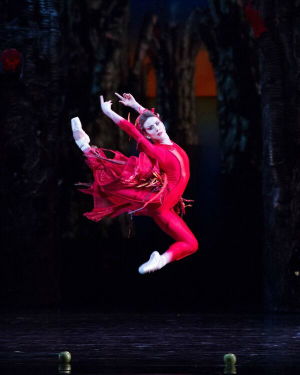 The evening’s last piece was Ratmansky’s overhaul of Firebird.
He has retained the music of Igor Stravinsky and the basics of the
Russian fairy tale about a magical bird and the man she helps in his
search for true love.
The evening’s last piece was Ratmansky’s overhaul of Firebird.
He has retained the music of Igor Stravinsky and the basics of the
Russian fairy tale about a magical bird and the man she helps in his
search for true love.
Other than that, there’s no spotting Mikhail Fokine’s original ballet in here. Indeed, it’s less the dreamy, airy ballet than something that could pass for Seussical the Musical. The Firebird (Isabella Boylston) shakes her tail feathers, literally, for a laugh. The enchanted maidens, held captive by Kaschei the sorcerer (Roman Zhurbin), move as if the evil guy smote them with a bad case of the sillies, at one point doing the Bunny Hop.
Ivan (Hammoudi again) may be in search of love, but he can’t even find the door out of his room. Give Ratmansky this: At the top of the piece, he suggests all might be Ivan’s dream. When Ivan meets The Maiden (Cassandra Trenary), she’s far from ideal. But true love sees through the curse. The dancing is flawless, particularly by Trenary, who gives herself over to her character and dances with comedic and then romantic abandon.
As do the other two works, this Firebird has a happy, Hollywood ending. Yet, somewhat troublingly, each of the “beautiful maidens” is a pale blonde. Fortunately, the beautiful ballerinas dancing the roles are a more representative mix of the races and national heritages that form the “American” in ABT.
Republished with kind permission of Los Angeles Daily News
Photo of Isabella Boylston as the Firebird by Rosalie O’Connor
American Ballet
Theatre’s All-
Ratmansky Program
Dorothy Chandler Pavilion at The Music Center
Reviewed by Dany Margolies

The dancers of Serenade After Plato’s Symposium
Photo by Rosalie O’Connor
Alexei Ratmansky has been called the most gifted choreographer specializing in classical ballet today. The all-Ratmansky program of three of his works, danced by American Ballet Theatre this weekend at The Music Center, seemed to prove otherwise, except in one regard.
Ratmansky is the artist-in-residence with ABT. Formerly, he held the directorship of Moscow’s Bolshoi Ballet, so he comes with expectations of the best of training and talent in his male dancers. And that, perhaps, is how he is “gifted” here.
ABT is stocked with a deep bench of male dancers, including members of the corps de ballet who would be principals in most other companies. But Ratmansky gives them the equivalent of awkward dialogue to speak. His vocabulary is more contemporary ballet than classical, creating movement that seems to have meaning. Then, distractingly, he pops in a recognizable classical-ballet turn, such as a pirouette or tour en l’air. Or, he’ll wedge in a Russian folk-dance step or insert a hand clap.
At the Music Center, ABT’s men were shown to spectacular effect, particularly in the evening’s middle slot, the West Coast premiere of Serenade After Plato’s Symposium, danced to Leonard Bernstein’s violin concerto (conducted crisply by Ormsby Wilkins, featuring tender violin passages by Benjamin Bowman).
Symposium is a conversation, via dance, among seven men in ancient Greece, each getting a dazzling solo. The work starts with one dancer’s statement. Another dancer offers a supporting argument. A counterargument is presented. So far all is clear. The piece then moves into another plane, perhaps revealing man’s emotional states, perhaps revealing the issues he confronts in relating to others. The audience starts to think and feel. And then pretty dance steps start to crop up, culminating in another pirouette into a tour en l’air.
But a series of bourees, steps traditionally done only by women, proves these men have the fluidity and fleetness of ballerinas in addition to the strength and stamina this piece demands.
The program began with Symphony #9, to the music of Dmitri Shostakovich. The men are playful, the women sassy in this mostly aerobic piece. Its style is free and loose-limbed, so the dancers, while not uniform, move in relaxed synchronization. Veronika Part and Alexandre Hammoudi danced the moderato movement, which juxtaposes humor with longing, Part infusing her beautiful technique with dramatic tension. Designer George Tsypin’s backdrop for the Largo movement seems to symbolize war and class, as do the dancers who seem to be waiting and then joining a political movement.
 The evening’s last piece was Ratmansky’s overhaul of Firebird.
He has retained the music of Igor Stravinsky and the basics of the
Russian fairy tale about a magical bird and the man she helps in his
search for true love.
The evening’s last piece was Ratmansky’s overhaul of Firebird.
He has retained the music of Igor Stravinsky and the basics of the
Russian fairy tale about a magical bird and the man she helps in his
search for true love.Other than that, there’s no spotting Mikhail Fokine’s original ballet in here. Indeed, it’s less the dreamy, airy ballet than something that could pass for Seussical the Musical. The Firebird (Isabella Boylston) shakes her tail feathers, literally, for a laugh. The enchanted maidens, held captive by Kaschei the sorcerer (Roman Zhurbin), move as if the evil guy smote them with a bad case of the sillies, at one point doing the Bunny Hop.
Ivan (Hammoudi again) may be in search of love, but he can’t even find the door out of his room. Give Ratmansky this: At the top of the piece, he suggests all might be Ivan’s dream. When Ivan meets The Maiden (Cassandra Trenary), she’s far from ideal. But true love sees through the curse. The dancing is flawless, particularly by Trenary, who gives herself over to her character and dances with comedic and then romantic abandon.
As do the other two works, this Firebird has a happy, Hollywood ending. Yet, somewhat troublingly, each of the “beautiful maidens” is a pale blonde. Fortunately, the beautiful ballerinas dancing the roles are a more representative mix of the races and national heritages that form the “American” in ABT.
July 11, 2016
Republished with kind permission of Los Angeles Daily News
Photo of Isabella Boylston as the Firebird by Rosalie O’Connor
Ballet Review
Don Quixote
Reviewed by Dany Margolies
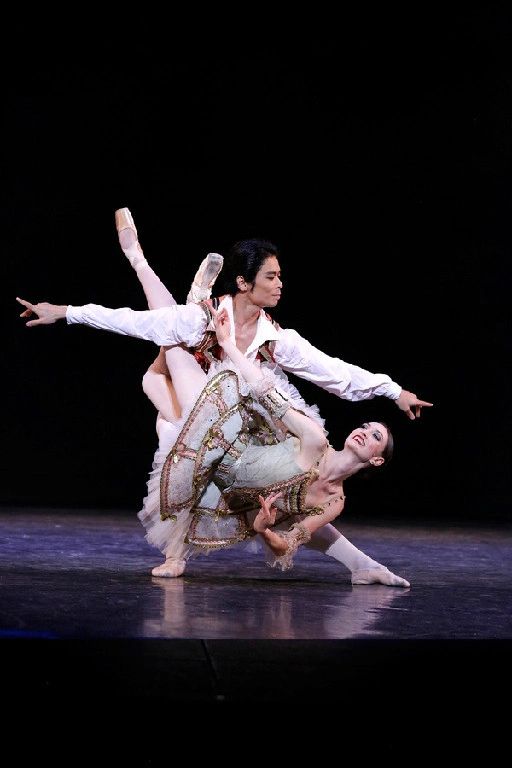
Kenta Shimizu as Basil and Julia Cinquemani as Kitri
The ballet Don Quixote is not known for narrative logic or life lessons. It is, however, known for its nonstop bravura dancing. In Los Angeles Ballet’s version—which opened this weekend at Redondo Beach Performing Arts Center and will appear twice more around the Los Angeles area through March—sparks fly. But they don’t always fly when and where needed.
The 19th-century ballet bears a tangential relationship to the 17th-century Cervantes novel, in which Don Quixote, after too much reading, seems to lose his mind and tries to become one of the knights he reads about.
It’s possible to glean from the muddled storytelling that his main though random quest might be to secure the marriage of the innkeeper’s daughter, Kitri, to the town’s barber, Basil. But what is clear is that this couple can fend for themselves. Only for tradition do we still call this ballet by the chivalric figure’s name. And this being ballet, it uses Don Quixote’s questing to wander into various Spanish settings where pretty much everyone is a fabulous dancer.
The company’s co–artistic directors, Thordal Christensen and Colleen Neary, choreographed here, based on the Russian originals of Marius Petipa and Alexander Gorsky to the vibrant score by Ludwig Minkus with a few dances by Riccardo Drigo (balletomanes will recognize these interpolations from other famous ballets).
The Christensens certainly left in the good bits, including the spectacularly difficult ones. The iconic 32 fouettés (the series of whipping turns done on tiptoe on one leg) that comes at the end of Act 3 merely stamps the seal on two and a half hours of daring balances, twisting leaps, dangerous lifts, and nonstop ballet-type entertainment.
The directors can boast a strong corps de ballet, particularly the men, who dance with the expected explosive bravura, albeit following all the rules of ballet. Some of the women, notably Chelsea Paige Johnston, bring flamenco’s dynamics and the style’s head and shoulder positions into their dances. Also amping up the fire, the powerhouse Allyssa Bross takes on the role of the, ahem, street dancer, Mercedes.
But although the principals—Julia Cinquemani as Kitri and Kenta Shimizu as Basil—are certainly beautifully schooled and technically adept, their portrayals lack that Spanish fire. Instead, from them, we see mostly serene elegance, more suited to the royalty or aristocracy of such ballets as The Sleeping Beauty and Raymonda.
Granted, Cinquemani could have been nervous at the top of the ballet. There’s a lot to carry here, technically and narratively. Her first few series of jumps are an iconic ballet moment: Kitri circles the stage with a split leaps so big that she ought to be able to touch her foot above her head as she arches back.
Cinquemani looked as if her feet were already giving out under her. But with each entrance as the ballet went along, she certainly seemed to gain her confidence and regain her technique. By Act 2, she bounded and sparkled, and she was fresh and raring for the world-famous Act 3 pas de deux. And, yes, she flew through her 32 fouettés.
So, remember Don Quixote? Rather than leaving the knight-errant out of the story completely, he’s brought onstage here and asked to somehow participate in his scenes. Performing the role, Adam Lüders does this by waving his arms airily.
Want to see characterization with specificity and purpose? Take a peek at—or keep your eyes glued on—Zheng Hua Li as he plays Kitri’s repulsive suitor, Gamache. The dancer has obviously made serious study of commedia dell’arte. From Gamache’s prissy first entrance through his deluded astonishment that Kitri could find a better mate than he, Li stays deeply in hilarious character throughout. Another comedic gem, onstage too briefly, is the Don’s wise but weary horse (uncredited).
Not helping the audience settle into any narrative threads, the sets and costumes, designed by Nikolas Georgiadas, are not the best around. The set includes such puzzling elements as square red columns; and too many of the costumes bear too little relationship to the story, in particular the Centurion-style bodices for the wood nymphs.
Yes, wood nymphs. At least Act 2 offers plenty of spectacular dancing by the company’s deep bench—including Bianca Bulle as a floaty Queen of the Dryads, and Dustin True as the head gypsy who leads his band in a traditional Russian-style mazurka. Again, this ballet promises panache, not ethnic accuracy nor storytelling logic. And, to a large extent, it keeps its promise.
Don Quixote
Reviewed by Dany Margolies

Kenta Shimizu as Basil and Julia Cinquemani as Kitri
Photo by Reed Hutchinson
The ballet Don Quixote is not known for narrative logic or life lessons. It is, however, known for its nonstop bravura dancing. In Los Angeles Ballet’s version—which opened this weekend at Redondo Beach Performing Arts Center and will appear twice more around the Los Angeles area through March—sparks fly. But they don’t always fly when and where needed.
The 19th-century ballet bears a tangential relationship to the 17th-century Cervantes novel, in which Don Quixote, after too much reading, seems to lose his mind and tries to become one of the knights he reads about.
It’s possible to glean from the muddled storytelling that his main though random quest might be to secure the marriage of the innkeeper’s daughter, Kitri, to the town’s barber, Basil. But what is clear is that this couple can fend for themselves. Only for tradition do we still call this ballet by the chivalric figure’s name. And this being ballet, it uses Don Quixote’s questing to wander into various Spanish settings where pretty much everyone is a fabulous dancer.
The company’s co–artistic directors, Thordal Christensen and Colleen Neary, choreographed here, based on the Russian originals of Marius Petipa and Alexander Gorsky to the vibrant score by Ludwig Minkus with a few dances by Riccardo Drigo (balletomanes will recognize these interpolations from other famous ballets).
The Christensens certainly left in the good bits, including the spectacularly difficult ones. The iconic 32 fouettés (the series of whipping turns done on tiptoe on one leg) that comes at the end of Act 3 merely stamps the seal on two and a half hours of daring balances, twisting leaps, dangerous lifts, and nonstop ballet-type entertainment.
The directors can boast a strong corps de ballet, particularly the men, who dance with the expected explosive bravura, albeit following all the rules of ballet. Some of the women, notably Chelsea Paige Johnston, bring flamenco’s dynamics and the style’s head and shoulder positions into their dances. Also amping up the fire, the powerhouse Allyssa Bross takes on the role of the, ahem, street dancer, Mercedes.
But although the principals—Julia Cinquemani as Kitri and Kenta Shimizu as Basil—are certainly beautifully schooled and technically adept, their portrayals lack that Spanish fire. Instead, from them, we see mostly serene elegance, more suited to the royalty or aristocracy of such ballets as The Sleeping Beauty and Raymonda.
Granted, Cinquemani could have been nervous at the top of the ballet. There’s a lot to carry here, technically and narratively. Her first few series of jumps are an iconic ballet moment: Kitri circles the stage with a split leaps so big that she ought to be able to touch her foot above her head as she arches back.
Cinquemani looked as if her feet were already giving out under her. But with each entrance as the ballet went along, she certainly seemed to gain her confidence and regain her technique. By Act 2, she bounded and sparkled, and she was fresh and raring for the world-famous Act 3 pas de deux. And, yes, she flew through her 32 fouettés.
So, remember Don Quixote? Rather than leaving the knight-errant out of the story completely, he’s brought onstage here and asked to somehow participate in his scenes. Performing the role, Adam Lüders does this by waving his arms airily.
Want to see characterization with specificity and purpose? Take a peek at—or keep your eyes glued on—Zheng Hua Li as he plays Kitri’s repulsive suitor, Gamache. The dancer has obviously made serious study of commedia dell’arte. From Gamache’s prissy first entrance through his deluded astonishment that Kitri could find a better mate than he, Li stays deeply in hilarious character throughout. Another comedic gem, onstage too briefly, is the Don’s wise but weary horse (uncredited).
Not helping the audience settle into any narrative threads, the sets and costumes, designed by Nikolas Georgiadas, are not the best around. The set includes such puzzling elements as square red columns; and too many of the costumes bear too little relationship to the story, in particular the Centurion-style bodices for the wood nymphs.
Yes, wood nymphs. At least Act 2 offers plenty of spectacular dancing by the company’s deep bench—including Bianca Bulle as a floaty Queen of the Dryads, and Dustin True as the head gypsy who leads his band in a traditional Russian-style mazurka. Again, this ballet promises panache, not ethnic accuracy nor storytelling logic. And, to a large extent, it keeps its promise.
February 22, 2016
Interview
Giving Us the Wilis
Abigail Boyle creates the cruel queen Myrtha in Royal New Zealand Ballet’s ‘Giselle.’
by Dany Margolies
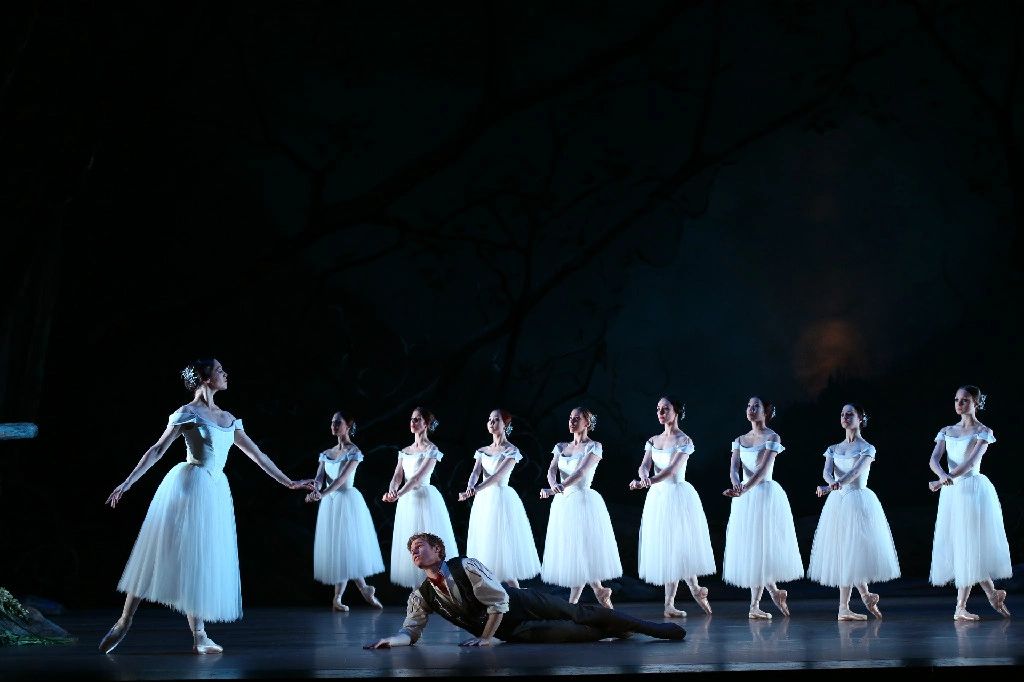
Abigail Boyle and Jacob Chown, with the Royal New Zealand Ballet corps,in Giselle
The 19th century ballet Giselle tells of a young woman whose heart and mind are broken by a young man, Albrecht. He had made Giselle promises of love that he failed to keep. She dies of heartache and madness. Albrecht visits her grave but sees she has become a Wili, an eternally vengeful female spirit. But Giselle’s kindness and gentleness won’t let her punish Albrecht, despite the strictures of Wili sisterhood, presided over by Myrtha, the queen of the Wilis.
At least that’s the way the original ballet, with music by Adolphe Adam and choreography by Jean Coralli and Jules Perrot unfolded. These days, Royal New Zealand Ballet has a reportedly revised new version, choreographed by Johan Kobborg, formerly of the Royal Danish Ballet and the Royal Ballet, and Ethan Stiefel, formerly of American Ballet Theatre.
 Giselle is the ballet’s titular lead, but the most interesting role in
it may be that of Myrtha. Abigail Boyle is one of three ballerinas
portraying the cold queen in RNZB’s version. A member of the company
since 2005 and a graduate of the International Ballet Academy in
Christchurch, she admits her training is a mix of Vaganova (Russian) and
Royal Academy of Dance (English) training, to which she has added input
from the American Stiefel.
Giselle is the ballet’s titular lead, but the most interesting role in
it may be that of Myrtha. Abigail Boyle is one of three ballerinas
portraying the cold queen in RNZB’s version. A member of the company
since 2005 and a graduate of the International Ballet Academy in
Christchurch, she admits her training is a mix of Vaganova (Russian) and
Royal Academy of Dance (English) training, to which she has added input
from the American Stiefel.
Boyle doesn’t see Myrtha as only a vicious spirit. “I think she’s somewhat of royalty in her past life, so she knows how to gain and sustain control, which his how she has power,” says Boyle. “It’s in her blood.”
Thus, Boyle plays her as coldly as ballet aficionados would expect, but Boyle says she has created sadness in her, too. She admits she forged the character the way actors do: recalling things in her own past that hurt her, thinking of vengefulness born of the failure to vent at the time.
Boyle admits her demeanor suits stronger roles. In other words, she looks like Myrtha should—commanding, powerful, sturdy—rather than like the frail, ethereal Giselle. And the choreography, she says, helps create Myrtha’s power. As Myrtha forces men to die, “I feel this pulse within me, huge anger. Girl power,” says Boyle.
Not surprisingly, she says the greatest challenge in performing the role is stamina, “having the strength to pump your legs for those big jumps.” Boyle and the two other company members with whom she shares the role—Lucy Balfour and Mayu Tanigaito—may each dance it with their own interpretations, but each roots for the other. “We rev each other up, ‘Come on, girl!’” reports Boyle.
 The night before the show, Boyle begins to go through the role in
her head, imagining herself onstage dancing it. On the day of the show,
she’ll take ballet class at 1pm, then mark (easily go through) the
choreography, then eat her dinner, lie down for 20 minutes, and then
ready herself for her appearance, which comes in Act Two.
The night before the show, Boyle begins to go through the role in
her head, imagining herself onstage dancing it. On the day of the show,
she’ll take ballet class at 1pm, then mark (easily go through) the
choreography, then eat her dinner, lie down for 20 minutes, and then
ready herself for her appearance, which comes in Act Two.
When she’s backstage, she says, “I try to disassociate myself with everyone in the dressing room, put myself in a bubble.” On shows in the past, she has listened to Nirvana. For this one, she says she’ll just “tuck myself away and start pulling up Myrtha.”
All this makes coming out of character difficult for her after the performance. “I feel like she’s always around me,” says Boyle. “She does linger.”
So, what’s different and revised about this version? Boyle isn’t revealing it. She says the choreography is true to the original, “but there are tweaks.” And, she reports, there’s a “slight twist” at the end. Are balletomanes in an uproar over this? “I haven’t heard anything bad,” says Boyle. “People find it more riveting and entertaining. I know I do.”
Giving Us the Wilis
Abigail Boyle creates the cruel queen Myrtha in Royal New Zealand Ballet’s ‘Giselle.’
by Dany Margolies

Abigail Boyle and Jacob Chown, with the Royal New Zealand Ballet corps,in Giselle
Photo courtesy RNZB
The 19th century ballet Giselle tells of a young woman whose heart and mind are broken by a young man, Albrecht. He had made Giselle promises of love that he failed to keep. She dies of heartache and madness. Albrecht visits her grave but sees she has become a Wili, an eternally vengeful female spirit. But Giselle’s kindness and gentleness won’t let her punish Albrecht, despite the strictures of Wili sisterhood, presided over by Myrtha, the queen of the Wilis.
At least that’s the way the original ballet, with music by Adolphe Adam and choreography by Jean Coralli and Jules Perrot unfolded. These days, Royal New Zealand Ballet has a reportedly revised new version, choreographed by Johan Kobborg, formerly of the Royal Danish Ballet and the Royal Ballet, and Ethan Stiefel, formerly of American Ballet Theatre.
 Giselle is the ballet’s titular lead, but the most interesting role in
it may be that of Myrtha. Abigail Boyle is one of three ballerinas
portraying the cold queen in RNZB’s version. A member of the company
since 2005 and a graduate of the International Ballet Academy in
Christchurch, she admits her training is a mix of Vaganova (Russian) and
Royal Academy of Dance (English) training, to which she has added input
from the American Stiefel.
Giselle is the ballet’s titular lead, but the most interesting role in
it may be that of Myrtha. Abigail Boyle is one of three ballerinas
portraying the cold queen in RNZB’s version. A member of the company
since 2005 and a graduate of the International Ballet Academy in
Christchurch, she admits her training is a mix of Vaganova (Russian) and
Royal Academy of Dance (English) training, to which she has added input
from the American Stiefel.Boyle doesn’t see Myrtha as only a vicious spirit. “I think she’s somewhat of royalty in her past life, so she knows how to gain and sustain control, which his how she has power,” says Boyle. “It’s in her blood.”
Thus, Boyle plays her as coldly as ballet aficionados would expect, but Boyle says she has created sadness in her, too. She admits she forged the character the way actors do: recalling things in her own past that hurt her, thinking of vengefulness born of the failure to vent at the time.
Boyle admits her demeanor suits stronger roles. In other words, she looks like Myrtha should—commanding, powerful, sturdy—rather than like the frail, ethereal Giselle. And the choreography, she says, helps create Myrtha’s power. As Myrtha forces men to die, “I feel this pulse within me, huge anger. Girl power,” says Boyle.
Not surprisingly, she says the greatest challenge in performing the role is stamina, “having the strength to pump your legs for those big jumps.” Boyle and the two other company members with whom she shares the role—Lucy Balfour and Mayu Tanigaito—may each dance it with their own interpretations, but each roots for the other. “We rev each other up, ‘Come on, girl!’” reports Boyle.
 The night before the show, Boyle begins to go through the role in
her head, imagining herself onstage dancing it. On the day of the show,
she’ll take ballet class at 1pm, then mark (easily go through) the
choreography, then eat her dinner, lie down for 20 minutes, and then
ready herself for her appearance, which comes in Act Two.
The night before the show, Boyle begins to go through the role in
her head, imagining herself onstage dancing it. On the day of the show,
she’ll take ballet class at 1pm, then mark (easily go through) the
choreography, then eat her dinner, lie down for 20 minutes, and then
ready herself for her appearance, which comes in Act Two.When she’s backstage, she says, “I try to disassociate myself with everyone in the dressing room, put myself in a bubble.” On shows in the past, she has listened to Nirvana. For this one, she says she’ll just “tuck myself away and start pulling up Myrtha.”
All this makes coming out of character difficult for her after the performance. “I feel like she’s always around me,” says Boyle. “She does linger.”
So, what’s different and revised about this version? Boyle isn’t revealing it. She says the choreography is true to the original, “but there are tweaks.” And, she reports, there’s a “slight twist” at the end. Are balletomanes in an uproar over this? “I haven’t heard anything bad,” says Boyle. “People find it more riveting and entertaining. I know I do.”
January 24, 2014
Interview
Dancing for and of the Mind
Mythili Prakash and Aditya Prakash tell ‘Mara’ through Indian classical dance and music.
by Dany Margolies
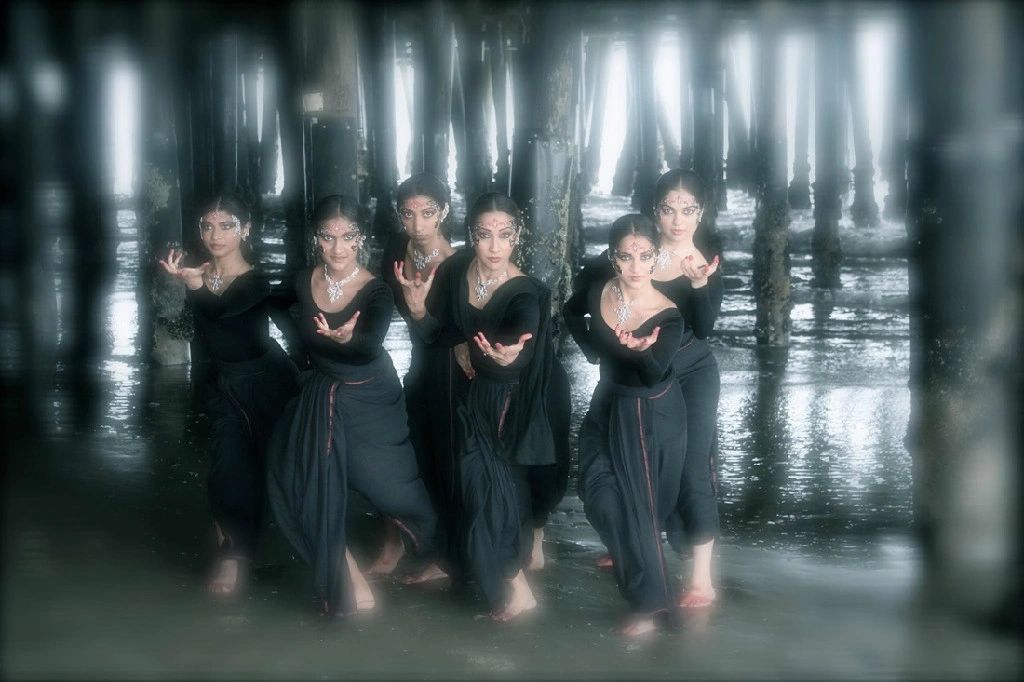 Mythili Prakash, fourth from left, with dancers of Mara
On a hot morning, a show rehearses in the community room of a church in the South Bay area. Warm-up scales waft from a saxophone. Tennis shoes chirp against the wooden floor as other musicians load in. A neighboring dog provides the counterpoint. Two mothers set up a tailgate party in the parking lot, ready for a long day as their young daughters in rehearsal garb gather in the hall.
 Well, there’s universality in the making of art. It sounds like a day
in the life of “Western” musical theater performers, right? But the
medium here is Bharata Natyam—or Bharatanatyam if you prefer—the
classical dance of South India, set to South Indian classical music.
Well, there’s universality in the making of art. It sounds like a day
in the life of “Western” musical theater performers, right? But the
medium here is Bharata Natyam—or Bharatanatyam if you prefer—the
classical dance of South India, set to South Indian classical music.
And in this case, the performers include the choreographer-dancer Mythili Prakash, vocalist Aditya Prakash and the musicians of Aditya Prakash Ensemble, and the dancers of Shakti Dance Company. They’re rehearsing for the world premiere of Mara, a multimedia dance and musical theater production, set for Sept. 21 at the Ford Theatre in Hollywood.
According to the company, “Mara explores the journey of the individual (Jeeva), as she negotiates the dangerous, dazzling maze that is the human mind (Mara). Mara, the demon who infamously attempted to entice Buddha, continues to distract humans from discovering what lies beyond worldly pleasures, the pursuit of true inner freedom. Can Jeeva break free from the chains that bind her to this world?”
The rehearsal begins with Siddhartha, portrayed by a very still dancer, sitting under the Bodhi tree, portrayed by dancers gently manipulating strips of delicate green fabric. The tale of the Buddha begins to unfold, Aditya singing the narration, the dancers working in universal gestures and recognizable activities, even while using the expressive eyes, signature hand positions, and traditional foot stamps of South Indian dance.
Practice (eventually) makes perfect
 Aditya and Mythili, brother and sister, are Los Angeles natives. He says most parents
of Indian-heritage children, especially those children born in America,
enroll those children in music or dance classes to keep them in touch
with their roots. His parents, too, tried to make him learn dance. “That
didn’t work out,” he says. So they tried music lessons. He wouldn’t
practice, even with a promised reward of TV. Once the young boy got
through the rigors of the basics, however, his interest grew.
Aditya and Mythili, brother and sister, are Los Angeles natives. He says most parents
of Indian-heritage children, especially those children born in America,
enroll those children in music or dance classes to keep them in touch
with their roots. His parents, too, tried to make him learn dance. “That
didn’t work out,” he says. So they tried music lessons. He wouldn’t
practice, even with a promised reward of TV. Once the young boy got
through the rigors of the basics, however, his interest grew.
Mythili, on the other hand, couldn’t wait to start her dance career. She is the daughter of dancer and teacher Viji Prakash. Mama wouldn’t let the tiny tot join the classes at the dance school she headed. Then she got quite a jolt when the 3-year-old Mythili performed one of the dances for her.
 Mythili says learning Bharata Natyam is similar to learning ballet.
“It’s very structured,” she says. “You go through a few years of basics:
technique, Adavus [loosely stated, the steps], the grammatical blocks.
It takes at least a year to learn the whole syllabus. Then you progress
to dances.” In her case, however, because of her early and immediate
immersion, the learning process was a little different.
Mythili says learning Bharata Natyam is similar to learning ballet.
“It’s very structured,” she says. “You go through a few years of basics:
technique, Adavus [loosely stated, the steps], the grammatical blocks.
It takes at least a year to learn the whole syllabus. Then you progress
to dances.” In her case, however, because of her early and immediate
immersion, the learning process was a little different.
While a ballet dancer needs an appropriate body (able to turn out at the hips, for example), with this style, says Mythili, the dancer needs musicality, as the accompaniment is highly complex rhythmically. The dancer must also “involve” herself, feeling the storytelling. “And transforming yourself, but we say that comes later,” she says. Also vital to the form are the facial expressions, the intricate use of the hands, the head-shaking.
But, she adds, “It’s hard to dance together, because everyone is so different. It’s not, ‘Here you raise your eyebrow.’ You breathe your own into it, naturally. As you mature, your expression matures; you develop the interpretation even more.”
Travails and travels
Not everyone in the family is a performer, nor did everyone immediately appreciate the path the siblings took. The siblings’ father is a businessman. However, he helped his wife start her dance school. “That’s what fueled my and my sister’s love for the arts,” says Aditya. Over the summers, Viji would bring musicians from India for her dance productions. Her son recalls, “When they were here, I was soaked in the atmosphere of Indian classical music. I learned with these musicians from India. Then I started wanting to have more regular classes. There are a lot of Indian classical teachers here. I went to classes in Cerritos. My next step, I wanted to go to South India.”
So, Aditya traveled Chennai, India, which he terms the hub of South Indian classical music. “I learned with venerated gurus,” he says. “The thing with Indian classical music, the whole teacher-student relationship is vital to that tradition. You need one-on-one classes with a guru. Once I went to India, my focus turned away from being an engineer or doctor, like my grandma wanted me to be.”
Now, he says, his grandma is all for his artistic path. And fortunately his parents pushed him through those early stages of reluctant learning, until he began to listen to concerts and intently practice on his own. He began studying at age 8 and gave his first solo vocal concert—“They’re usually two to three hours,” he reports—at age 13.
At ages 16 through 19, he began touring with Ravi Shankar. “He’s the one who inspired me to do music full time,” Aditya says. “I was so lucky, at 16 to be able to tour, travel, learn, perform, perform at Carnegie Hall, the Hollywood Bowl, when I was 17. This is what Indian classical music can do: It can reach American audiences and touch people, even though they don’t know the art form. It can create emotion. That’s what Indian music is, it’s emotion, bringing out something you won’t feel in daily life.”
So he doesn’t need to study anymore, right? “You’re always learning, scales, practicing, warming up,” he says, so the process of studying never stops.
Mothering and mentoring
Mythili, too, still studies. Her mother is her main teacher, though the daughter says it’s more of a mentorship at this point. Mythili also has a mentor in India: Malavika Sarukkai. “My classes with her are showing my choreography, and we comb through it,” says Mythili. Sarukkai urges Mythili to clarify details, to bring mindfulness to her choreography.
 For example, Mythili created a dance about the wife of Buddha and her
journey when Buddha leaves her. Mythili choreographed a segment in
which the wife was painting a portrait. So Mythili and her mentor worked
in detail, exploring how to show thoughts and emotions with the back of
the body, how to show retreat, betrayal, disappointment.
For example, Mythili created a dance about the wife of Buddha and her
journey when Buddha leaves her. Mythili choreographed a segment in
which the wife was painting a portrait. So Mythili and her mentor worked
in detail, exploring how to show thoughts and emotions with the back of
the body, how to show retreat, betrayal, disappointment.
Mythili recalls the two discussing, “How do my feet feel, what is the speed with which I walk? I carry material, which I throw on the picture. With what force? If I’m miming material, she’ll ask what color the material is.”
Aditya, too, is still on the never-ending path to improving his artistry. “Indian classical music is based on melodic scales called ragas—I could talk for hours, but that’s the skeletal definition,” he says. “Each raga has its own identity, its own emotion. The work, the constant practicing, is to bring those out without changing its structure, having the freedom to bring out one’s own creativity.”
With Western vocal music, a voice coach is usually part of the initial lessons. With Indian classical, says Aditya, “unfortunately” nobody guided his vocal technique early on, so he developed vocal nodules when he was 14. He had a “frustrating” time of it and was forced to stop singing—indeed, to stop talking for three to four months. In addition, the breaking of his voice in adolescence ushered in a tough time. Finally, he said, “I started to figure out my voice, meeting with vocal coaches in India. I began to use Western voice techniques. Now it’s about discovering your own voice and discovering the secrets behind it. I’m always constantly doing it.”
Ragas and riffs
What if he weren’t immersed in Indian music? He admits to being attracted to flamenco music, Qawwali from Pakistan, and jazz. Really, jazz? During his days studying ethnomusicology at UCLA, he lived with three jazz musicians, who would jam. “I’d be there but not participating,” Aditya recalls. “During one of the sessions, I got prodded to sing. We improvised, and something came out of it that was amazing.”
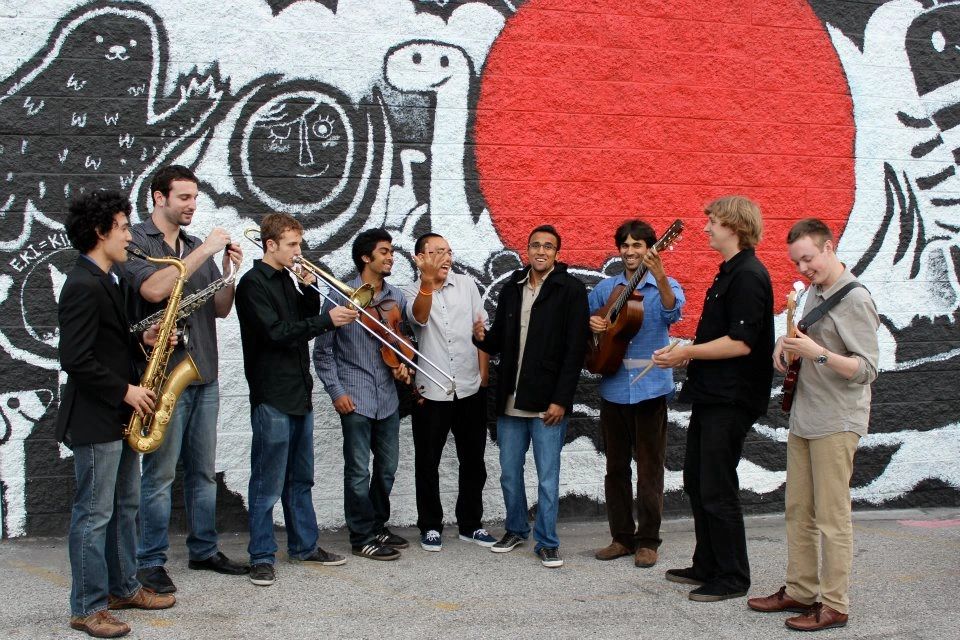
The group stayed together, performing as the Aditya Prakash Ensemble, starting as a vocalist plus jazz trio of piano, bass, and drums. At the premiere of Mara, the ensemble will also include horn, guitar, Indian classical violin, Latin percussion, and Indian percussion. What do the knowledgeable audiences hear in this music? Aditya says they hear the technicalities of the system, for example whether he’s singing the proper phrases. “You have to be on top of your game, you have to focus on getting the techniques of the raga right,” he explains. “There are certain phrases people want to hear. For me, when I perform for an audience, I try to keep those technicalities in place, but I feel I can let go and focus on emoting. Focusing on technique can make the music dry and heady. It’s about finding balance between the heady style and going from the heart.”
Mara involves much improvising, but, he points out, the production houses 35 dancers and 15 musicians. And, he says, “The goal is to create that world of Mara, so not just music for music’s sake. Every line has a purpose to it. It’s to go with the dance, go with the theme of the show.”
And so, this weekend, the beauty and intricacies of Mara—the character from folklore and the human mind—will be revealed by the once-reluctant music scholar and the once-tiny dance prodigy.
Mythili Prakash portrait for Mara, photo by Roshni Badlani & Kamala Venkatesh
Aditya Prakash, from Vimeo by Alex Rapine
Mythili Prakash, photo by D. Krishnan, courtesy of The Hindu
Mythili Prakash
Aditya Prakesh, fourth from right, and ensemble
Dancing for and of the Mind
Mythili Prakash and Aditya Prakash tell ‘Mara’ through Indian classical dance and music.
by Dany Margolies
 Mythili Prakash, fourth from left, with dancers of Mara
On a hot morning, a show rehearses in the community room of a church in the South Bay area. Warm-up scales waft from a saxophone. Tennis shoes chirp against the wooden floor as other musicians load in. A neighboring dog provides the counterpoint. Two mothers set up a tailgate party in the parking lot, ready for a long day as their young daughters in rehearsal garb gather in the hall.
 Well, there’s universality in the making of art. It sounds like a day
in the life of “Western” musical theater performers, right? But the
medium here is Bharata Natyam—or Bharatanatyam if you prefer—the
classical dance of South India, set to South Indian classical music.
Well, there’s universality in the making of art. It sounds like a day
in the life of “Western” musical theater performers, right? But the
medium here is Bharata Natyam—or Bharatanatyam if you prefer—the
classical dance of South India, set to South Indian classical music.And in this case, the performers include the choreographer-dancer Mythili Prakash, vocalist Aditya Prakash and the musicians of Aditya Prakash Ensemble, and the dancers of Shakti Dance Company. They’re rehearsing for the world premiere of Mara, a multimedia dance and musical theater production, set for Sept. 21 at the Ford Theatre in Hollywood.
According to the company, “Mara explores the journey of the individual (Jeeva), as she negotiates the dangerous, dazzling maze that is the human mind (Mara). Mara, the demon who infamously attempted to entice Buddha, continues to distract humans from discovering what lies beyond worldly pleasures, the pursuit of true inner freedom. Can Jeeva break free from the chains that bind her to this world?”
The rehearsal begins with Siddhartha, portrayed by a very still dancer, sitting under the Bodhi tree, portrayed by dancers gently manipulating strips of delicate green fabric. The tale of the Buddha begins to unfold, Aditya singing the narration, the dancers working in universal gestures and recognizable activities, even while using the expressive eyes, signature hand positions, and traditional foot stamps of South Indian dance.
Practice (eventually) makes perfect
 Aditya and Mythili, brother and sister, are Los Angeles natives. He says most parents
of Indian-heritage children, especially those children born in America,
enroll those children in music or dance classes to keep them in touch
with their roots. His parents, too, tried to make him learn dance. “That
didn’t work out,” he says. So they tried music lessons. He wouldn’t
practice, even with a promised reward of TV. Once the young boy got
through the rigors of the basics, however, his interest grew.
Aditya and Mythili, brother and sister, are Los Angeles natives. He says most parents
of Indian-heritage children, especially those children born in America,
enroll those children in music or dance classes to keep them in touch
with their roots. His parents, too, tried to make him learn dance. “That
didn’t work out,” he says. So they tried music lessons. He wouldn’t
practice, even with a promised reward of TV. Once the young boy got
through the rigors of the basics, however, his interest grew.Mythili, on the other hand, couldn’t wait to start her dance career. She is the daughter of dancer and teacher Viji Prakash. Mama wouldn’t let the tiny tot join the classes at the dance school she headed. Then she got quite a jolt when the 3-year-old Mythili performed one of the dances for her.
 Mythili says learning Bharata Natyam is similar to learning ballet.
“It’s very structured,” she says. “You go through a few years of basics:
technique, Adavus [loosely stated, the steps], the grammatical blocks.
It takes at least a year to learn the whole syllabus. Then you progress
to dances.” In her case, however, because of her early and immediate
immersion, the learning process was a little different.
Mythili says learning Bharata Natyam is similar to learning ballet.
“It’s very structured,” she says. “You go through a few years of basics:
technique, Adavus [loosely stated, the steps], the grammatical blocks.
It takes at least a year to learn the whole syllabus. Then you progress
to dances.” In her case, however, because of her early and immediate
immersion, the learning process was a little different.While a ballet dancer needs an appropriate body (able to turn out at the hips, for example), with this style, says Mythili, the dancer needs musicality, as the accompaniment is highly complex rhythmically. The dancer must also “involve” herself, feeling the storytelling. “And transforming yourself, but we say that comes later,” she says. Also vital to the form are the facial expressions, the intricate use of the hands, the head-shaking.
But, she adds, “It’s hard to dance together, because everyone is so different. It’s not, ‘Here you raise your eyebrow.’ You breathe your own into it, naturally. As you mature, your expression matures; you develop the interpretation even more.”
Travails and travels
Not everyone in the family is a performer, nor did everyone immediately appreciate the path the siblings took. The siblings’ father is a businessman. However, he helped his wife start her dance school. “That’s what fueled my and my sister’s love for the arts,” says Aditya. Over the summers, Viji would bring musicians from India for her dance productions. Her son recalls, “When they were here, I was soaked in the atmosphere of Indian classical music. I learned with these musicians from India. Then I started wanting to have more regular classes. There are a lot of Indian classical teachers here. I went to classes in Cerritos. My next step, I wanted to go to South India.”
So, Aditya traveled Chennai, India, which he terms the hub of South Indian classical music. “I learned with venerated gurus,” he says. “The thing with Indian classical music, the whole teacher-student relationship is vital to that tradition. You need one-on-one classes with a guru. Once I went to India, my focus turned away from being an engineer or doctor, like my grandma wanted me to be.”
Now, he says, his grandma is all for his artistic path. And fortunately his parents pushed him through those early stages of reluctant learning, until he began to listen to concerts and intently practice on his own. He began studying at age 8 and gave his first solo vocal concert—“They’re usually two to three hours,” he reports—at age 13.
At ages 16 through 19, he began touring with Ravi Shankar. “He’s the one who inspired me to do music full time,” Aditya says. “I was so lucky, at 16 to be able to tour, travel, learn, perform, perform at Carnegie Hall, the Hollywood Bowl, when I was 17. This is what Indian classical music can do: It can reach American audiences and touch people, even though they don’t know the art form. It can create emotion. That’s what Indian music is, it’s emotion, bringing out something you won’t feel in daily life.”
So he doesn’t need to study anymore, right? “You’re always learning, scales, practicing, warming up,” he says, so the process of studying never stops.
Mothering and mentoring
Mythili, too, still studies. Her mother is her main teacher, though the daughter says it’s more of a mentorship at this point. Mythili also has a mentor in India: Malavika Sarukkai. “My classes with her are showing my choreography, and we comb through it,” says Mythili. Sarukkai urges Mythili to clarify details, to bring mindfulness to her choreography.
 For example, Mythili created a dance about the wife of Buddha and her
journey when Buddha leaves her. Mythili choreographed a segment in
which the wife was painting a portrait. So Mythili and her mentor worked
in detail, exploring how to show thoughts and emotions with the back of
the body, how to show retreat, betrayal, disappointment.
For example, Mythili created a dance about the wife of Buddha and her
journey when Buddha leaves her. Mythili choreographed a segment in
which the wife was painting a portrait. So Mythili and her mentor worked
in detail, exploring how to show thoughts and emotions with the back of
the body, how to show retreat, betrayal, disappointment.Mythili recalls the two discussing, “How do my feet feel, what is the speed with which I walk? I carry material, which I throw on the picture. With what force? If I’m miming material, she’ll ask what color the material is.”
Aditya, too, is still on the never-ending path to improving his artistry. “Indian classical music is based on melodic scales called ragas—I could talk for hours, but that’s the skeletal definition,” he says. “Each raga has its own identity, its own emotion. The work, the constant practicing, is to bring those out without changing its structure, having the freedom to bring out one’s own creativity.”
With Western vocal music, a voice coach is usually part of the initial lessons. With Indian classical, says Aditya, “unfortunately” nobody guided his vocal technique early on, so he developed vocal nodules when he was 14. He had a “frustrating” time of it and was forced to stop singing—indeed, to stop talking for three to four months. In addition, the breaking of his voice in adolescence ushered in a tough time. Finally, he said, “I started to figure out my voice, meeting with vocal coaches in India. I began to use Western voice techniques. Now it’s about discovering your own voice and discovering the secrets behind it. I’m always constantly doing it.”
Ragas and riffs
What if he weren’t immersed in Indian music? He admits to being attracted to flamenco music, Qawwali from Pakistan, and jazz. Really, jazz? During his days studying ethnomusicology at UCLA, he lived with three jazz musicians, who would jam. “I’d be there but not participating,” Aditya recalls. “During one of the sessions, I got prodded to sing. We improvised, and something came out of it that was amazing.”

The group stayed together, performing as the Aditya Prakash Ensemble, starting as a vocalist plus jazz trio of piano, bass, and drums. At the premiere of Mara, the ensemble will also include horn, guitar, Indian classical violin, Latin percussion, and Indian percussion. What do the knowledgeable audiences hear in this music? Aditya says they hear the technicalities of the system, for example whether he’s singing the proper phrases. “You have to be on top of your game, you have to focus on getting the techniques of the raga right,” he explains. “There are certain phrases people want to hear. For me, when I perform for an audience, I try to keep those technicalities in place, but I feel I can let go and focus on emoting. Focusing on technique can make the music dry and heady. It’s about finding balance between the heady style and going from the heart.”
Mara involves much improvising, but, he points out, the production houses 35 dancers and 15 musicians. And, he says, “The goal is to create that world of Mara, so not just music for music’s sake. Every line has a purpose to it. It’s to go with the dance, go with the theme of the show.”
And so, this weekend, the beauty and intricacies of Mara—the character from folklore and the human mind—will be revealed by the once-reluctant music scholar and the once-tiny dance prodigy.
September 19, 2013
Mythili Prakash portrait for Mara, photo by Roshni Badlani & Kamala Venkatesh
Aditya Prakash, from Vimeo by Alex Rapine
Mythili Prakash, photo by D. Krishnan, courtesy of The Hindu
Mythili Prakash
Aditya Prakesh, fourth from right, and ensemble
Interview
Corps Values
How ABT ballerina Courtney Lavine has gone from strength to strength.
by Dany Margolies
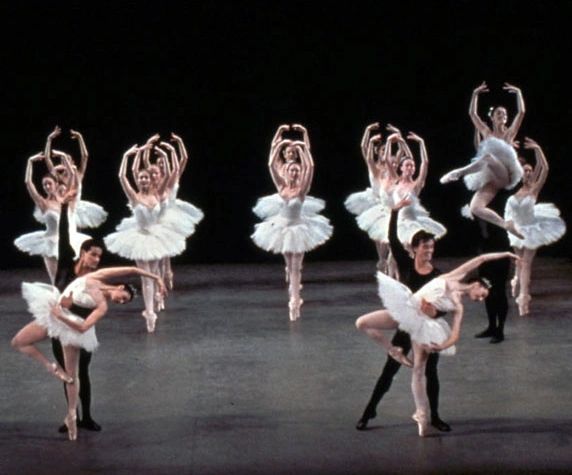
American Ballet Theatre corps and principals in George Balanchine's Symphony in C
Ballerina Courtney Lavine certainly seems levelheaded about and contented with her chosen profession and current artistic home. She is a member of the corps de ballet of American Ballet Theatre. The world-class company, based in New York, tours the globe, as well as performing across America. Lavine’s job these days is to help form those glorious patterns of dancers behind the soloists, but she’s learning to keep an eye on the work of those soloists for when her turn comes.
As a young dancer, she won competitions, including the Youth American Grand Prix’s Regional “Hope Award,” and a full scholarship to study at the Kirov Institute in Washington, D.C. She earned a Virginia Johnson Scholarship to the Washington Ballet School and began her studies there in 2001.
From 2001 through 2005, she studied on scholarship at School of American Ballet (the school of New York City Ballet) and at San Francisco Ballet summer intensive programs. She then studied full time at SAB on a merit scholarship. She joined ABT’s studio company in 2008, the main company as an apprentice in February 2010, and the corps de ballet in August of that year.
She’ll be having a homecoming of sorts July 11–14, when ABT returns to perform in the city of her birth, Los Angeles. Read on to learn a bit more about her and her life as a successful professional ballerina.
You started studying ballet at age 8. How did you first become interested in it?
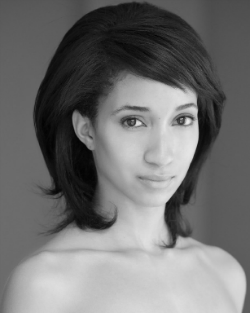 When
I was 4 or 5, my mom would take me to Kennedy Center, and I would see
ABT and San Francisco Ballet—whoever came to the Kennedy Center. And I
was always really interested in ballet. Age 8 was when I started taking
it seriously. I did competitions in jazz, tap, lyrical. At 8, I noticed
that ballet seemed to be my strong suit, and I noticed I liked it more
than anything else. I started studying with Troy Brown at a competition
school [Dancensations Dance Center in Virginia]. He took me up to SAB to
audition for their summer program. I was at SAB, and I thought, “Wow, I
love this whole world.” It seemed so magical, and I would see New York
City Ballet and ABT and became immersed in the training and performing. I
still did competitions until 14. I still did a little bit of lyrical
and jazz, but I definitely stood out more in ballet.
When
I was 4 or 5, my mom would take me to Kennedy Center, and I would see
ABT and San Francisco Ballet—whoever came to the Kennedy Center. And I
was always really interested in ballet. Age 8 was when I started taking
it seriously. I did competitions in jazz, tap, lyrical. At 8, I noticed
that ballet seemed to be my strong suit, and I noticed I liked it more
than anything else. I started studying with Troy Brown at a competition
school [Dancensations Dance Center in Virginia]. He took me up to SAB to
audition for their summer program. I was at SAB, and I thought, “Wow, I
love this whole world.” It seemed so magical, and I would see New York
City Ballet and ABT and became immersed in the training and performing. I
still did competitions until 14. I still did a little bit of lyrical
and jazz, but I definitely stood out more in ballet.
Did you have a supportive family?
Oh, yes. My mom loved it. My mom, I think, wanted to dance when she was younger, and she might have taken a couple of classes in college. So when I got into it, she loved it and took me to all my rehearsals and competitions. She was right there, cheering me along.
You must have been extraordinarily strong mentally to compete and win all those competitions.
I was probably stronger mentally then than now. I was so unaware of anyone around me. I focused on my character, which is strange for an 8- or 9-year-old. I didn’t notice people in the wings. I was in character onstage. Now I’m a little different. Then it was easy.
Physically, what did you struggle with?
I was always really thin, and that was the reason ballet came naturally. I was very small, with long legs and long arms. So I guess I struggled with strength, because I was so gangly. I started doing Gyrotonics when I went to Washington Ballet to train.
Is it easier now that you’ve “grown into” your body?
It is still something I have to make sure I’m on top of. I do Pilates to pull everything together.
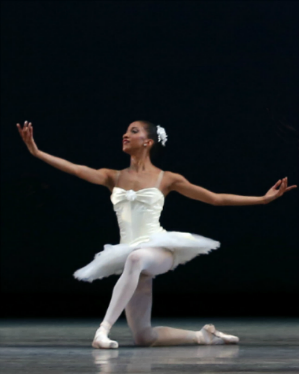 What did you not know when you joined the company?
It was a shock. I wasn’t used to 80-some people in a ballet company, and I had to start to dance in a vertical line. In school we never had to dance together. That was hard. There were definitely some senior corps girls who helped me out and made sure I was in a line. Swan Lake and La Bayadère were the biggest shock. Not only do you have to be together and in line, it’s physically demanding. Again, it’s the strength thing. I don’t think I had that strength going into the company. I would almost be in tears, standing on the stage for [the dance of] the Little Swans and the Big Swans and the pas de deux. I’d think, “What did I get myself into?” It’s gotten easier, but at the beginning it was definitely a shock.
The audience doesn’t realize how hard it is to just stand onstage.
You would never know unless you talk to a corps dancer.
Do you notice competitiveness within the corps de ballet?
I’ve been thinking about this recently. It can be relatively competitive, but at the same time, with myself, I don’t compete with a person. I try to push myself to see if I can be a better dancer than I was the year before. I try to make sure I’m improving. There are some people who can be extremely competitive, and there are people who are like me. I’m not a competitive person, I don’t push to the front in class, but I do want to go far in ballet.
What are you doing, if anything, to move up to soloist or principal rank?
I remember in a meeting with Kevin [McKenzie, ABT artistic director], he told me to do a lot of watching. I watch the principals and soloists I admire, and I notice, “Oh, wow, they do this well.” And the whole thing with getting stronger. You don’t want to get an opportunity and then not have the stamina. So I’ve been doing a lot of strengthening of my feet and my core. And watching.
This meeting with Mr. McKenzie, was it a company meeting or does he meet with dancers individually? Did he tell everyone to watch, or just you?
He’s probably said it in general meetings, but every dancer gets a meeting with Kevin and Victor [Barbee, associate artistic director] every year. You can ask them questions, and they let you know how you’re doing. It’s a positive thing. And he said, “Just watch. Watching is always good. You watch the principals and soloists, and you can find things they’re doing that you like, and it will help you grow as an artist,” and I took that to heart.
I take you have been diligently following his advice. What have you noticed as you watch?
I’ve been noticing their port de bras [the positions and movement of the arms] a lot, maybe because it’s something I need to work on. Certain ballerinas, I really like how they move their arms.
For example?
Julie Kent, Polina Semionova, I love their port de bras. It seems to come so naturally to them. I hope one day I won’t have to think about what I do with my hands.
What do you enjoy most about being in a company that tours?
I love traveling and culture. So when we’re in a foreign country, I love to explore, even if I’m by myself. We were in Beijing, and we went to the Great Wall. I met some younger girls who do ballet in Hong Kong, and they gave me traditional egg [custard] tarts. They were so friendly. I love all of that interacting.
What’s the hard part about touring?
It can get a little lonely, but, for the most part, you’re usually too busy to get that lonely. On our day off, I usually find something to do or somebody to talk to.
Courtney Lavine, photo by Jade Young
Lavine in Symphony in C, photo by Marty Sohl
Corps Values
How ABT ballerina Courtney Lavine has gone from strength to strength.
by Dany Margolies

American Ballet Theatre corps and principals in George Balanchine's Symphony in C
Photo by Paul Kolnik
Ballerina Courtney Lavine certainly seems levelheaded about and contented with her chosen profession and current artistic home. She is a member of the corps de ballet of American Ballet Theatre. The world-class company, based in New York, tours the globe, as well as performing across America. Lavine’s job these days is to help form those glorious patterns of dancers behind the soloists, but she’s learning to keep an eye on the work of those soloists for when her turn comes.
As a young dancer, she won competitions, including the Youth American Grand Prix’s Regional “Hope Award,” and a full scholarship to study at the Kirov Institute in Washington, D.C. She earned a Virginia Johnson Scholarship to the Washington Ballet School and began her studies there in 2001.
From 2001 through 2005, she studied on scholarship at School of American Ballet (the school of New York City Ballet) and at San Francisco Ballet summer intensive programs. She then studied full time at SAB on a merit scholarship. She joined ABT’s studio company in 2008, the main company as an apprentice in February 2010, and the corps de ballet in August of that year.
She’ll be having a homecoming of sorts July 11–14, when ABT returns to perform in the city of her birth, Los Angeles. Read on to learn a bit more about her and her life as a successful professional ballerina.
You started studying ballet at age 8. How did you first become interested in it?
 When
I was 4 or 5, my mom would take me to Kennedy Center, and I would see
ABT and San Francisco Ballet—whoever came to the Kennedy Center. And I
was always really interested in ballet. Age 8 was when I started taking
it seriously. I did competitions in jazz, tap, lyrical. At 8, I noticed
that ballet seemed to be my strong suit, and I noticed I liked it more
than anything else. I started studying with Troy Brown at a competition
school [Dancensations Dance Center in Virginia]. He took me up to SAB to
audition for their summer program. I was at SAB, and I thought, “Wow, I
love this whole world.” It seemed so magical, and I would see New York
City Ballet and ABT and became immersed in the training and performing. I
still did competitions until 14. I still did a little bit of lyrical
and jazz, but I definitely stood out more in ballet.
When
I was 4 or 5, my mom would take me to Kennedy Center, and I would see
ABT and San Francisco Ballet—whoever came to the Kennedy Center. And I
was always really interested in ballet. Age 8 was when I started taking
it seriously. I did competitions in jazz, tap, lyrical. At 8, I noticed
that ballet seemed to be my strong suit, and I noticed I liked it more
than anything else. I started studying with Troy Brown at a competition
school [Dancensations Dance Center in Virginia]. He took me up to SAB to
audition for their summer program. I was at SAB, and I thought, “Wow, I
love this whole world.” It seemed so magical, and I would see New York
City Ballet and ABT and became immersed in the training and performing. I
still did competitions until 14. I still did a little bit of lyrical
and jazz, but I definitely stood out more in ballet.Did you have a supportive family?
Oh, yes. My mom loved it. My mom, I think, wanted to dance when she was younger, and she might have taken a couple of classes in college. So when I got into it, she loved it and took me to all my rehearsals and competitions. She was right there, cheering me along.
You must have been extraordinarily strong mentally to compete and win all those competitions.
I was probably stronger mentally then than now. I was so unaware of anyone around me. I focused on my character, which is strange for an 8- or 9-year-old. I didn’t notice people in the wings. I was in character onstage. Now I’m a little different. Then it was easy.
Physically, what did you struggle with?
I was always really thin, and that was the reason ballet came naturally. I was very small, with long legs and long arms. So I guess I struggled with strength, because I was so gangly. I started doing Gyrotonics when I went to Washington Ballet to train.
Is it easier now that you’ve “grown into” your body?
It is still something I have to make sure I’m on top of. I do Pilates to pull everything together.
 What did you not know when you joined the company?
It was a shock. I wasn’t used to 80-some people in a ballet company, and I had to start to dance in a vertical line. In school we never had to dance together. That was hard. There were definitely some senior corps girls who helped me out and made sure I was in a line. Swan Lake and La Bayadère were the biggest shock. Not only do you have to be together and in line, it’s physically demanding. Again, it’s the strength thing. I don’t think I had that strength going into the company. I would almost be in tears, standing on the stage for [the dance of] the Little Swans and the Big Swans and the pas de deux. I’d think, “What did I get myself into?” It’s gotten easier, but at the beginning it was definitely a shock.
The audience doesn’t realize how hard it is to just stand onstage.
You would never know unless you talk to a corps dancer.
Do you notice competitiveness within the corps de ballet?
I’ve been thinking about this recently. It can be relatively competitive, but at the same time, with myself, I don’t compete with a person. I try to push myself to see if I can be a better dancer than I was the year before. I try to make sure I’m improving. There are some people who can be extremely competitive, and there are people who are like me. I’m not a competitive person, I don’t push to the front in class, but I do want to go far in ballet.
What are you doing, if anything, to move up to soloist or principal rank?
I remember in a meeting with Kevin [McKenzie, ABT artistic director], he told me to do a lot of watching. I watch the principals and soloists I admire, and I notice, “Oh, wow, they do this well.” And the whole thing with getting stronger. You don’t want to get an opportunity and then not have the stamina. So I’ve been doing a lot of strengthening of my feet and my core. And watching.
This meeting with Mr. McKenzie, was it a company meeting or does he meet with dancers individually? Did he tell everyone to watch, or just you?
He’s probably said it in general meetings, but every dancer gets a meeting with Kevin and Victor [Barbee, associate artistic director] every year. You can ask them questions, and they let you know how you’re doing. It’s a positive thing. And he said, “Just watch. Watching is always good. You watch the principals and soloists, and you can find things they’re doing that you like, and it will help you grow as an artist,” and I took that to heart.
I take you have been diligently following his advice. What have you noticed as you watch?
I’ve been noticing their port de bras [the positions and movement of the arms] a lot, maybe because it’s something I need to work on. Certain ballerinas, I really like how they move their arms.
For example?
Julie Kent, Polina Semionova, I love their port de bras. It seems to come so naturally to them. I hope one day I won’t have to think about what I do with my hands.
What do you enjoy most about being in a company that tours?
I love traveling and culture. So when we’re in a foreign country, I love to explore, even if I’m by myself. We were in Beijing, and we went to the Great Wall. I met some younger girls who do ballet in Hong Kong, and they gave me traditional egg [custard] tarts. They were so friendly. I love all of that interacting.
What’s the hard part about touring?
It can get a little lonely, but, for the most part, you’re usually too busy to get that lonely. On our day off, I usually find something to do or somebody to talk to.
Courtney Lavine spoke with ArtsInLA.com on July 5, 2013
Courtney Lavine, photo by Jade Young
Lavine in Symphony in C, photo by Marty Sohl
Review
ABT Mixed Bill: Apollo, Chamber Symphony, Symphony in C
Glorya Kaufman Presents Dance at the Music Center
Reviewed by Dany Margolies
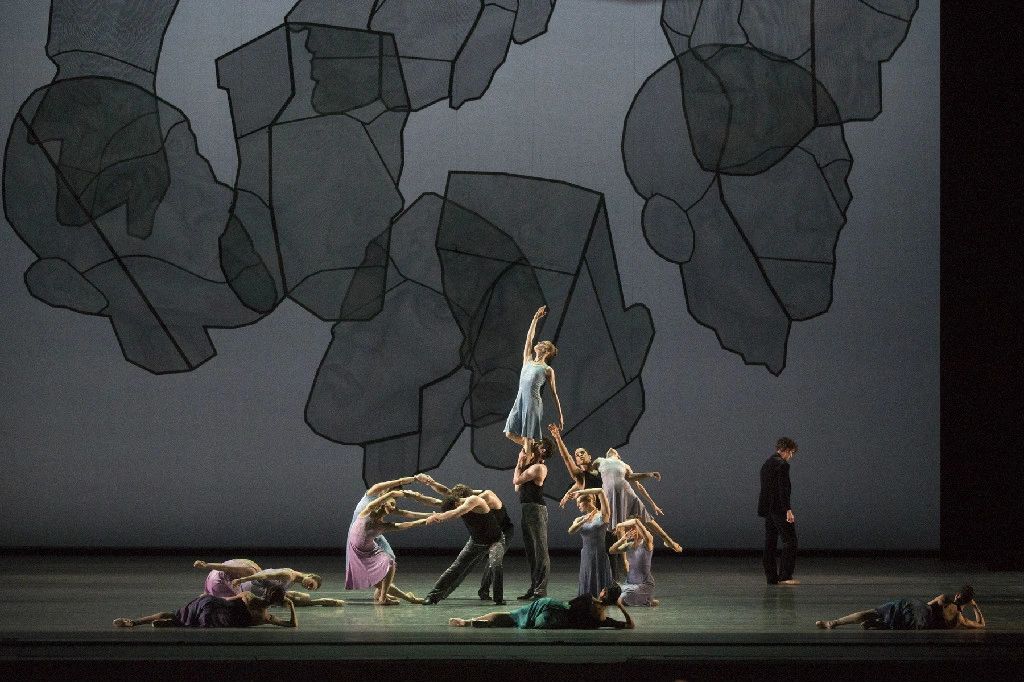
Chamber Symphony, James Whiteside walking at right
In baseball, batting .666 would be considered miraculous. When American Ballet Theatre performs only two out of three ballets well, some might consider that a disappointment. It’s not fair, but it’s the way of the performing arts.
The mixed bill program the company brought to Los Angeles this week featured two pieces choreographed by George Balanchine, sandwiching a recent work choreographed by another émigré from Russia: the clearly talented Alexei Ratmansky.
The evening opened with Balanchine’s Apollo, choreographed in 1928 to Igor Stravinsky’s “Apollon Musagète.” The Balanchine steps were there—including, in this version, the birth of Apollo (Marcelo Gomes) out of the laboring Leto (Sarah Smith). But where during Balanchine’s lifetime many dancers heaved and contorted into his signature choreography, the ABT cast elongated and melted into the unique style, fluidly linking steps, finding ease in the offset balances, bringing strong classical technique to the piece while remaining true to Balanchine’s eccentricities. Two handmaidens (danced cleanly and securely by Luciana Paris and Adrienne Schulte) help baby Apollo find his feet and then his musicianship. Apollo then learns from and ultimately rules the muses: Terpsichore, the lyre-playing muse of dance (Paloma Herrera); Polyhymnia, the mask-wearing, miming muse (Devon Teuscher); and Calliope, the literate muse (Melanie Hamrick).
Gomes is an adept actor, convincingly playing the sun god, but he also possesses beautiful ballon (easy bouncing jumps that end in soft, pliable landings) and reliable yet elegant partnering. The muses danced in perfect sync, including port de bras (arm movements) and épaulement (upper-body positioning).
Next, Ratmansky’s enigmatic Chamber Symphony certainly fascinated, even if it failed to elucidate. Danced to Dmitri Shostakovich’s “Chamber Symphony” Op. 110a, the piece featured an apparent outsider (James Whiteside) in a world of insiders. He wears a black velvet suit, shirtless; those around him are casually clad. In this age of tattoos (one thought they were verboten in the ballet world), Whiteside might be inked on his left ribcage; but if not, he wore makeup that resembled either stab wounds or gills. But his dancing leaves no doubt that he’s a talent as a technician and an actor. The three women in the loner’s life—danced by Isabella Boylston, Yuriko Kajiya, and Julie Kent—treat him relatively well, apparently teaching him along the way, but he ends up isolated as ever. The staging’s intriguing backdrop, with its images of a man’s face at various ages and at various angles, adds visual interest and an aura of being “watched.”
Last, and surprisingly least on this night, was the musically exquisite Symphony in C, choreographed by Balanchine to the music of Georges Bizet. The ballet dates from the 1940s, but it feels classical because of its spatial patterns and its costuming in tiaras and white tutus. Again, however, the choreography is uniquely Balanchine.
And whether it’s fear of that style or newness to the stage, the ABT dancers did not shine from stem to stern here. Do we, in Los Angeles, get the “try-outs”? Or do not all dancers give us their all because we’re so Hollywood?
In the first movement (led by Stella Abrera and Eric Tamm), too many company members barely rose above local-recital level. If the style is now for toothy grins rather than the elegant smiles that were de rigueur not that long ago (which kept dancers from looking like they were panting), so be it. But in no way can shoulders up and brittle landings pass for “nowadays acceptable.” Nor should the audience see any tension or effort in partnering—and that includes a tongue that poked out during a lift.
In the second movement, the corps again revealed bad technique: curled wrists, failure to end steps in a clean fifth position. Nor were leads Veronika Part and Thomas Forster immune from error: Most noticeably, a pirouette went predictably off balance.
Yuriko Kajiya and Daniil Simkin danced cleanly if without chemistry in the third movement, and Sarah Lane and Sascha Radetsky dutifully fulfilled the obligations of the fourth. But give the dancers in the corps this: They are musical, pleasantly uniform in style, and disciplined in line.
Also fortunately, Charles Barker led the orchestra in the wistful Stravinsky, and Ormsby Wilkins brought balletic vibrancy to the Shostakovich and the Bizet (despite, or perhaps enhanced by the charm of, a wayward horn).
ABT Mixed Bill: Apollo, Chamber Symphony, Symphony in C
Glorya Kaufman Presents Dance at the Music Center
Reviewed by Dany Margolies

Chamber Symphony, James Whiteside walking at right
In baseball, batting .666 would be considered miraculous. When American Ballet Theatre performs only two out of three ballets well, some might consider that a disappointment. It’s not fair, but it’s the way of the performing arts.
The mixed bill program the company brought to Los Angeles this week featured two pieces choreographed by George Balanchine, sandwiching a recent work choreographed by another émigré from Russia: the clearly talented Alexei Ratmansky.
The evening opened with Balanchine’s Apollo, choreographed in 1928 to Igor Stravinsky’s “Apollon Musagète.” The Balanchine steps were there—including, in this version, the birth of Apollo (Marcelo Gomes) out of the laboring Leto (Sarah Smith). But where during Balanchine’s lifetime many dancers heaved and contorted into his signature choreography, the ABT cast elongated and melted into the unique style, fluidly linking steps, finding ease in the offset balances, bringing strong classical technique to the piece while remaining true to Balanchine’s eccentricities. Two handmaidens (danced cleanly and securely by Luciana Paris and Adrienne Schulte) help baby Apollo find his feet and then his musicianship. Apollo then learns from and ultimately rules the muses: Terpsichore, the lyre-playing muse of dance (Paloma Herrera); Polyhymnia, the mask-wearing, miming muse (Devon Teuscher); and Calliope, the literate muse (Melanie Hamrick).
Gomes is an adept actor, convincingly playing the sun god, but he also possesses beautiful ballon (easy bouncing jumps that end in soft, pliable landings) and reliable yet elegant partnering. The muses danced in perfect sync, including port de bras (arm movements) and épaulement (upper-body positioning).
Next, Ratmansky’s enigmatic Chamber Symphony certainly fascinated, even if it failed to elucidate. Danced to Dmitri Shostakovich’s “Chamber Symphony” Op. 110a, the piece featured an apparent outsider (James Whiteside) in a world of insiders. He wears a black velvet suit, shirtless; those around him are casually clad. In this age of tattoos (one thought they were verboten in the ballet world), Whiteside might be inked on his left ribcage; but if not, he wore makeup that resembled either stab wounds or gills. But his dancing leaves no doubt that he’s a talent as a technician and an actor. The three women in the loner’s life—danced by Isabella Boylston, Yuriko Kajiya, and Julie Kent—treat him relatively well, apparently teaching him along the way, but he ends up isolated as ever. The staging’s intriguing backdrop, with its images of a man’s face at various ages and at various angles, adds visual interest and an aura of being “watched.”
Last, and surprisingly least on this night, was the musically exquisite Symphony in C, choreographed by Balanchine to the music of Georges Bizet. The ballet dates from the 1940s, but it feels classical because of its spatial patterns and its costuming in tiaras and white tutus. Again, however, the choreography is uniquely Balanchine.
And whether it’s fear of that style or newness to the stage, the ABT dancers did not shine from stem to stern here. Do we, in Los Angeles, get the “try-outs”? Or do not all dancers give us their all because we’re so Hollywood?
In the first movement (led by Stella Abrera and Eric Tamm), too many company members barely rose above local-recital level. If the style is now for toothy grins rather than the elegant smiles that were de rigueur not that long ago (which kept dancers from looking like they were panting), so be it. But in no way can shoulders up and brittle landings pass for “nowadays acceptable.” Nor should the audience see any tension or effort in partnering—and that includes a tongue that poked out during a lift.
In the second movement, the corps again revealed bad technique: curled wrists, failure to end steps in a clean fifth position. Nor were leads Veronika Part and Thomas Forster immune from error: Most noticeably, a pirouette went predictably off balance.
Yuriko Kajiya and Daniil Simkin danced cleanly if without chemistry in the third movement, and Sarah Lane and Sascha Radetsky dutifully fulfilled the obligations of the fourth. But give the dancers in the corps this: They are musical, pleasantly uniform in style, and disciplined in line.
Also fortunately, Charles Barker led the orchestra in the wistful Stravinsky, and Ormsby Wilkins brought balletic vibrancy to the Shostakovich and the Bizet (despite, or perhaps enhanced by the charm of, a wayward horn).
July 12, 2013
Review
Trisha Brown Dance Company
The Retrospective Project
UCLA Center for the Art of Performance at Royce Hall
Reviewed by Dany Margolies
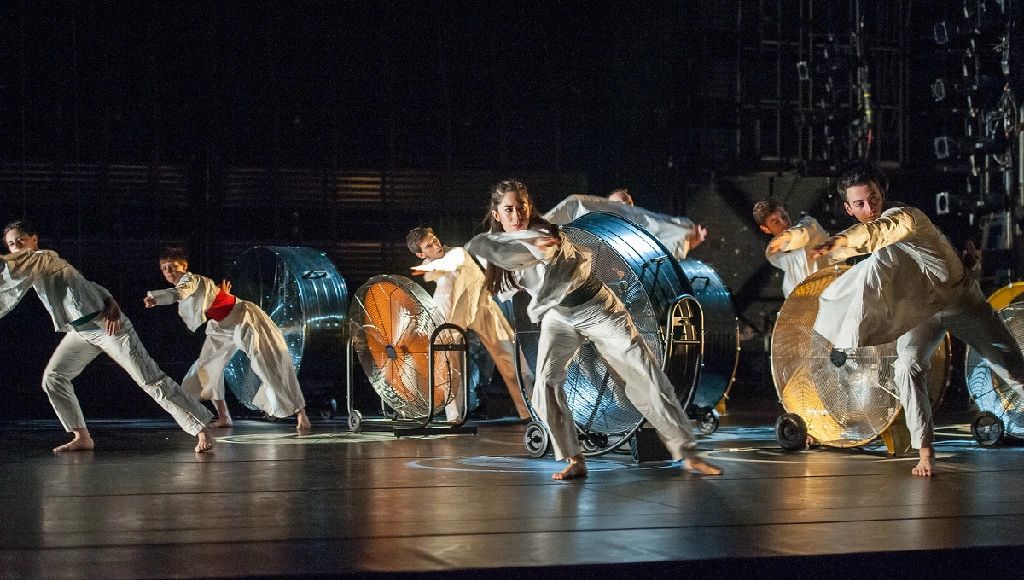 Trisha Brown Dance Company in I'm going to toss my arms–if you catch them they’re yours
Photo by Stephanie Berger
Trisha Brown’s choreography abstracts movement. Period, end of conversation. Try as one might, it seems impossible to pull meaning, story, even “entertainment” out of her works. If, however, one is satisfied to consider her work as movement per se, her ideas stimulate at least interest and appreciation, at best fascination and awe.
CAP UCLA, the university’s performing arts center, curated this collection of Brown’s work (more is continuing at various UCLA-affiliated venues). The evening “Performance A” comprised a range of Brown’s works, from early to her latest, from a solo to complex group choreographies, from frenetic perpetual motion to slightly more placid dances. One can visualize the magnificent young Brown (she is now 76) dancing each of them, so distinctive is her work.
Set and Reset is Brown’s iconic 1983 dance. It’s a half-hour piece set to Laurie Anderson’s original, chattering score titled “Long Time No See,” accented by bells and drums. Eight dancers (Tara Lorenzen, Megan Madorin, Leah Morrison, Tamara Riewe, Jamie Scott, Stuart Shugg, Nicholas Strafaccia, and Samuel Wentz) were draped in diaphanous fabric vaguely resembling large newsprint. Years ahead of their time, costuming and visuals were designed by Brown’s reliable collaborator Robert Rauschenberg. The stage’s wings are translucent, so the audience can watch as the dancers prepare for entrances and wilt in exhaustion on exiting. The dancers invariably did both. The piece consists of manic perpetual motion, seemingly random—obviously not, though—until relatively far in, when first two dancers and then more dance in unison. Exhilarating to watch, it’s even more exhilarating to ponder its creation and structure.
Next on the evening’s program, Brown’s 1978 solo Watermotor featured Samuel Wentz. The three-minute piece is a charming etude in which the dancer, clad in grey sweats, works in movement impulses that occasionally develop into a finished phrase.
Foray Forêt, from 1990, starts with dancers in silhouette against a cyc lit in deep purple. The eight dancers from Set and Reset, joined by Neal Beasley, wore Rauschenberg’s coppery-gold costumes. The 35-minute piece provided the evening’s first moments of stillness. It begins in silence, as movement develops from single dance steps. Occasionally the steps were recognizable, such as the expansive leg sweep of a grand rond de jambe en l’air. Movement periodically led to pauses, as dancers struck Egyptian-pictograph poses. Hands and feet peeked from the wings, building anticipation.
Music for Foray is credited to “traditional” and is played by marching bands from neighboring schools. This evening the Hamilton High School Marching Yankee Band displayed its chops, even though the musicians played outside the theater as their sounds reverberated through walls and drifted under doorways.
In the moments of silence, dancers seemed to stay in unison by glancing at each other. Normally not permitted, nor expected, in a professional performance, the “informality” lends an academic-study feel to the piece.
The troupe, minus Scott, lastly offered a 30-minute work said to be Brown’s last: the 2011 I’m going to toss my arms—if you catch them they’re yours. Its title comes from a transcript of a rehearsal, part of directions from Brown to her dancers. A portion of the transcript, reprinted in the program, allows great insight into her creative process and the work the dancers do, the understanding and kinship they have with her, to be able to derive movement from her words.
On a bare stage—no backdrop or wings—the piece features huge wind machines. The air stirs the dancers and their identical loose-fitting white trousers and tops, eventually peeled off to reveal bright-colored leotards and shorts (costumes by Kaye Voyce). Dancers gather as if members of a group, then strike off on their own to take on their own personas. Original music, by Alvin Curran, titled “Toss and Find” as fits Brown’s directions to her dancers, consists of notes in octaves, played on horns, piccolo, and harmonica.
Brown’s dancers, though flawless in her choreography and certainly stageworthy, don’t concern themselves with “performing.” There’s not much of the presentational in their presence. In the audience, the professional contemporary dancers, dance students, and dance lovers clearly found this evening to their satisfaction. Others in the audience had hoped she would speak more directly to them.
Trisha Brown Dance Company
The Retrospective Project
UCLA Center for the Art of Performance at Royce Hall
Reviewed by Dany Margolies
 Trisha Brown Dance Company in I'm going to toss my arms–if you catch them they’re yours
Photo by Stephanie Berger
Trisha Brown’s choreography abstracts movement. Period, end of conversation. Try as one might, it seems impossible to pull meaning, story, even “entertainment” out of her works. If, however, one is satisfied to consider her work as movement per se, her ideas stimulate at least interest and appreciation, at best fascination and awe.
CAP UCLA, the university’s performing arts center, curated this collection of Brown’s work (more is continuing at various UCLA-affiliated venues). The evening “Performance A” comprised a range of Brown’s works, from early to her latest, from a solo to complex group choreographies, from frenetic perpetual motion to slightly more placid dances. One can visualize the magnificent young Brown (she is now 76) dancing each of them, so distinctive is her work.
Set and Reset is Brown’s iconic 1983 dance. It’s a half-hour piece set to Laurie Anderson’s original, chattering score titled “Long Time No See,” accented by bells and drums. Eight dancers (Tara Lorenzen, Megan Madorin, Leah Morrison, Tamara Riewe, Jamie Scott, Stuart Shugg, Nicholas Strafaccia, and Samuel Wentz) were draped in diaphanous fabric vaguely resembling large newsprint. Years ahead of their time, costuming and visuals were designed by Brown’s reliable collaborator Robert Rauschenberg. The stage’s wings are translucent, so the audience can watch as the dancers prepare for entrances and wilt in exhaustion on exiting. The dancers invariably did both. The piece consists of manic perpetual motion, seemingly random—obviously not, though—until relatively far in, when first two dancers and then more dance in unison. Exhilarating to watch, it’s even more exhilarating to ponder its creation and structure.
Next on the evening’s program, Brown’s 1978 solo Watermotor featured Samuel Wentz. The three-minute piece is a charming etude in which the dancer, clad in grey sweats, works in movement impulses that occasionally develop into a finished phrase.
Foray Forêt, from 1990, starts with dancers in silhouette against a cyc lit in deep purple. The eight dancers from Set and Reset, joined by Neal Beasley, wore Rauschenberg’s coppery-gold costumes. The 35-minute piece provided the evening’s first moments of stillness. It begins in silence, as movement develops from single dance steps. Occasionally the steps were recognizable, such as the expansive leg sweep of a grand rond de jambe en l’air. Movement periodically led to pauses, as dancers struck Egyptian-pictograph poses. Hands and feet peeked from the wings, building anticipation.
Music for Foray is credited to “traditional” and is played by marching bands from neighboring schools. This evening the Hamilton High School Marching Yankee Band displayed its chops, even though the musicians played outside the theater as their sounds reverberated through walls and drifted under doorways.
In the moments of silence, dancers seemed to stay in unison by glancing at each other. Normally not permitted, nor expected, in a professional performance, the “informality” lends an academic-study feel to the piece.
The troupe, minus Scott, lastly offered a 30-minute work said to be Brown’s last: the 2011 I’m going to toss my arms—if you catch them they’re yours. Its title comes from a transcript of a rehearsal, part of directions from Brown to her dancers. A portion of the transcript, reprinted in the program, allows great insight into her creative process and the work the dancers do, the understanding and kinship they have with her, to be able to derive movement from her words.
On a bare stage—no backdrop or wings—the piece features huge wind machines. The air stirs the dancers and their identical loose-fitting white trousers and tops, eventually peeled off to reveal bright-colored leotards and shorts (costumes by Kaye Voyce). Dancers gather as if members of a group, then strike off on their own to take on their own personas. Original music, by Alvin Curran, titled “Toss and Find” as fits Brown’s directions to her dancers, consists of notes in octaves, played on horns, piccolo, and harmonica.
Brown’s dancers, though flawless in her choreography and certainly stageworthy, don’t concern themselves with “performing.” There’s not much of the presentational in their presence. In the audience, the professional contemporary dancers, dance students, and dance lovers clearly found this evening to their satisfaction. Others in the audience had hoped she would speak more directly to them.
April 15, 2013
Review
Traversing Time/s
Pennington Dance Group at ARC Pasadena
Reviewed by Pamela Hurley Diamond
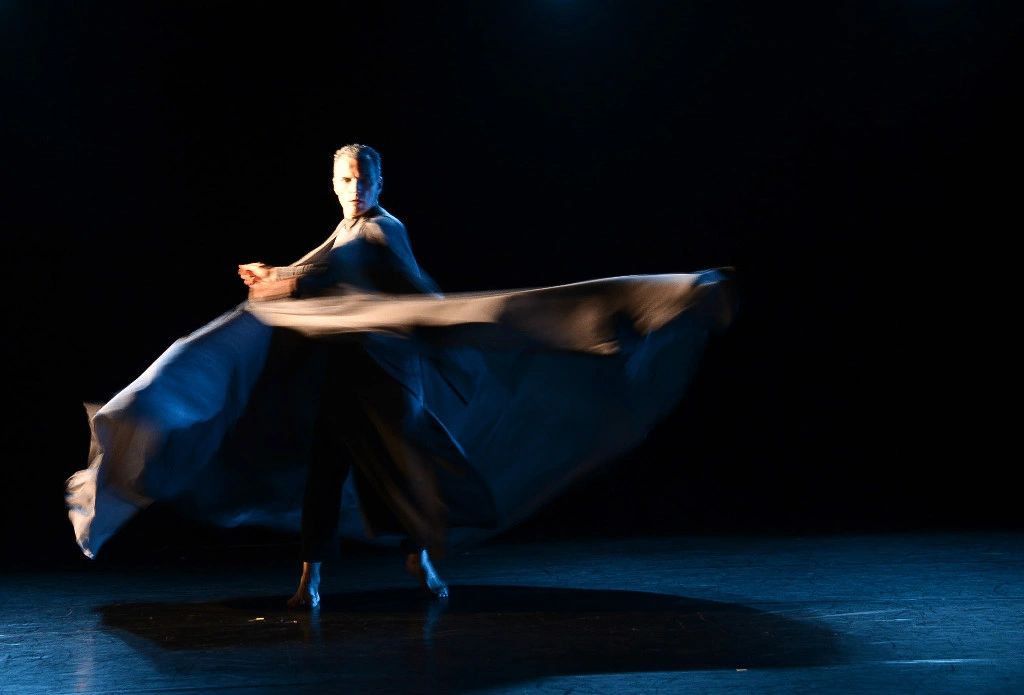
Four intriguing and intelligent dances whose choreography, musical scores, and sensibilities were culled from influences spanning 100 years constituted Pennington Dance Group’s Traversing Time/s.
Five dancers in filmy cape-like garments flowed onstage for The Goodman Dances, choreographed by John Pennington with music by Alexander Zemlinsky, whose art songs were inspired by period Germanic poetry and cogitate on the nature of love. Detailed, nuanced, and beautiful, the dance was an evocative, classically modern piece imbued with naturalistic movements and a soft, precise fluidity that’s often more difficult to achieve than an oh-so-showy athleticism. In solo after solo, the dancers embodied elements of nature, with hands fluttering and feet skittering like autumn leaves and with draperies that floated behind like the wings of doves.
Li Chang Rothermich’s solo crackled with energy from head to toes, an inner fire burning through fierce barrel turns and strong slow balances. By contrast, Michael Szanyi brought sprightly timing and a graceful expressionism to his solo, deftly emoting his character to create a visual poem.
Choreographed by Pennington with music by Mary Lou Newmark and Edgar Rothermich, Overlay was originally a collaboration with the London-based Yorke Dance Project. Here Pennington gave his modern moves a slight contemporary feel, and the dancers embraced them with a clean, effortless cohesion. Backed by the score’s rather jarring, techno beat, they edged in and out of spotlights and swung back and forth like pendulums engendering tension and a weighted serenity born of confidence: These dancers seem mature beyond their years, and that emotive quality played well in the intimate space of ARC.
Pennington danced the iconic solos of Tänze vor Gott, choreographer Harald Keutzberg’s 1927 dark jewel, reprised and with new choreography by Lew Thomas and Pennington, with music by Paul Des Marais based on the original scores by Friederich Wilckens. In much the same way that Baryshnikov can command a role—and a room—by the simplest step or sweep of an arm, Pennington wowed with his opening moves: a slow, stately turning of his head, the slight gesture of a hand to his face. The intensity of emotion pierced the air. It’s a silent scream of a dance, a work in which the costume (here a stone-grey tunic and cape) sculpts its wearer—expressing tension, anger, fear as it whips and binds, much like the shroud in Martha Graham’s 1930 Lamentations. Pennington’s swirling cape unfurled like fate as his clasped hands pled; it spilled around him like wet cement when he fell forward to the ground in supplication.
At first glance a puff of a piece, the premiere of PODCAST—with extra text by the cast, a witty sound collage by Pennington, and score by Tom Peters—proved its worthiness in the end. It was an interesting juxtaposition to follow such heavy drama with seeming fluff, but while the dancers romped in cartoon color jogging suits and bright T-shirts reacting to fictionalized podcasts, they began to take on a cultish cheerfulness that engendered questions about the podcasts’ meaning.
While Tänze vor Gott explored the angst of the inner, PODCAST offered a sendup of the outer: today’s focus on attention, expression, going with the crowd. The not-so-silent scream, perhaps? In the end, Pennington’s deft choreography had the dancers stumbling backwards like zombies, one hand on their headsets and one hand outstretched toward the audience. Are podcasts the genesis of the possible zombie apocalypse everyone is talking about, or do they just represent our ongoing quest for self-expression? Is it healthier to hold it in or to let it all hang out? Perhaps not even Pennington knows the answer.
www.PenningtonDanceGroup.org
Traversing Time/s
Pennington Dance Group at ARC Pasadena
Reviewed by Pamela Hurley Diamond

John Pennington
Photo by Frances CheeFour intriguing and intelligent dances whose choreography, musical scores, and sensibilities were culled from influences spanning 100 years constituted Pennington Dance Group’s Traversing Time/s.
Five dancers in filmy cape-like garments flowed onstage for The Goodman Dances, choreographed by John Pennington with music by Alexander Zemlinsky, whose art songs were inspired by period Germanic poetry and cogitate on the nature of love. Detailed, nuanced, and beautiful, the dance was an evocative, classically modern piece imbued with naturalistic movements and a soft, precise fluidity that’s often more difficult to achieve than an oh-so-showy athleticism. In solo after solo, the dancers embodied elements of nature, with hands fluttering and feet skittering like autumn leaves and with draperies that floated behind like the wings of doves.
Li Chang Rothermich’s solo crackled with energy from head to toes, an inner fire burning through fierce barrel turns and strong slow balances. By contrast, Michael Szanyi brought sprightly timing and a graceful expressionism to his solo, deftly emoting his character to create a visual poem.
Choreographed by Pennington with music by Mary Lou Newmark and Edgar Rothermich, Overlay was originally a collaboration with the London-based Yorke Dance Project. Here Pennington gave his modern moves a slight contemporary feel, and the dancers embraced them with a clean, effortless cohesion. Backed by the score’s rather jarring, techno beat, they edged in and out of spotlights and swung back and forth like pendulums engendering tension and a weighted serenity born of confidence: These dancers seem mature beyond their years, and that emotive quality played well in the intimate space of ARC.
Pennington danced the iconic solos of Tänze vor Gott, choreographer Harald Keutzberg’s 1927 dark jewel, reprised and with new choreography by Lew Thomas and Pennington, with music by Paul Des Marais based on the original scores by Friederich Wilckens. In much the same way that Baryshnikov can command a role—and a room—by the simplest step or sweep of an arm, Pennington wowed with his opening moves: a slow, stately turning of his head, the slight gesture of a hand to his face. The intensity of emotion pierced the air. It’s a silent scream of a dance, a work in which the costume (here a stone-grey tunic and cape) sculpts its wearer—expressing tension, anger, fear as it whips and binds, much like the shroud in Martha Graham’s 1930 Lamentations. Pennington’s swirling cape unfurled like fate as his clasped hands pled; it spilled around him like wet cement when he fell forward to the ground in supplication.
At first glance a puff of a piece, the premiere of PODCAST—with extra text by the cast, a witty sound collage by Pennington, and score by Tom Peters—proved its worthiness in the end. It was an interesting juxtaposition to follow such heavy drama with seeming fluff, but while the dancers romped in cartoon color jogging suits and bright T-shirts reacting to fictionalized podcasts, they began to take on a cultish cheerfulness that engendered questions about the podcasts’ meaning.
While Tänze vor Gott explored the angst of the inner, PODCAST offered a sendup of the outer: today’s focus on attention, expression, going with the crowd. The not-so-silent scream, perhaps? In the end, Pennington’s deft choreography had the dancers stumbling backwards like zombies, one hand on their headsets and one hand outstretched toward the audience. Are podcasts the genesis of the possible zombie apocalypse everyone is talking about, or do they just represent our ongoing quest for self-expression? Is it healthier to hold it in or to let it all hang out? Perhaps not even Pennington knows the answer.
December 27, 2012
www.PenningtonDanceGroup.org
Sic Transit (Space) Gloria
Diavolo Dance Theater brings its newest ‘modern acrobatic dance’ piece to The Broad Stage.
by Pamela Hurley Diamond
When you discover that French-born artistic director and self-proclaimed rebel-with-a-cause Jacques Heim earned his early creds as a street perfo rmer in Paris, dancing with friends on cars and in the subway in
what sounds like a très-cool takeoff on the movie Fame, the origin of the avant-garde architectural aesthetic that drives his Los
Angeles–based Diavolo Dance Theater becomes immediately clear.
rmer in Paris, dancing with friends on cars and in the subway in
what sounds like a très-cool takeoff on the movie Fame, the origin of the avant-garde architectural aesthetic that drives his Los
Angeles–based Diavolo Dance Theater becomes immediately clear.
An early non-conformist who admits he was kicked out of several schools as a youth, Heim stayed true to himself, emigrated to America, and found a home in the dance department at Middlebury College, Vt., where he earned a BFA in theater, dance, and film, and where he discovered, “it didn’t matter that they couldn’t understand my accent.”
Speaking by cell from Holland, he continues, “It was only years later that I realized my fascination with architecture came from the streets of Paris. One was rebelling against schools and the rules of Paris. I was kicked out of six schools; it was too rigid, too exclusive. So I did a lot of performing in the streets and later realized I was connecting with the environment; I realized how fragile we are, how powerful the environment is, yet also how powerful we are.” It was at Middlebury that he fell in love with the power of movement and in California—where he received an MFA in choreography from California Institute of the Arts—where he began to experiment with space, architectural structure, and their effects on movement. “That’s how it started,” he says.
Heim formed Diavolo in 1992, and the company has been astounding audiences since with its blend of dance, drama, gymnastics, and athletics, spiced by surrealistic sets and unusual structures. Its 14 multitalented performers tackle an array of works that “explore challenges and relationships.”
The Boards at The Broad
Diavolo brings the California premiere of Transit Space to Santa
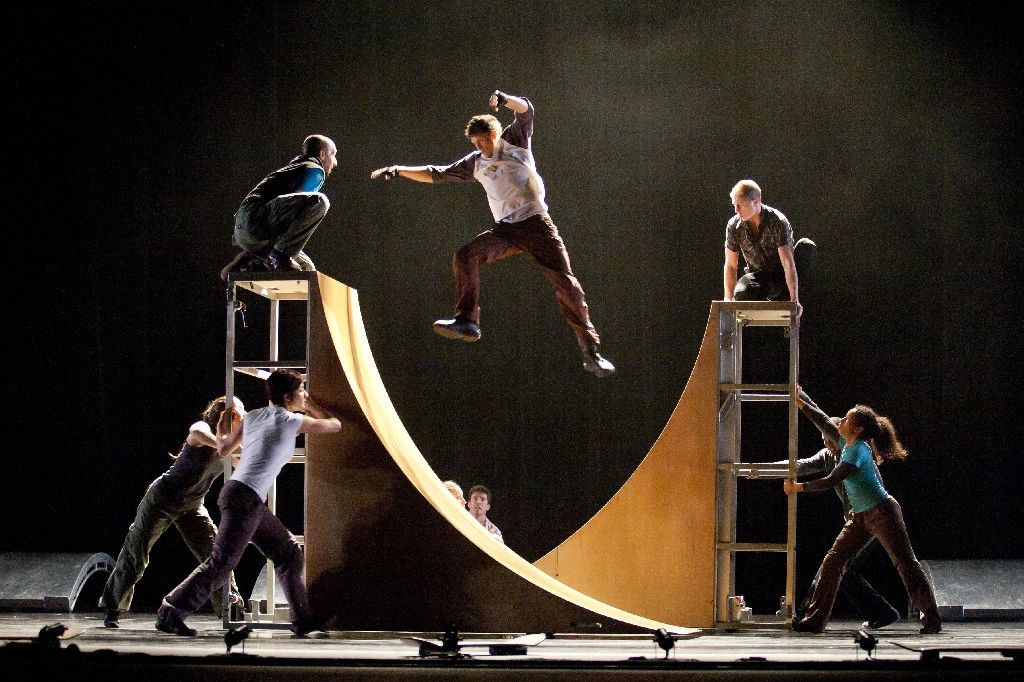
Monica’s The Broad Stage this weekend. [show closed] The piece originated at Penn State University, where the company was in residence, and grew out of a grant the campus had received, the theme of which was “the secret life of public spaces.” Inspired by the 2001 documentary Dogtown and Z-Boys, the new work is edgy and urban, culling Diavolo’s trademark intensity, energy, and connectivity to create an abstract take on the skateboarders’ world.
The title of the piece grew out of an intensive workshop at Penn State. The company had invited students from the dance, architecture, and landscape architecture departments to participate. Using skateboard ramps, students experimented with movement and afterwards discussed what they had seen and experienced. They came up with the title Transit Space—meaning the space between the physical and the mental. Says Heim: “In our life we are always in transit, whether physically or mentally, and we have to navigate between them. Skateboarders are, too—they’re always looking ahead to the next, higher ramp.
“I was always fascinated with skateboard ramps and parks and inspired by skateboard movement,” he says. “A long time ago I saw a documentary about a group of friends, all a bit rebellious. Their life was all about skateboarding, it was all ‘how can we go further.’ As soon as the group was together, there was strength and power, but individually not. Transit Space began to emerge about a group of people who can function together, who belong with one another and are trying to connect. It is not about skateboarding but about the philosophy behind it.”
 In creating the piece, the company worked with 17- and
18-year-olds. The group spoke about skateboarding and the reputation it
has for “disturbing the peace.” On the contrary, says Heim, “I would say
they are very much bringing peace within themselves.” He asked one, “Do
you worry you will get hurt?” The youngster replied, “If you worry
about everything that is going to happen, you cannot move forward in
life.”
In creating the piece, the company worked with 17- and
18-year-olds. The group spoke about skateboarding and the reputation it
has for “disturbing the peace.” On the contrary, says Heim, “I would say
they are very much bringing peace within themselves.” He asked one, “Do
you worry you will get hurt?” The youngster replied, “If you worry
about everything that is going to happen, you cannot move forward in
life.”
So, notes Heim, “They are very much Zen, at peace. There is a looseness of movement that as adults we forget about. They just have to be completely relaxed and at one with the board. With Transit Space it’s about the unit, and one individual connects with the group. To be able to function at peace with himself, to go further in life, he needs the group.”
As is usual with Heim’s artistic process, he brought in other artists to collaborate on the piece. Steve Connell, a spoken-word artist, wrote all the text, which has been recorded and intertwined with a musical score by Paul James Prendergast. Physical-interactive designers David and Valeria Beaudry created sensors that are placed in the dancers costumes; when the dancers touch their costumes at certain points, the text begins. Additionally, sensors under the skateboard-like props allow the music to start when the performers jump on. This gives a sense of immediacy that is important to Heim: “In one scene of freeways, the dancers go up ramps and there’s the sounds of cars. The audience doesn’t know about the sensors—and it’s not about the audience knowing—the point is the immediate response. A board operator will not be able to move with the speed of the dancers. Immediate response, immediate interactive movement and sound, is more real.”
Diavolo in the Details
Calling himself “the most dyslexic and un-flexible artistic director you will ever meet,” Heim says he loves the process of collaborating with his dancers. When he’s working with them, he says, he’s “extracting their minds.” For Transit Space he sent his performers home with homework: to deconstruct skateboard movement and explore other movement that used the imagery of Connell’s words, “which are layers of metaphors for connection, disconnection, going away, freeways, and getting lost not only physically but mentally.” The piece fuses everyday movement with ballet, modern dance, hip-hop, and martial arts. Added in, says Heim, are his favorite themes of chaos, borders, danger, survival, love, faith, deconstruction, and reconstruction. “That’s the company in a nutshell!”
“I am driven by passion,” says Heim. “When we watch rehearsal, I drive my dancers crazy. It’s not anger, it is passion, and I will push them physically and mentally until they cannot stand it, and then I can touch them, find their passion. Then they feel more like gladiators or heroes. They are ready to climb Everest, they are ready to fly.”
He says his efforts are not so much about the work on stage but about the dancers respecting one another, pushing one another. “It’s funny how some dance companies look at us, wondering if what we do is dance because our work is very abstract, very visual,” he says. “You can just feel the wow factor. For me it is a load of crap. For me, going to the supermarket and watching carts in the aisles is a form of dance.”
Top photo: Jacques Heim, courtesy Diavolo Dance Theater.
Middle photo: Transit Space, photo by Julie Shelton.
Bottom photo: Transit Space, photo by Michael Misciagno.
Diavolo Dance Theater brings its newest ‘modern acrobatic dance’ piece to The Broad Stage.
by Pamela Hurley Diamond
When you discover that French-born artistic director and self-proclaimed rebel-with-a-cause Jacques Heim earned his early creds as a street perfo
 rmer in Paris, dancing with friends on cars and in the subway in
what sounds like a très-cool takeoff on the movie Fame, the origin of the avant-garde architectural aesthetic that drives his Los
Angeles–based Diavolo Dance Theater becomes immediately clear.
rmer in Paris, dancing with friends on cars and in the subway in
what sounds like a très-cool takeoff on the movie Fame, the origin of the avant-garde architectural aesthetic that drives his Los
Angeles–based Diavolo Dance Theater becomes immediately clear.An early non-conformist who admits he was kicked out of several schools as a youth, Heim stayed true to himself, emigrated to America, and found a home in the dance department at Middlebury College, Vt., where he earned a BFA in theater, dance, and film, and where he discovered, “it didn’t matter that they couldn’t understand my accent.”
Speaking by cell from Holland, he continues, “It was only years later that I realized my fascination with architecture came from the streets of Paris. One was rebelling against schools and the rules of Paris. I was kicked out of six schools; it was too rigid, too exclusive. So I did a lot of performing in the streets and later realized I was connecting with the environment; I realized how fragile we are, how powerful the environment is, yet also how powerful we are.” It was at Middlebury that he fell in love with the power of movement and in California—where he received an MFA in choreography from California Institute of the Arts—where he began to experiment with space, architectural structure, and their effects on movement. “That’s how it started,” he says.
Heim formed Diavolo in 1992, and the company has been astounding audiences since with its blend of dance, drama, gymnastics, and athletics, spiced by surrealistic sets and unusual structures. Its 14 multitalented performers tackle an array of works that “explore challenges and relationships.”
The Boards at The Broad
Diavolo brings the California premiere of Transit Space to Santa

Monica’s The Broad Stage this weekend. [show closed] The piece originated at Penn State University, where the company was in residence, and grew out of a grant the campus had received, the theme of which was “the secret life of public spaces.” Inspired by the 2001 documentary Dogtown and Z-Boys, the new work is edgy and urban, culling Diavolo’s trademark intensity, energy, and connectivity to create an abstract take on the skateboarders’ world.
The title of the piece grew out of an intensive workshop at Penn State. The company had invited students from the dance, architecture, and landscape architecture departments to participate. Using skateboard ramps, students experimented with movement and afterwards discussed what they had seen and experienced. They came up with the title Transit Space—meaning the space between the physical and the mental. Says Heim: “In our life we are always in transit, whether physically or mentally, and we have to navigate between them. Skateboarders are, too—they’re always looking ahead to the next, higher ramp.
“I was always fascinated with skateboard ramps and parks and inspired by skateboard movement,” he says. “A long time ago I saw a documentary about a group of friends, all a bit rebellious. Their life was all about skateboarding, it was all ‘how can we go further.’ As soon as the group was together, there was strength and power, but individually not. Transit Space began to emerge about a group of people who can function together, who belong with one another and are trying to connect. It is not about skateboarding but about the philosophy behind it.”
 In creating the piece, the company worked with 17- and
18-year-olds. The group spoke about skateboarding and the reputation it
has for “disturbing the peace.” On the contrary, says Heim, “I would say
they are very much bringing peace within themselves.” He asked one, “Do
you worry you will get hurt?” The youngster replied, “If you worry
about everything that is going to happen, you cannot move forward in
life.”
In creating the piece, the company worked with 17- and
18-year-olds. The group spoke about skateboarding and the reputation it
has for “disturbing the peace.” On the contrary, says Heim, “I would say
they are very much bringing peace within themselves.” He asked one, “Do
you worry you will get hurt?” The youngster replied, “If you worry
about everything that is going to happen, you cannot move forward in
life.”So, notes Heim, “They are very much Zen, at peace. There is a looseness of movement that as adults we forget about. They just have to be completely relaxed and at one with the board. With Transit Space it’s about the unit, and one individual connects with the group. To be able to function at peace with himself, to go further in life, he needs the group.”
As is usual with Heim’s artistic process, he brought in other artists to collaborate on the piece. Steve Connell, a spoken-word artist, wrote all the text, which has been recorded and intertwined with a musical score by Paul James Prendergast. Physical-interactive designers David and Valeria Beaudry created sensors that are placed in the dancers costumes; when the dancers touch their costumes at certain points, the text begins. Additionally, sensors under the skateboard-like props allow the music to start when the performers jump on. This gives a sense of immediacy that is important to Heim: “In one scene of freeways, the dancers go up ramps and there’s the sounds of cars. The audience doesn’t know about the sensors—and it’s not about the audience knowing—the point is the immediate response. A board operator will not be able to move with the speed of the dancers. Immediate response, immediate interactive movement and sound, is more real.”
Diavolo in the Details
Calling himself “the most dyslexic and un-flexible artistic director you will ever meet,” Heim says he loves the process of collaborating with his dancers. When he’s working with them, he says, he’s “extracting their minds.” For Transit Space he sent his performers home with homework: to deconstruct skateboard movement and explore other movement that used the imagery of Connell’s words, “which are layers of metaphors for connection, disconnection, going away, freeways, and getting lost not only physically but mentally.” The piece fuses everyday movement with ballet, modern dance, hip-hop, and martial arts. Added in, says Heim, are his favorite themes of chaos, borders, danger, survival, love, faith, deconstruction, and reconstruction. “That’s the company in a nutshell!”
“I am driven by passion,” says Heim. “When we watch rehearsal, I drive my dancers crazy. It’s not anger, it is passion, and I will push them physically and mentally until they cannot stand it, and then I can touch them, find their passion. Then they feel more like gladiators or heroes. They are ready to climb Everest, they are ready to fly.”
He says his efforts are not so much about the work on stage but about the dancers respecting one another, pushing one another. “It’s funny how some dance companies look at us, wondering if what we do is dance because our work is very abstract, very visual,” he says. “You can just feel the wow factor. For me it is a load of crap. For me, going to the supermarket and watching carts in the aisles is a form of dance.”
September 27, 2012
Top photo: Jacques Heim, courtesy Diavolo Dance Theater.
Middle photo: Transit Space, photo by Julie Shelton.
Bottom photo: Transit Space, photo by Michael Misciagno.
Ballet Review
The Nutcracker
Los Angeles Ballet
Reviewed by Dany Margolies

Petra Conti and Tigran Sargsyan
Photo by Reed Hutchinson
In resetting the traditionally European story in Los Angeles and reorganizing Tchaikovsky’s beloved score, Los Angeles Ballet muddies rather than enhances The Nutcracker. But the Christmas ballet nonetheless remains a joyous extravaganza. Fortunately, we still get that gorgeous, lushly orchestrated and memorably melodic music, danced by performers who look genuinely happy to be onstage and giving joy.
Let’s commend choreographers Thordal Christensen and Colleen Neary for keeping the score’s overture unadorned—no dancing, no visuals, just time for the audience to settle into the seasonal magic. Then we see young Clara (Cleo Taneja), playing with three dolls as she imagines being a ballerina. Her friends don’t get this girl with big dreams. But dream she does.
Her parents host a party in their spacious drawing room (scenic design by Catherine Kanner). Mrs. Staulbaum (Chelsea Paige Johnston) is as pretty as expected, but Mr. Staulbaum (Eris Nezha) is an unexpected hoot as he reacts to the many goings-on around him.
Tots in the audience will watch the envy-inducing children onstage, in Edwardian party attire and performing pretty little dances. They’re led by Fritz (Zachary Li), who’s Clara’s little brother and ballet’s youngest miscreant. Maids and butlers dance alongside snooty guests—which we know from Julian Fellowes wouldn’t actually happen in those days. Speaking of Downton Abbey, milliners must have been working in fevered states to create hats for the Staulbaum guests to rival those of Maggie Smith (Nutcracker costumes designed by Mikael Melbye).
Uncle Drosselmeyer (Zheng Hua Li) arrives. In most versions he troublingly creeps around the younger guests, but happily here he casts his flirtatious eye on the pretty moms as he sweeps by in his long grey fur coat. He presents three life-size dolls he has magicked to dance. Harlequin (Akimitsu Yahata) and Columbine (Alyssa Harrington) are sweet. But jaws drops when the Cossack Doll (Jeongkon Kim) takes center stage. Kim has huge, light jumps—unexpected for a man of his height, more associated with stocky dancers.
And then Drosselmeyer gives Clara a life-size nutcracker, who fascinates Clara. The guests depart. Clara is put to bed with her favorite doll, Marie. The Nutcracker is propped up nearby. The lighting darkens (Penny Jacobus and Tyler Lambert-Perkins), the music darkens, and giant mice creep out, one daring to perch on Clara’s bed. Fortunately, Fritz’s toy soldiers (the children from the party) come to life and battle the mice.
Honestly, who throws a shoe? Clara does, helping her Nutcracker vanquish the Mouse King (Joshua Brown). The Nutcracker is in fact a sweet-faced boy (Joshua Schwartz). Schwartz shows well-schooled technique, crisp clear mime, and perhaps the kindest, most genuine, most heartfelt smile ever seen on a ballet stage.
Drosselmeyer now wears a floor-length white fur coat, turning him into a blend of Winter Warlock and Liberace. He takes Clara and the Nutcracker to the Land of Snow. He’s pushing their sleigh, so it’s probably no farther than Angeles Crest Highway. But we forget practicalities while 12 corps members display refined musicality and immense discipline in creating the clean lines and dizzying patterns of Waltz of the Snowflakes. So far, the story pretty much hews to traditional Nutcrackers.

Bianca Bulle as the rose in a garden of sunflowers
Photo by Reed Hutchinson
Then comes Act 2. The red, white and black color scheme of the first act gives way to warm adobe tones, and we’re in a palacio, or perhaps on Olvera Street. Seated around the stage are Russian, Arabian and Spanish dancers, life-size sunflowers, and the Harlequins from Act 1. Clara’s beloved doll Marie has come to life (classically flawless Petra Conti), substituted for the more traditional Sugar Plum Fairy. She and her Prince (Tigran Sargsyan) watch as Clara and the Nutcracker recap Act 1’s grand battle.
Two Heralds (Ugo Cirri, David Renaud), or pashas, or peons, host the festive dance-off. Without reference to other Nutcrackers, it’s probably hard to tell what’s going on. Few of the dances acknowledge Clara and the Nutcracker watching from the sidelines.
But we have the hoped-for return of the spectacular Kim as the head Russian Dancer, accompanied by two agile, bounding comrades (Dallas Finley, Costache Mihai). Music for The Chinese Dance, or Tea, is given over to the Harlequins. Is this a political boycott, or are the customary Chinese characters more racist than the Russians, Arabians (Jasmine Perry, Brown) or Spaniards (Laura Chachich, Magnus Christoffersen, Madeline Houk, Clay Murray)?
The original Sugar Plum choreography by Marius Petipa and Lev Ivanov remains, though Christensen and Neary moved the two solo variations from the pas de deux to the top of Act 2, keeping the Adagio in its place near the ballet’s end but omitting the vibrant Coda. Also excised is the Dance of the Reed Pipes, along with any of the ballet’s subtext, leaving it scrupulously sanitized.
The corps of sunflowers, though dancing Waltz of the Flowers beautifully, looks pallid behind the Rose (traditionally the Dew Drop Fairy), who actually looks more like a sweet pea (sturdily elegant Bianca Bulle).
Still and all, this Nutcracker is bound to satisfy our need to annually hear the glorious score and watch the panoply of fine dancers, from tiny through veteran, who graciously welcome us into this ballet, ultimately about our biggest dreams.
November 26, 2018
Published with kind permission of Los Angeles Daily News.
Ballet Review
Romeo & Juliet
Joffrey Ballet at Dorothy Chandler Pavilion
Reviewed by Dany Margolies

Photo by Cheryl Mann
To see astonishingly good dancing, one need go no farther than the Dorothy Chandler Pavilion this week, where the Joffrey Ballet brings its latest incarnation of Romeo & Juliet.
Many choreographers have taken on Shakespeare’s text to create a ballet about teen love and age-old hatreds, about heated violence and icy intransigence. Most if not all these choreographers have used Sergei Prokofiev’s lush, textural, programmatic score, as does this one. In the mid-1980s the Joffrey, then of New York, danced choreographer John Cranko’s version of the ballet. Now of Chicago, the Joffrey has taken on Krzysztof Pastor’s choreography.
Though the women dance en pointe, in toe shoes, the style is contemporary, only occasionally dipping into classical ballet steps. This should give Pastor much more movement to work with. But somehow all the characters seem to “speak” in the same vocabulary. So, with one exception, it’s up to the costuming and to the dancers’ acting skills to let the audience in on who’s who and what’s what.
What Pastor tells the audience about Juliet’s parents, the Capulets, is fascinating. Lord Capulet is chillingly controlling and, danced by the very tall Fabrice Calmels, is brutishly threatening. Lady Capulet, here called “His Wife” as if mere chattel, is almost certainly abused by him; danced by April Daly, she pours her love into dressing her infantilized daughter. (Juliet’s Nurse doesn’t appear in this version.) This family dynamic, perhaps better than even Shakespeare’s text, explains why otherwise brave little Juliet, given irrepressible self-confidence here by Christine Rocas, can’t talk to her parents about Romeo Montague, danced with an almost genteel shyness and dignity by Rory Hohenstein.
The remainder of Pastor’s narrative is muddled and confusing. Further, Pastor uses no mime, removing the traditional ways the story is conveyed to balletomanes.

Rory Hohenstein and Temur-Suluasvhili
Photo by Cheryl Mann
Pastor’s first act takes place in 1930s Italy. Of course that’s Mussolini’s era and the decade in which Prokofiev wrote the score. Across a crowded plaza comes a tall, stately man in a black waistcoat and tails. Surely he must be the Prince. It takes awhile to realize he is Lord Capulet.
Act 2 takes place in the political unrest of 1950s Italy, though the characters haven’t aged and wear the same clothes. Romeo and Juliet marry, though the audience is clued in only by the Friar Lawrence’s (Dylan Gutierrez) sign of the cross.
Costuming (Tatyana Van Walsum, who also designed the sparse but visually striking sets) includes taffeta dirndl skirts for the townswomen and suits for the men in the first two acts, then briefly introduces grunge for the third-act 1990s. But the set relies on the audience’s knowledge of the play, particularly that Juliet is left in the family crypt, where Romeo finds her. And then the Montagues and the Capulets carry their dead son and daughter off in different directions, and no one seems to have learned a thing.
The choreography includes hand-to-hand combat, including arm bars that, if not perfectly rehearsed as they are here, could go wrong. Indeed, most of the fighting looks real and rough. The dour Tybalt (Temur Suluashvili) needs a blade to kill the impish Mercutio (Yoshihisa Arai); here Lord Capulet slips him a knife.
So it’s left to the dancing to thrill the audience here. And thrill it does. The ensemble is uniform in skill and style and looks as if any of its members could be a principal dancer elsewhere. The principals here are steely strong yet have gorgeously fluid technique, clearly schooled in Pastor’s style. See this production for the dance technique. But if you’re at all interested in story and storytelling, other choreographers’ versions of the “story of woe” are far more compelling.
March 12, 2018
Republished courtesy of Los Angeles Daily News
Ballet Review
L.A. Ballet’s all-Balanchine program
Various Los Angeles venues
Reviewed by Dany Margolies

The dancers of Divertimento No. 15
Those who talk ballet often refer to the Balanchine style. Los Angeles Ballet’s current offering magnificently reminds us that choreographer George Balanchine (1904–1983) created in many styles.
Born and schooled in Russia, Balanchine came to America in 1933, soon founding the School of American Ballet and New York City Ballet. Trained in the strict traditions of the Imperial Ballet in Russia, given freedom to break rules in an America that was a haven for artistic rule breakers, Balanchine pushed classical lines and rhythms into what we now call “modern” and “jazz” forms.
Los Angeles Ballet’s mixed-bill program, running through March, features three one-acts: an abstract tribute to the Imperial style, an early forerunner of modern-dance storytelling and an homage to American musicals.
The jewel in this crown is Prodigal Son, Balanchine’s depiction of the Biblical parable, set to music by Sergei Prokofiev. Patricia Neary stages this 1929 ballet for LAB, using Georges Rouault’s set and costume designs from the ballet’s 1950 revival.
Unlike many Balanchine ballets, which are usually abstract, this one clearly tells a story, of a wild restless lad (Kenta Shimizu) who cannot wait to leave his father’s (Zheng Hua Li) control and see what the world has to offer. The Prodigal Son gets an eyeful out there.
His Drinking Companions are false friends. They lure him into too much boozing and very bendy adventures with the very tall Siren (Elizabeth Claire Walker). Playing those louts, the male corps de ballet thoroughly commits to the grotesque movements
—to their, and the audience’s, extreme glee.
If you take your young child to this evening of dance, you might have to explain your fellow adults’ tittering reactions to the unambiguous gymnastics of the Siren and the Son. On the other hand, it teaches the young ones a painless lesson about the wear-and-tear extreme depravity causes.
Shimizu is all emotion, so no mime is needed here, nor does stager Colleen Neary re-impose any from various early revivals. So we don’t need to see Shimizu kiss the ground to feel how grateful this Son is to come home, to know how much he regrets dabbling in debauchery, to understand his hope for forgiveness.
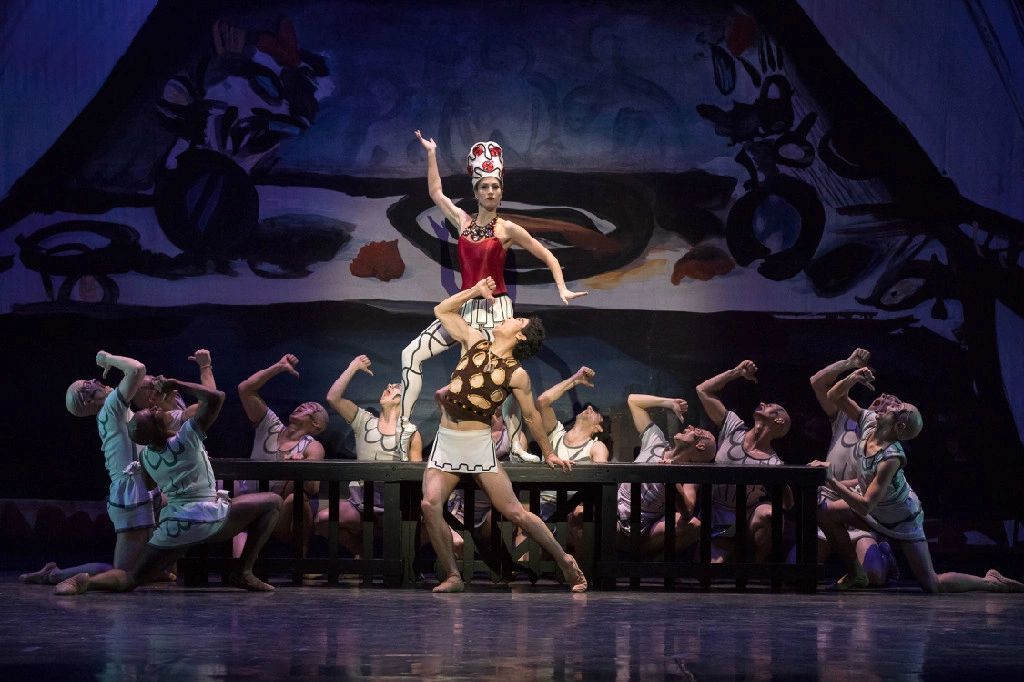
Kenta Shimizu and Elizabeth Claire Walker in Prodigal Son
Two days prior, the company lost one of its two principal ballerinas to an injury. Lia Cirio, a principal with Boston Ballet, flew in to heroically replace the injured Allyssa Bross. This may have led to the distractions and strain visible onstage. A ballerina’s slip was the first evidence of tension, followed by stiffness in a few corps members.
Cirio is a vibrant dancer and a good soul for helping out a company in need across the country. Her style, however, with the exaggerated limbs sometimes (perhaps wrongly) associated with Balanchine, contrasts with what LAB co–Artistic Director Colleen Neary had developed in her company: a stately, more-classical demeanor. But this unshowiness too often translated as lacking performing fire.
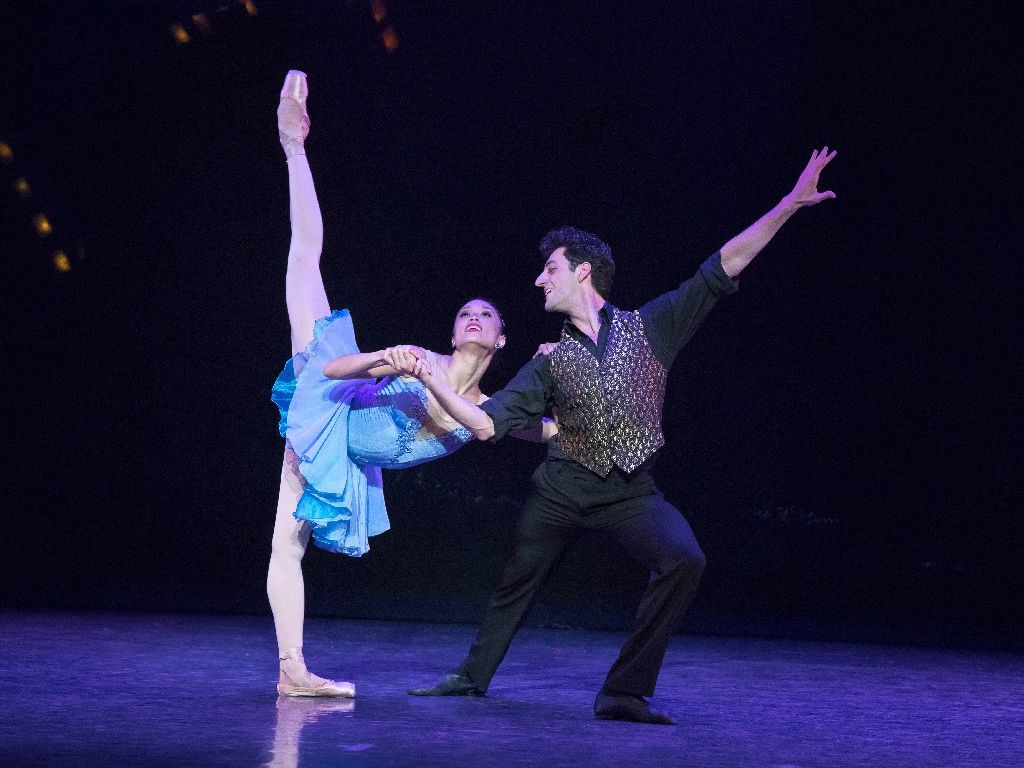
Lia Cirio and Tigran Sarsgyan in Who Cares?
Who Cares? closes the show. Though choreographed in 1970, it captures the newness and excitement of jazz in its early years. Set to music by George Gershwin, the 12 dances here celebrate the syncopations and contrasting rhythms of the musical form, plus the sensuality and off-balance dance style that once made jazz seem dangerous.
That contained, purposeful danger was mostly absent on opening night, replaced by a near complacency that felt as if the dancers had settled for learning the steps. They learned them well, and there were moments of lovely synchronization among the corps.
But only two dancers brought excitement to the stage. Julia Cinquemani shows sultriness and musicality in her solo, “Fascinatin’ Rhythm,” and pairs perfectly with Tigran Sargsyan for “The Man I Love.”
He then partners Cirio for “Embraceable You” and Bianca Bulle for “Who Cares?” And then he takes his solo, “Liza,” displaying all the hoped-for jazziness and a musicality that toys delightfully with the music. At last, who could ask for anything more?
L.A. Ballet’s all-Balanchine program
Various Los Angeles venues
Reviewed by Dany Margolies

The dancers of Divertimento No. 15
Photo by Reed Hutchinson/
Los Angeles Ballet
Los Angeles Ballet
Those who talk ballet often refer to the Balanchine style. Los Angeles Ballet’s current offering magnificently reminds us that choreographer George Balanchine (1904–1983) created in many styles.
Born and schooled in Russia, Balanchine came to America in 1933, soon founding the School of American Ballet and New York City Ballet. Trained in the strict traditions of the Imperial Ballet in Russia, given freedom to break rules in an America that was a haven for artistic rule breakers, Balanchine pushed classical lines and rhythms into what we now call “modern” and “jazz” forms.
Los Angeles Ballet’s mixed-bill program, running through March, features three one-acts: an abstract tribute to the Imperial style, an early forerunner of modern-dance storytelling and an homage to American musicals.
The jewel in this crown is Prodigal Son, Balanchine’s depiction of the Biblical parable, set to music by Sergei Prokofiev. Patricia Neary stages this 1929 ballet for LAB, using Georges Rouault’s set and costume designs from the ballet’s 1950 revival.
Unlike many Balanchine ballets, which are usually abstract, this one clearly tells a story, of a wild restless lad (Kenta Shimizu) who cannot wait to leave his father’s (Zheng Hua Li) control and see what the world has to offer. The Prodigal Son gets an eyeful out there.
His Drinking Companions are false friends. They lure him into too much boozing and very bendy adventures with the very tall Siren (Elizabeth Claire Walker). Playing those louts, the male corps de ballet thoroughly commits to the grotesque movements
—to their, and the audience’s, extreme glee.
If you take your young child to this evening of dance, you might have to explain your fellow adults’ tittering reactions to the unambiguous gymnastics of the Siren and the Son. On the other hand, it teaches the young ones a painless lesson about the wear-and-tear extreme depravity causes.
Shimizu is all emotion, so no mime is needed here, nor does stager Colleen Neary re-impose any from various early revivals. So we don’t need to see Shimizu kiss the ground to feel how grateful this Son is to come home, to know how much he regrets dabbling in debauchery, to understand his hope for forgiveness.

Kenta Shimizu and Elizabeth Claire Walker in Prodigal Son
Photo by Reed Hutchinson/
Los Angeles Ballet
The program opens with Divertimento No. 15 Divertimento No. 15, Balanchine’s take on 18th-century courtliness, set to music by Mozart. Balanchine choreographed the piece in 1956, seeming to look back fondly at his Russian roots. Understated elegance is the style here. Still, the piece needs undercurrents of energy, other than opening-night nerves.Los Angeles Ballet
Two days prior, the company lost one of its two principal ballerinas to an injury. Lia Cirio, a principal with Boston Ballet, flew in to heroically replace the injured Allyssa Bross. This may have led to the distractions and strain visible onstage. A ballerina’s slip was the first evidence of tension, followed by stiffness in a few corps members.
Cirio is a vibrant dancer and a good soul for helping out a company in need across the country. Her style, however, with the exaggerated limbs sometimes (perhaps wrongly) associated with Balanchine, contrasts with what LAB co–Artistic Director Colleen Neary had developed in her company: a stately, more-classical demeanor. But this unshowiness too often translated as lacking performing fire.

Lia Cirio and Tigran Sarsgyan in Who Cares?
Photo by Reed Hutchinson/
Los Angeles Ballet
Los Angeles Ballet
Who Cares? closes the show. Though choreographed in 1970, it captures the newness and excitement of jazz in its early years. Set to music by George Gershwin, the 12 dances here celebrate the syncopations and contrasting rhythms of the musical form, plus the sensuality and off-balance dance style that once made jazz seem dangerous.
That contained, purposeful danger was mostly absent on opening night, replaced by a near complacency that felt as if the dancers had settled for learning the steps. They learned them well, and there were moments of lovely synchronization among the corps.
But only two dancers brought excitement to the stage. Julia Cinquemani shows sultriness and musicality in her solo, “Fascinatin’ Rhythm,” and pairs perfectly with Tigran Sargsyan for “The Man I Love.”
He then partners Cirio for “Embraceable You” and Bianca Bulle for “Who Cares?” And then he takes his solo, “Liza,” displaying all the hoped-for jazziness and a musicality that toys delightfully with the music. At last, who could ask for anything more?
Ballet Review
Frederick Ashton’s Romeo and Juliet
Los Angeles Ballet, reviewed at Alex Theatre
Reviewed by Dany Margolies

Allyssa Bross as Juliet and Kenta Shimizu as Romeo
A sculptor shapes material into a tangible object. A good sculptor can add a story to the object. A great sculptor can add emotion and purpose. So it is with a choreographer who puts ballet steps together, occasionally adding nonballetic movement, to give the steps interest and make the dancing fit its music. A good choreographer tells a story without spoken words. A genius makes movement reveal emotion and subtext.
What do we have in the case of Frederick Ashton and his version of Romeo and Juliet? Los Angeles Ballet closes out its 10th anniversary season this month by being the first American company to perform the British choreographer’s ballet, which was originally set on the Royal Danish Ballet in 1955. That’s enough of a coup to merit the attention of local balletomanes.
So is most of the dancing here. Staged by Peter Schaufuss, it’s certainly technically clean and pliable. But Ashton’s telling of Shakespeare’s star-crossed lovers is not as narratively strong as other choreographers’ versions of the story—for example, the more familiar one by Kenneth MacMillan.
The major characters are here. But Ashton doesn’t establish each by movement alone, nor does he give the characters a chance to grow. Juliet fares best, going from impetuous child to love-struck teen to despondent bride. Romeo, however, remains a cipher.
That can’t be the fault of Kenta Shimizu, who dances the role of Romeo. Shimizu has proven himself a fine actor in the season’s previous ballets. Allyssa Bross, who dances Juliet here, gives her finest interpretation of the season, as her Juliet grows dramatically from impetuous child to desperate wife.
The two teens take a quick first look at each other at the Capulets’s ball, and then Romeo whisks Juliet offstage, twice, where, presumably, the more-interesting interactions between them are taking place. There’s no balcony in the iconic balcony scene. They hook up on the terrace, no hesitation, no persuasion. There is no foreshadowing. There is, however, necking, which might be a modern intercalation into the choreography.

Magnus Christoffersen as Benvolio, Kenta Shimizu as Romeo, and Luke Shaufuss as Mercutio, with Los Angeles Ballet Ensemble
As in other versions, a floppy-haired Mercutio gambols (Luke Schaufuss), a sleek Tybalt preens (Zheng Hua Li), Lady Capulet rages, Lord Capulet terrorizes. But Benvolio, the Nurse, and Friar Laurence must pretty much depend on their costumes to reveal who they are. As so often the case in this ballet, no matter the version, Paris is extremely tall and extremely handsome, and no more so than danced here by Erik Thordal-Christensen. And though Paris is a cool cookie, it makes one wonder why Juliet never gives him a second glance.
But the dancing is quite good throughout. The choreography was created for the Danes, who have been schooled in the Bournonville style, which consists mostly of petit allegro: light, quick, bounding steps that here change direction midway, as do turns. Some of it looks fiendishly difficult, and the dancers give it a deceptive effortlessness. But the men’s committed swordplay ups the adrenaline.
The corps, particularly the sextet of Juliet’s friends, is remarkably disciplined. One can see why this is so, watching the company’s artistic directors, Colleen Neary and Thordal Christensen, in the fervid roles of the Capulets. If Neary’s Lady Capulet so vehemently berates Romeo for slaying Tybalt, imagine what Neary does when one of her ballerinas slips out of epaulement.
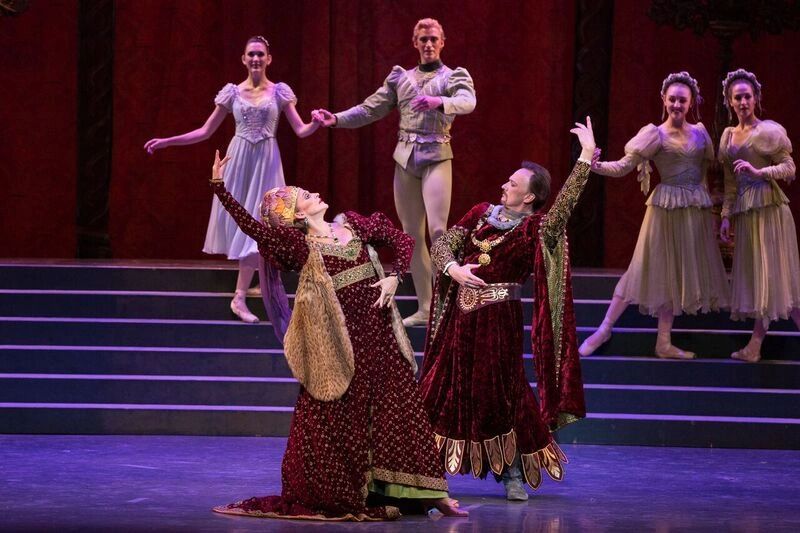
At front, Colleen Neary and Thordal Christensen as the Capulets; at rear, Allyssa Bross as Juliet and Erik Thordal-Christensen as Paris
It’s noteworthy that over the years so many versions of the choreography, from so many nations and in so many styles, have relied on a single score, by Sergei Prokofiev. Ballet scores don’t get more programmatic nor more impassioned. It’s prerecorded here, but the Christensens chose, or pieced together, a lovely recording of it.
The Christensens and Schaufuss also stage the ballet with two 20-minute intermissions.
Republished courtesy of Los Angeles Daily News
Frederick Ashton’s Romeo and Juliet
Los Angeles Ballet, reviewed at Alex Theatre
Reviewed by Dany Margolies

Allyssa Bross as Juliet and Kenta Shimizu as Romeo
A sculptor shapes material into a tangible object. A good sculptor can add a story to the object. A great sculptor can add emotion and purpose. So it is with a choreographer who puts ballet steps together, occasionally adding nonballetic movement, to give the steps interest and make the dancing fit its music. A good choreographer tells a story without spoken words. A genius makes movement reveal emotion and subtext.
What do we have in the case of Frederick Ashton and his version of Romeo and Juliet? Los Angeles Ballet closes out its 10th anniversary season this month by being the first American company to perform the British choreographer’s ballet, which was originally set on the Royal Danish Ballet in 1955. That’s enough of a coup to merit the attention of local balletomanes.
So is most of the dancing here. Staged by Peter Schaufuss, it’s certainly technically clean and pliable. But Ashton’s telling of Shakespeare’s star-crossed lovers is not as narratively strong as other choreographers’ versions of the story—for example, the more familiar one by Kenneth MacMillan.
The major characters are here. But Ashton doesn’t establish each by movement alone, nor does he give the characters a chance to grow. Juliet fares best, going from impetuous child to love-struck teen to despondent bride. Romeo, however, remains a cipher.
That can’t be the fault of Kenta Shimizu, who dances the role of Romeo. Shimizu has proven himself a fine actor in the season’s previous ballets. Allyssa Bross, who dances Juliet here, gives her finest interpretation of the season, as her Juliet grows dramatically from impetuous child to desperate wife.
The two teens take a quick first look at each other at the Capulets’s ball, and then Romeo whisks Juliet offstage, twice, where, presumably, the more-interesting interactions between them are taking place. There’s no balcony in the iconic balcony scene. They hook up on the terrace, no hesitation, no persuasion. There is no foreshadowing. There is, however, necking, which might be a modern intercalation into the choreography.

Magnus Christoffersen as Benvolio, Kenta Shimizu as Romeo, and Luke Shaufuss as Mercutio, with Los Angeles Ballet Ensemble
As in other versions, a floppy-haired Mercutio gambols (Luke Schaufuss), a sleek Tybalt preens (Zheng Hua Li), Lady Capulet rages, Lord Capulet terrorizes. But Benvolio, the Nurse, and Friar Laurence must pretty much depend on their costumes to reveal who they are. As so often the case in this ballet, no matter the version, Paris is extremely tall and extremely handsome, and no more so than danced here by Erik Thordal-Christensen. And though Paris is a cool cookie, it makes one wonder why Juliet never gives him a second glance.
But the dancing is quite good throughout. The choreography was created for the Danes, who have been schooled in the Bournonville style, which consists mostly of petit allegro: light, quick, bounding steps that here change direction midway, as do turns. Some of it looks fiendishly difficult, and the dancers give it a deceptive effortlessness. But the men’s committed swordplay ups the adrenaline.
The corps, particularly the sextet of Juliet’s friends, is remarkably disciplined. One can see why this is so, watching the company’s artistic directors, Colleen Neary and Thordal Christensen, in the fervid roles of the Capulets. If Neary’s Lady Capulet so vehemently berates Romeo for slaying Tybalt, imagine what Neary does when one of her ballerinas slips out of epaulement.

At front, Colleen Neary and Thordal Christensen as the Capulets; at rear, Allyssa Bross as Juliet and Erik Thordal-Christensen as Paris
It’s noteworthy that over the years so many versions of the choreography, from so many nations and in so many styles, have relied on a single score, by Sergei Prokofiev. Ballet scores don’t get more programmatic nor more impassioned. It’s prerecorded here, but the Christensens chose, or pieced together, a lovely recording of it.
The Christensens and Schaufuss also stage the ballet with two 20-minute intermissions.
May 9, 2016
Photos by Reed HutchinsonRepublished courtesy of Los Angeles Daily News
Ballet Review
Giselle
Los Angeles Ballet at Redondo Beach Performing Arts Center
Reviewed by Dany Margolies
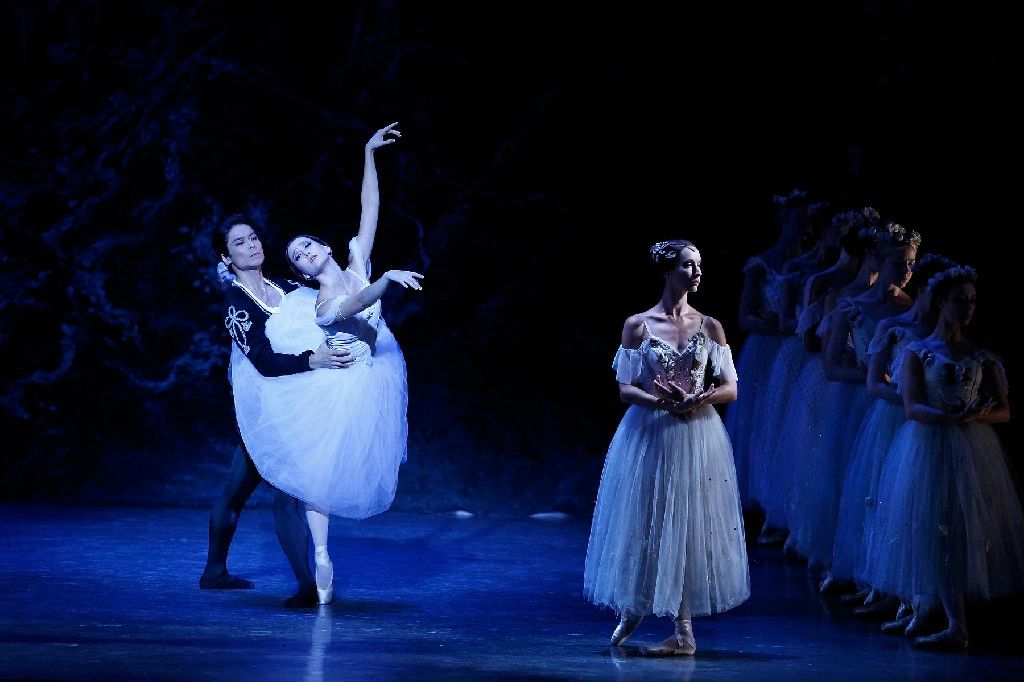
Allyssa Bross, Kenta Shimizu, and Kate Highstrete
Perfection is a goal rarely, if ever, reached in ballet. Opening Los Angeles Ballet’s 10th season, this production of Giselle strives for perfection and momentarily nears it, though not in all the right places.
This ballet, with music by Adolphe Adam, was first choreographed in 1841 by Jean Coralli and Jules Perrot, and later revived and restaged in the early 20th century by Marius Petipa. Here, Los Angeles Ballet co–artistic directors Colleen Neary and Thordal Christensen honor this traditional version, with minor changes that improve the storytelling and focus on the main characters.
Giselle tells the story of the naive young country girl seduced by a man and left brokenhearted. The man, Albrecht, at first pretends to be of her class, but over the course of Act 1 she learns he is of the nobility and betrothed to a princess. Giselle goes mad and dies. Act 2 finds her spirit haunting her grave along with the Wilis — the spirits of other girls jilted before their wedding days. Albrecht, now a broken man, visits and sees her spirit. But the vengeful queen of the Wilis, Myrtha, condemns him to death by exhaustion. Giselle’s purity won’t let her feel vengeance, so she keeps him alive until daybreak, when the power of the Wilis over him dissipates.
The power of the Wilis over the audience doesn’t dissipate, even a day after the ballet’s opening performance at Redondo Beach Performing Arts Center. This company’s corps de ballet is uniform in line and musicality. So the ballet’s iconic moments—such as the Wilis’ long series of balletic chugs in arabesque across the stage—reflect the depth of the company’s skills.
Kenta Shimizu, whose Prince in Los Angeles Ballet’s The Sleeping Beauty early this year was a pure-hearted soul open to the chance for true love, hints here from his first entrance that his Albrecht is, in current parlance, a jerk. That’s no slight task, given the constraints of a 19th-century Romantic ballet, but Shimizu is a gifted storyteller, above and beyond his beautifully schooled ballet technique. When he first sees Giselle’s grave, he visibly sickens.
Dancing the role of Giselle, Allyssa Bross is a powerhouse. She needs to be to last through this demanding ballet. Unlike many in the ballet canon, “Giselle” doesn’t give its ballerina a cavalier who hoists her jumps and rights her turns. But Giselle is of the air, and Bross is of the earth, and this isn’t the best role for Bross. Particularly in Act 1, the role calls for light bouncy jumps, and ballon is not Bross’s strength. This becomes further apparent when Julia Cinquemani takes on Act 1’s Peasant Pas de Deux and silently and elegantly lands her jumps.
Dancing the role of Myrtha, Kate Highstrete likewise has strength. But she’s expressionless. Myrtha, too, was betrayed by a faithless man, yet Highstrete reflects no avenging fury, nor glee nor even a bit of regret. Balletic mime and character work are clear and energized, however, in the hands of Alexander Castillo as Hilarion, who loves and then mourns Giselle; Neary as Giselle’s mother, who worries for her daughter’s emotionally and physically fragile heart; and Chelsea Paige Johnston, as Albrecht’s equally betrayed but infinitely sturdier fiancée.
For those who didn’t grow up with ballet, or for those who did but now can look at its storytelling objectively, we must let its quirks wash over us. No one would in reality believe that Giselle could go through the Kübler-Ross stages of grief in 64 bars of music, before she collapses (no self-stabbing here) and dies. Nor would anyone understand why, when sentenced to dance, Albrecht chooses for his moves 32 consecutive entrechats (vertical jumps in which the turned-out legs swap places, which Shimizu accomplishes without a wiggled hip). But great traditions continue, and Los Angeles Ballet reflects a respectful devotion to them.
Scenery and costumes here are credited to The National Ballet of Canada. The music is recorded. The overture is taken, or electronically sped up, at a brisk clip. But in a preshow speech, Neary noted that the company “dreams” of the “honor and privilege to have an orchestra.”
Giselle
Los Angeles Ballet at Redondo Beach Performing Arts Center
Reviewed by Dany Margolies

Allyssa Bross, Kenta Shimizu, and Kate Highstrete
Photo by Reed Hutchinson
Perfection is a goal rarely, if ever, reached in ballet. Opening Los Angeles Ballet’s 10th season, this production of Giselle strives for perfection and momentarily nears it, though not in all the right places.
This ballet, with music by Adolphe Adam, was first choreographed in 1841 by Jean Coralli and Jules Perrot, and later revived and restaged in the early 20th century by Marius Petipa. Here, Los Angeles Ballet co–artistic directors Colleen Neary and Thordal Christensen honor this traditional version, with minor changes that improve the storytelling and focus on the main characters.
Giselle tells the story of the naive young country girl seduced by a man and left brokenhearted. The man, Albrecht, at first pretends to be of her class, but over the course of Act 1 she learns he is of the nobility and betrothed to a princess. Giselle goes mad and dies. Act 2 finds her spirit haunting her grave along with the Wilis — the spirits of other girls jilted before their wedding days. Albrecht, now a broken man, visits and sees her spirit. But the vengeful queen of the Wilis, Myrtha, condemns him to death by exhaustion. Giselle’s purity won’t let her feel vengeance, so she keeps him alive until daybreak, when the power of the Wilis over him dissipates.
The power of the Wilis over the audience doesn’t dissipate, even a day after the ballet’s opening performance at Redondo Beach Performing Arts Center. This company’s corps de ballet is uniform in line and musicality. So the ballet’s iconic moments—such as the Wilis’ long series of balletic chugs in arabesque across the stage—reflect the depth of the company’s skills.
Kenta Shimizu, whose Prince in Los Angeles Ballet’s The Sleeping Beauty early this year was a pure-hearted soul open to the chance for true love, hints here from his first entrance that his Albrecht is, in current parlance, a jerk. That’s no slight task, given the constraints of a 19th-century Romantic ballet, but Shimizu is a gifted storyteller, above and beyond his beautifully schooled ballet technique. When he first sees Giselle’s grave, he visibly sickens.
Dancing the role of Giselle, Allyssa Bross is a powerhouse. She needs to be to last through this demanding ballet. Unlike many in the ballet canon, “Giselle” doesn’t give its ballerina a cavalier who hoists her jumps and rights her turns. But Giselle is of the air, and Bross is of the earth, and this isn’t the best role for Bross. Particularly in Act 1, the role calls for light bouncy jumps, and ballon is not Bross’s strength. This becomes further apparent when Julia Cinquemani takes on Act 1’s Peasant Pas de Deux and silently and elegantly lands her jumps.
Dancing the role of Myrtha, Kate Highstrete likewise has strength. But she’s expressionless. Myrtha, too, was betrayed by a faithless man, yet Highstrete reflects no avenging fury, nor glee nor even a bit of regret. Balletic mime and character work are clear and energized, however, in the hands of Alexander Castillo as Hilarion, who loves and then mourns Giselle; Neary as Giselle’s mother, who worries for her daughter’s emotionally and physically fragile heart; and Chelsea Paige Johnston, as Albrecht’s equally betrayed but infinitely sturdier fiancée.
For those who didn’t grow up with ballet, or for those who did but now can look at its storytelling objectively, we must let its quirks wash over us. No one would in reality believe that Giselle could go through the Kübler-Ross stages of grief in 64 bars of music, before she collapses (no self-stabbing here) and dies. Nor would anyone understand why, when sentenced to dance, Albrecht chooses for his moves 32 consecutive entrechats (vertical jumps in which the turned-out legs swap places, which Shimizu accomplishes without a wiggled hip). But great traditions continue, and Los Angeles Ballet reflects a respectful devotion to them.
Scenery and costumes here are credited to The National Ballet of Canada. The music is recorded. The overture is taken, or electronically sped up, at a brisk clip. But in a preshow speech, Neary noted that the company “dreams” of the “honor and privilege to have an orchestra.”
October 4, 2015
Ballet Review
The Sleeping Beauty
Los Angeles Ballet at Redondo Beach Performing Arts Center
Reviewed by Dany Margolies
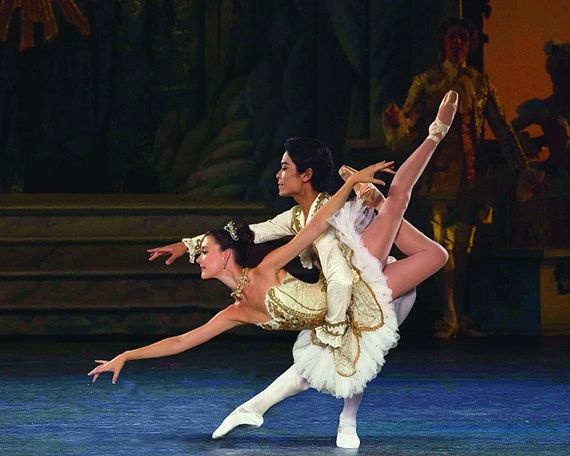
Allyssa Bross and Kenta Shimizu
Two fairy tales took place onstage when Los Angeles Ballet premiered its Sleeping Beauty this weekend. One was scripted, telling the classic story of a princess destined to sleep for one hundred years until awakened by a prince’s kiss. The other was about a ballerina who didn’t come alive until a prince of a dancer took her in his capable arms.
Los Angeles Ballet’s brand-new version of the balletis a sumptuous affair, with sets borrowed from Boston Ballet, designed by Royal Ballet’s David Walker. For the most part, it also boasts elegant, disciplined dancing—from its leads through the corps de ballet.
In the ballet’s Prologue, the King and Queen host the christening of their daughter, Princess Aurora. Fairies endow the baby with their qualities, including joy, generosity, and eloquence.
But the royals neglected to invite the evil fairy Carabosse. She comes unbidden, announcing that on Aurora’s 16th birthday the princess will prick herself with a poisoned spindle and die. The fairy of wisdom, the Lilac Fairy, cannot undo the curse, but she can soften it so that Aurora will merely sleep, to be awakened only by a prince’s kiss.
Act One takes place at Aurora’s 16th birthday party. And yes, here the pause between the Prologue and this act felt nearly that long, though it’s presumably needed for costume changes. But it’s a chance to listen undistractedly to Tchaikovsky’s exquisite music—prerecorded here, the production’s only major disappointment.
At the party, Aurora must select her prospective husband from among four princes. Instead, she accidentally pricks her finger, and she and the entire court fall into a deep sleep.
In Act Two, the Lilac Fairy comes upon Prince Désiré, who, unlike his friends, is open to the goodness and wisdom around him. The Lilac Fairy thus shows him a vision of Aurora, whom he pledges to rescue. Act Three celebrates the wedding of this pair.
Choreography, by company artistic directors Thordal Christensen and Colleen Neary, hews to the 1890 Russian original by Marius Petipa but reconfigures the corps dances, nonetheless with beautiful 19th-century sensibilities, to suit the makeup of the company.
And that makeup is top drawer. The female corps members are of identical height and build, with evenly matched technique and musicality, so the ensemble work is mesmerizingly uniform and together. Even the children appearing onstage as pages and peasants are focused and stageworthy.
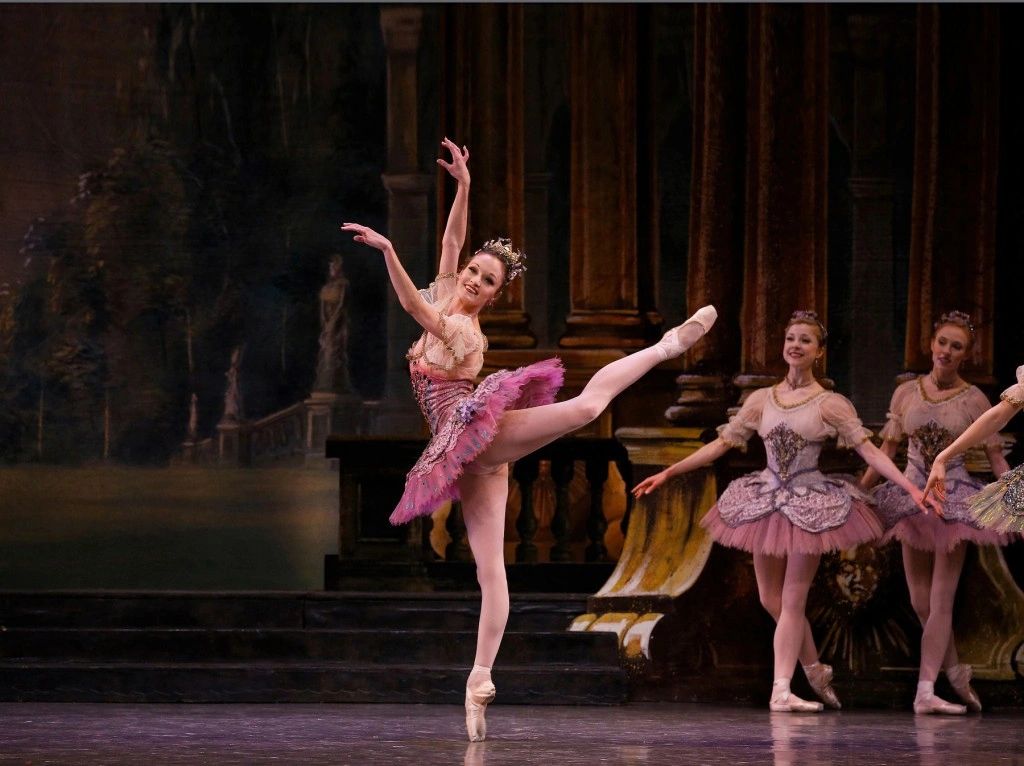
Allynne Noelle
At the acme of the troupe is Allynne Noelle, in the role of the Lilac Fairy, with gracious lines, floaty turns, and a spirit of warmth and assurance. As the ballet’s “second leads,” Luke Schaufuss and Julia Cinquemani disappoint in Act Three’s Bluebird Variation: He’s brittle and she’s unmusical.
Still, we came to see Sleeping Beauty. We meet Aurora in Act One. As danced by Allyssa Bross, she seemed a disappointment. Bross couldn’t hold her balance during the Rose Adagio with the four princes. Her placement was ungainly, and she looked wilted.
Then we meet Prince Désiré in Act Two. And from the moment Kenta Shimizu does his first step, it’s clear he’s a world-class dancer and a fine actor. He has gorgeous dynamics, exquisite lines, and soft, easy landings of his expansive jumps. He’s also a sensitive prince, ripe for the vision of purity he’s about to see and act on. The Prince and the Lilac Fairy sail off on a misty sea to find Aurora.
Not with a kiss but with the physics and psychology of ballet partnering does Shimizu awaken the ballerina in Bross. With his hands at her waist, her turns are plumb straight and relaxed. With well-rehearsed precision, he upends her into three consecutive perfectly placed fish-dives. With a smiling glance, he brings a confident glow to her whole presence.
So, as this Sleeping Beauty ends, goodness has triumphed. The Lilac Fairy gets pride of place in the final tableau. And the audience can go home believing at last in a long future for a professional ballet company in Los Angeles.
The Sleeping Beauty
Los Angeles Ballet at Redondo Beach Performing Arts Center
Reviewed by Dany Margolies

Allyssa Bross and Kenta Shimizu
Photo by Reed Hutchinson
Two fairy tales took place onstage when Los Angeles Ballet premiered its Sleeping Beauty this weekend. One was scripted, telling the classic story of a princess destined to sleep for one hundred years until awakened by a prince’s kiss. The other was about a ballerina who didn’t come alive until a prince of a dancer took her in his capable arms.
Los Angeles Ballet’s brand-new version of the balletis a sumptuous affair, with sets borrowed from Boston Ballet, designed by Royal Ballet’s David Walker. For the most part, it also boasts elegant, disciplined dancing—from its leads through the corps de ballet.
In the ballet’s Prologue, the King and Queen host the christening of their daughter, Princess Aurora. Fairies endow the baby with their qualities, including joy, generosity, and eloquence.
But the royals neglected to invite the evil fairy Carabosse. She comes unbidden, announcing that on Aurora’s 16th birthday the princess will prick herself with a poisoned spindle and die. The fairy of wisdom, the Lilac Fairy, cannot undo the curse, but she can soften it so that Aurora will merely sleep, to be awakened only by a prince’s kiss.
Act One takes place at Aurora’s 16th birthday party. And yes, here the pause between the Prologue and this act felt nearly that long, though it’s presumably needed for costume changes. But it’s a chance to listen undistractedly to Tchaikovsky’s exquisite music—prerecorded here, the production’s only major disappointment.
At the party, Aurora must select her prospective husband from among four princes. Instead, she accidentally pricks her finger, and she and the entire court fall into a deep sleep.
In Act Two, the Lilac Fairy comes upon Prince Désiré, who, unlike his friends, is open to the goodness and wisdom around him. The Lilac Fairy thus shows him a vision of Aurora, whom he pledges to rescue. Act Three celebrates the wedding of this pair.
Choreography, by company artistic directors Thordal Christensen and Colleen Neary, hews to the 1890 Russian original by Marius Petipa but reconfigures the corps dances, nonetheless with beautiful 19th-century sensibilities, to suit the makeup of the company.
And that makeup is top drawer. The female corps members are of identical height and build, with evenly matched technique and musicality, so the ensemble work is mesmerizingly uniform and together. Even the children appearing onstage as pages and peasants are focused and stageworthy.

Allynne Noelle
Photo by Reed Hutchinson
At the acme of the troupe is Allynne Noelle, in the role of the Lilac Fairy, with gracious lines, floaty turns, and a spirit of warmth and assurance. As the ballet’s “second leads,” Luke Schaufuss and Julia Cinquemani disappoint in Act Three’s Bluebird Variation: He’s brittle and she’s unmusical.
Still, we came to see Sleeping Beauty. We meet Aurora in Act One. As danced by Allyssa Bross, she seemed a disappointment. Bross couldn’t hold her balance during the Rose Adagio with the four princes. Her placement was ungainly, and she looked wilted.
Then we meet Prince Désiré in Act Two. And from the moment Kenta Shimizu does his first step, it’s clear he’s a world-class dancer and a fine actor. He has gorgeous dynamics, exquisite lines, and soft, easy landings of his expansive jumps. He’s also a sensitive prince, ripe for the vision of purity he’s about to see and act on. The Prince and the Lilac Fairy sail off on a misty sea to find Aurora.
Not with a kiss but with the physics and psychology of ballet partnering does Shimizu awaken the ballerina in Bross. With his hands at her waist, her turns are plumb straight and relaxed. With well-rehearsed precision, he upends her into three consecutive perfectly placed fish-dives. With a smiling glance, he brings a confident glow to her whole presence.
So, as this Sleeping Beauty ends, goodness has triumphed. The Lilac Fairy gets pride of place in the final tableau. And the audience can go home believing at last in a long future for a professional ballet company in Los Angeles.
February 23, 2015
BalletBoyz in the ’Hood
London’s contemporary dance company assemblés in LA this weekend.
by Helen Peppard
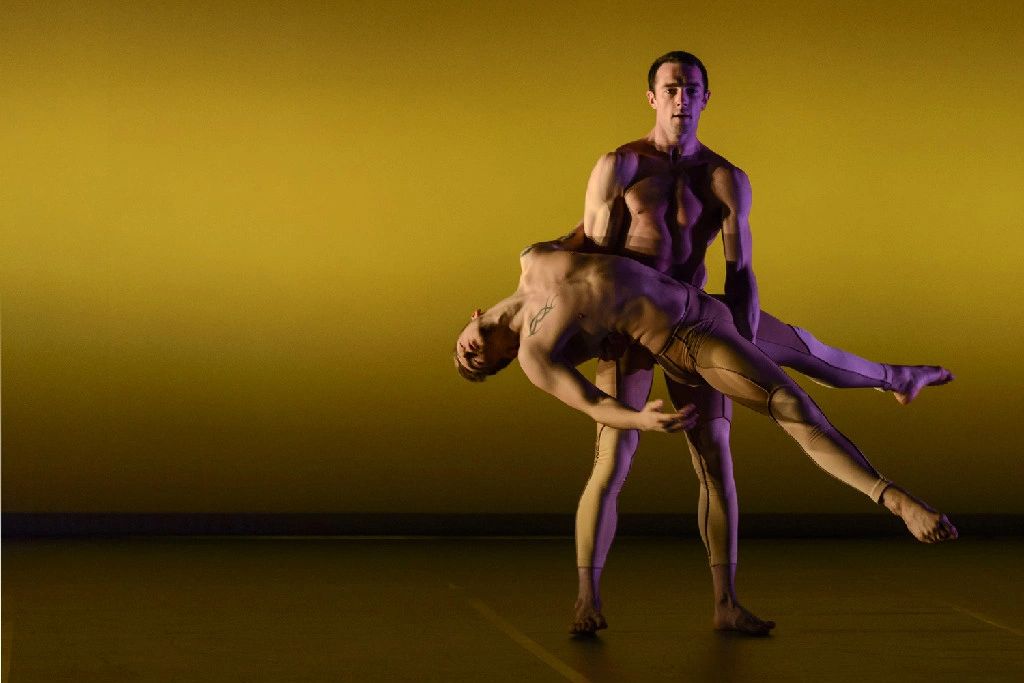
Coming to the Ahmanson Theatre at the Music Center this weekend, Nov. 7–9, is one of the most spectacular young dance companies touring the world these days: BalletBoyz, a 15-year-old contemporary-dance company from London.
Its founders, William Trevitt and Michael Nunn, trained at Britain’s elite Royal Ballet School—Trevitt began at the school at age 10, Nunn at age 15—then danced with Britain’s Royal Ballet Company for a number of years. But the two felt attracted to a wider dance vocabulary, one that would appeal to non-balletomanes, that would be accessible and entertaining to the man on the street, so to speak. Their company grew out of a project they were hired to do for the Ovation Network, a seven-part series of programs exploring different styles and concepts of movement, titled eventually A Chance to Dance.
 The dancers they assembled for this project—10 young male dancers between the ages of 18 and 26, now referred to as “The Talent”—were picked for their expressiveness as well as their strength, and the company Trevitt and Nunn have today still displays those characteristics. While ballet training is not a requirement for their dancers, those bodies reflect a strength that often comes only through the rigors of classical ballet training. The choreography is extremely athletic and full of breathtaking and unexpected moves, following a trend in contemporary dance to astound the viewer with seemingly impossible, even daredevil tricks. Trevitt refers to his dancers as edgy, versatile technicians.
But Trevitt and Nunn have additional tricks up their sleeves. Originally to fill in spots in their work when dancers needed to be offstage, for example to change costumes, the duo began to use films of the dancers rehearsing or chatting or revealing themselves as just people, which Trevitt and Nunn thought would make the audience feel more comfortable with the troupe. The films have been a very popular feature. Also, rather than setting movement to music or vice versa, the duo commissions music that complements the dance, as does the lighting, which has been described as exquisite by more than one reviewer.
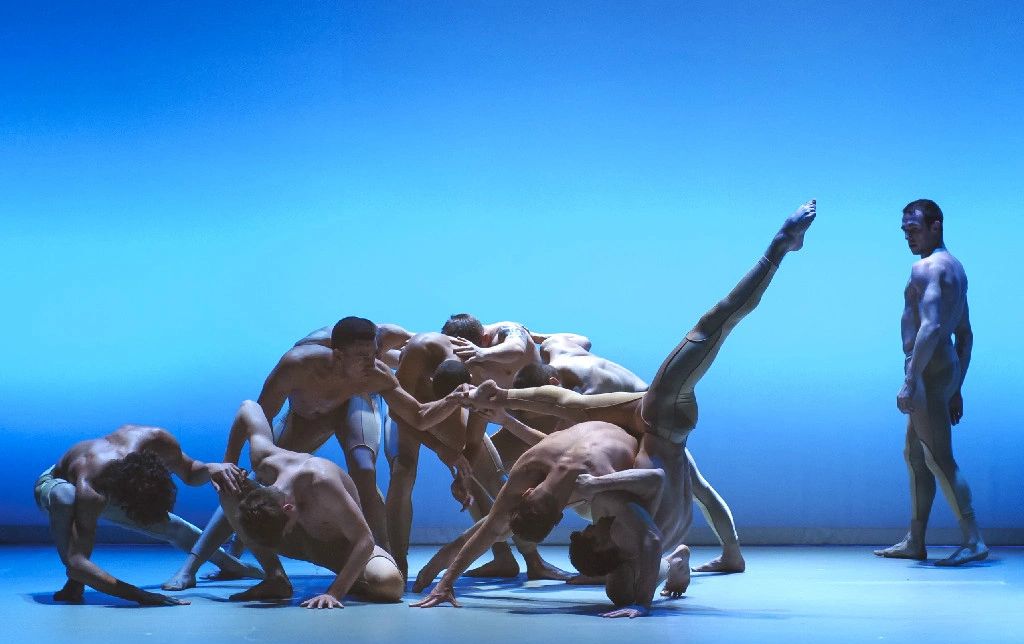
From the beginning, the directors wanted to engage other choreographers for their company, though they still occasionally create pieces themselves. The two pieces they’ll bring to the Ahmanson are works by Liam Scarlett (Serpent) and Russell Maliphant (Fallen).
Meanwhile, much of their time these days is taken up with the operation of a huge complex they acquired two and a half years ago: originally an old aircraft factory they’ve turned it into two studios, one for their company rehearsals and one for classes for the public.
In their continuing drive to assimilate dance into the lives of the entire population, says Trevitt, they bring as many different artistic mediums as there are to create a world where everyone will not just partake and enjoy and appreciate the arts, but where it will be part of their lives.
London’s contemporary dance company assemblés in LA this weekend.
by Helen Peppard

Coming to the Ahmanson Theatre at the Music Center this weekend, Nov. 7–9, is one of the most spectacular young dance companies touring the world these days: BalletBoyz, a 15-year-old contemporary-dance company from London.
Its founders, William Trevitt and Michael Nunn, trained at Britain’s elite Royal Ballet School—Trevitt began at the school at age 10, Nunn at age 15—then danced with Britain’s Royal Ballet Company for a number of years. But the two felt attracted to a wider dance vocabulary, one that would appeal to non-balletomanes, that would be accessible and entertaining to the man on the street, so to speak. Their company grew out of a project they were hired to do for the Ovation Network, a seven-part series of programs exploring different styles and concepts of movement, titled eventually A Chance to Dance.
 The dancers they assembled for this project—10 young male dancers between the ages of 18 and 26, now referred to as “The Talent”—were picked for their expressiveness as well as their strength, and the company Trevitt and Nunn have today still displays those characteristics. While ballet training is not a requirement for their dancers, those bodies reflect a strength that often comes only through the rigors of classical ballet training. The choreography is extremely athletic and full of breathtaking and unexpected moves, following a trend in contemporary dance to astound the viewer with seemingly impossible, even daredevil tricks. Trevitt refers to his dancers as edgy, versatile technicians.
But Trevitt and Nunn have additional tricks up their sleeves. Originally to fill in spots in their work when dancers needed to be offstage, for example to change costumes, the duo began to use films of the dancers rehearsing or chatting or revealing themselves as just people, which Trevitt and Nunn thought would make the audience feel more comfortable with the troupe. The films have been a very popular feature. Also, rather than setting movement to music or vice versa, the duo commissions music that complements the dance, as does the lighting, which has been described as exquisite by more than one reviewer.

From the beginning, the directors wanted to engage other choreographers for their company, though they still occasionally create pieces themselves. The two pieces they’ll bring to the Ahmanson are works by Liam Scarlett (Serpent) and Russell Maliphant (Fallen).
Meanwhile, much of their time these days is taken up with the operation of a huge complex they acquired two and a half years ago: originally an old aircraft factory they’ve turned it into two studios, one for their company rehearsals and one for classes for the public.
In their continuing drive to assimilate dance into the lives of the entire population, says Trevitt, they bring as many different artistic mediums as there are to create a world where everyone will not just partake and enjoy and appreciate the arts, but where it will be part of their lives.
November 3, 2014
Dance Review
Les Nuits
Ballet Preljocaj
Glorya Kaufman Presents Dance at the Music Center
Reviewed by Dany Margolies
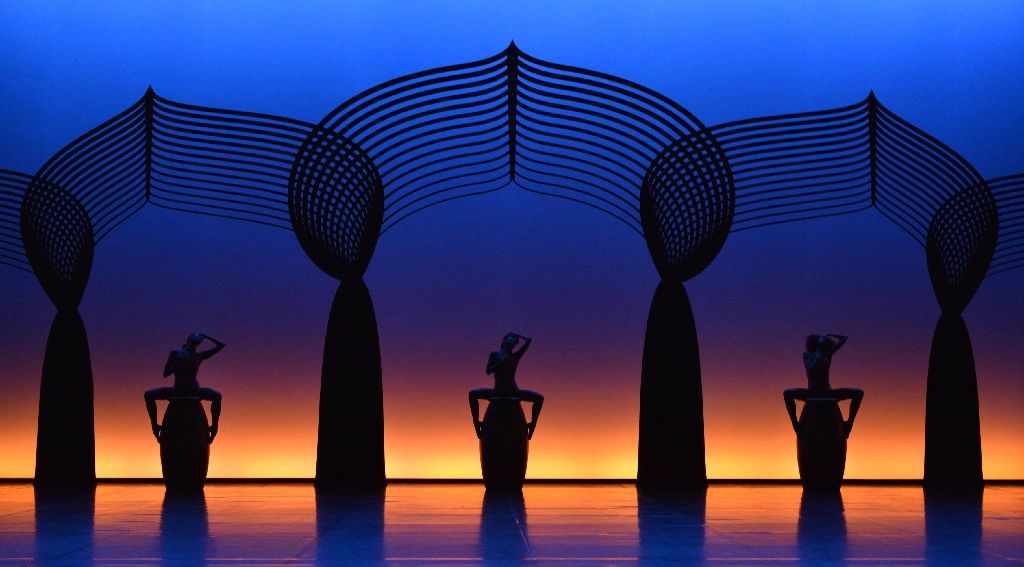
Fine print indicates Angelin Preljocaj’s US premiere, titled Les Nuits (The Nights) is “inspired by One Thousand and One Nights.” But this 85-minute intermissionless piece—long by most dance-production standards—though based on tales by one of literature’s greatest and most purposeful storytellers, tells very little.
It opens on a magnificent tableau of a women’s bathhouse. Under Cécile Giovansili-Vissierè’s lighting, the scene appears at first to be on film. Bodies, clad in relatively modest white wraps, languorously stretch and writhe in the billowing vapor. The idea is expressed, the beauty is perceived. Then one notices that the choreography is symmetrical, the movement repetitive, set to a soundscape of drones and drips. This scene lasts for 11 minutes. Don’t expect 1,001 tales, or even one, to follow.
Next come black-hooded men, in a martial-style abduction from this seraglio. Women in red tunics—or cheerleader outfits—bounce and fight back. The company’s dancers are strong; clearly they’re trained and rehearsed in Preljocaj’s style.
The pieces bob and weave, using ballet and contemporary vocabulary, creating strong stage pictures, occasionally establishing a mood, but at no time including choreography that isn’t predictable. A burst of strong chaînés is invariably followed by a jeté en tournant. Over the evening, pairs of men and women, men and men, and women and women, love and fight. In the end, cages or jails segregate the individual.
To mix clichés, the piece wears out its welcome early and often. Late in the lineup, a few scenes provide visual interest—and look like they were the seeds for the entire evening, which then needed filling out. Notable for its beauty and originality, one segment opens on three women perched atop tall vases, their heads forming the stoppers and their bent legs the handles of amphorae. Notable for its peculiarity, in another segment, carpets are carried on by dancers hiding behind them, so the audience sees only legs in a kickline shown from the knees down.
Music, by Natacha Atlas and Samy Bishai, ranges from “sounds” through “electronic” to orchestral and pop vocal. Costumes range from explicative to unappealing. All in all, for at least this viewer, this was not a good Night.
Les Nuits
Ballet Preljocaj
Glorya Kaufman Presents Dance at the Music Center
Reviewed by Dany Margolies

Photo by Jean-Claude Carbonne
Fine print indicates Angelin Preljocaj’s US premiere, titled Les Nuits (The Nights) is “inspired by One Thousand and One Nights.” But this 85-minute intermissionless piece—long by most dance-production standards—though based on tales by one of literature’s greatest and most purposeful storytellers, tells very little.
It opens on a magnificent tableau of a women’s bathhouse. Under Cécile Giovansili-Vissierè’s lighting, the scene appears at first to be on film. Bodies, clad in relatively modest white wraps, languorously stretch and writhe in the billowing vapor. The idea is expressed, the beauty is perceived. Then one notices that the choreography is symmetrical, the movement repetitive, set to a soundscape of drones and drips. This scene lasts for 11 minutes. Don’t expect 1,001 tales, or even one, to follow.
Next come black-hooded men, in a martial-style abduction from this seraglio. Women in red tunics—or cheerleader outfits—bounce and fight back. The company’s dancers are strong; clearly they’re trained and rehearsed in Preljocaj’s style.
The pieces bob and weave, using ballet and contemporary vocabulary, creating strong stage pictures, occasionally establishing a mood, but at no time including choreography that isn’t predictable. A burst of strong chaînés is invariably followed by a jeté en tournant. Over the evening, pairs of men and women, men and men, and women and women, love and fight. In the end, cages or jails segregate the individual.
To mix clichés, the piece wears out its welcome early and often. Late in the lineup, a few scenes provide visual interest—and look like they were the seeds for the entire evening, which then needed filling out. Notable for its beauty and originality, one segment opens on three women perched atop tall vases, their heads forming the stoppers and their bent legs the handles of amphorae. Notable for its peculiarity, in another segment, carpets are carried on by dancers hiding behind them, so the audience sees only legs in a kickline shown from the knees down.
Music, by Natacha Atlas and Samy Bishai, ranges from “sounds” through “electronic” to orchestral and pop vocal. Costumes range from explicative to unappealing. All in all, for at least this viewer, this was not a good Night.
June 25, 2014
Dance Review
Jessica Lang Dance
Wallis Annenberg Center for the Performing Arts
Reviewed by Dany Margolies
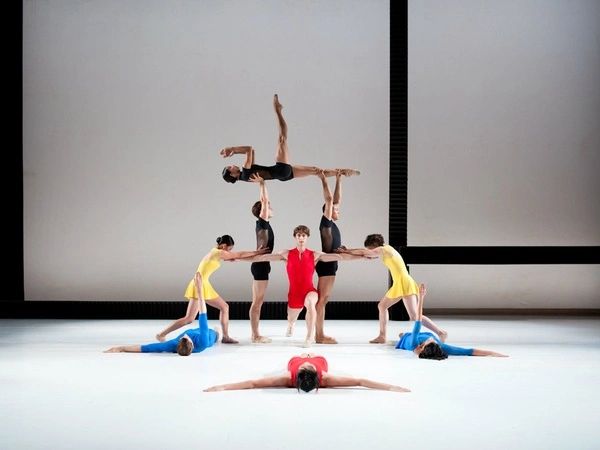
The company in Lines Cubed
What route has so-called modern dance followed in the last 40 years? Or perhaps the better question is why one has expectations of the art form’s growth.
Jessica Lang Dance is a new arrival to the world of modern dance. As evidenced by the concert this weekend at Wallis Annenberg Center for the Performing Arts, choreographer Lang greatly respects her predecessors. She also takes a few steps in her own direction.
The concert began as is traditional: with a cheery, color-coded, form-driven piece. This one, however is not set to the now-almost-clichéd J.S. Bach but to music by John Metcalfe and Thomas Metcalfe (all is prerecorded in this program). Titled “Lines Cubed,” the piece at the very least introduces the company members to the audience. The dancers are apparently quite well-versed in Lang’s style and disciplined enough to look like a tight ensemble.
As most human locomotion does, the piece starts with walking. Soon the dancers leap, turn, kick, and fall and recover. Clad in skin-tight black shorts topped by tunics of solid and netted fabric, the onstage figures seem simultaneously dressy and sporty. Their faces are, for the most part, neutral, suggesting neither that they’re aware they’re performing nor expressing mood or emotion. “Lines Cubed” brings a two-dimensional, Mondrian-like concept to three-dimensional life, tying together vibrant visuals with what seems like an educational history of dance.
Starting with the section titled “Black,” the dancers evoke structure and stability, against a background of two black stripes. “Red” introduces a dominating square of red light, as Kana Kimura dominates four male dancers to suspenseful, “electronic” music in choreographic patterns that call to mind Petipa/Ivanov’s Swan Lake. “Yellow,” a happy dance of course, evokes Balanchine, as a piano provides a propulsive continuo. “Blue” slides onstage, to a solo flute, in a segment reminiscent of “contact improvisation” days.
Second on the program, “Mendelssohn/Incomplete” brings lyricism to the stage. Dancing to the Andante from the composer’s “Concerto No. 1,” six dancers costumed in greys and plums form trios and break apart as they tug the interest of one of the women. The piece has an ethereal, Frederick Ashton quality, as the dancers turn while airborne in balancés en tournant, though it also has a pop component, featuring several iterations of “the wave.”
“Among the Stars” is a duet, danced by Laura Mead and Clifton Brown to music by Ryuichi Sakamoto that is dominated by light chimes. Mead here dances en pointe, the only time in the program toe shoes appear. She begins attached to a yards-long train of gauzy fabric, winding and unwinding herself in it—or perhaps in the relationship with Brown—and then stepping away from the fabric. The choreography and costuming emphasize graphics and geometry while remaining lyrical and fluid. Brown is controlled yet communicates with the audience, at ease with percussive and legato movement equally, while making visual an emotional state, in this case wistful longing. The dance ends in celestial motion, as she twists herself into a whorl of fabric while he runs in a circle, though not orbiting her.
After intermission, the solo “The Calling,” to music by Trio Mediaeval, features Kimura in a white dress, the skirt of which flows over a substantial portion of the stage (costume concept by Lang, credited also to Elena Comendador). Apparently unable to move her legs, Kimura is left to ply her port de bras and port de corps, embodying pleading, longing, refusal, intransigence, as she hinges into to the floor, Graham-style, then rises to twist herself into the skirt, then melts to the floor once and for all. Tied down, twisted up, the dancer arises, grows, triumphs, and then succumbs.
Lang’s film “White” follows (credited to director of photography Shinichi Maruyama, editor and compositor Tetsushi Wakasugi and Jackson Notier). The work is shot looking upward, so the dancers, in white, seem to fly against a black background. With the action variously in slow motion or sped up, the dancing keeps up with the music, by Grieg, using any steps Lang chose rather than those that would be dictated by laws of physics. Thus, the piece elicits the joy in apparent freedom of movement.
For the program’s final number, “i.n.k.,” Lang offers as backdrop a video of liquid, presumably ink, as it creates a splashing, bubbling, dripping, sloshing, black motion on a stark white background. So, too, her dancers, clad in black again, seem to embody the vagaries of fluidity, to the soundscape by Jakob Ciupinski (perhaps taking a page from John Cage’s bubbles).
Powerfully evocative, one section offers a duet (Kimura and Milan Misko) while a single drop falls from the top of the screen to the bottom. How much of life happens in that instant. Of all Lang’s works displayed in this program, “i.n.k.” seems to forgo her focus on form, this time clearly, at least to this viewer, exploring the world outside the stage.
Jessica Lang Dance
Wallis Annenberg Center for the Performing Arts
Reviewed by Dany Margolies

The company in Lines Cubed
Photo by Takao Komaru
What route has so-called modern dance followed in the last 40 years? Or perhaps the better question is why one has expectations of the art form’s growth.
Jessica Lang Dance is a new arrival to the world of modern dance. As evidenced by the concert this weekend at Wallis Annenberg Center for the Performing Arts, choreographer Lang greatly respects her predecessors. She also takes a few steps in her own direction.
The concert began as is traditional: with a cheery, color-coded, form-driven piece. This one, however is not set to the now-almost-clichéd J.S. Bach but to music by John Metcalfe and Thomas Metcalfe (all is prerecorded in this program). Titled “Lines Cubed,” the piece at the very least introduces the company members to the audience. The dancers are apparently quite well-versed in Lang’s style and disciplined enough to look like a tight ensemble.
As most human locomotion does, the piece starts with walking. Soon the dancers leap, turn, kick, and fall and recover. Clad in skin-tight black shorts topped by tunics of solid and netted fabric, the onstage figures seem simultaneously dressy and sporty. Their faces are, for the most part, neutral, suggesting neither that they’re aware they’re performing nor expressing mood or emotion. “Lines Cubed” brings a two-dimensional, Mondrian-like concept to three-dimensional life, tying together vibrant visuals with what seems like an educational history of dance.
Starting with the section titled “Black,” the dancers evoke structure and stability, against a background of two black stripes. “Red” introduces a dominating square of red light, as Kana Kimura dominates four male dancers to suspenseful, “electronic” music in choreographic patterns that call to mind Petipa/Ivanov’s Swan Lake. “Yellow,” a happy dance of course, evokes Balanchine, as a piano provides a propulsive continuo. “Blue” slides onstage, to a solo flute, in a segment reminiscent of “contact improvisation” days.
Second on the program, “Mendelssohn/Incomplete” brings lyricism to the stage. Dancing to the Andante from the composer’s “Concerto No. 1,” six dancers costumed in greys and plums form trios and break apart as they tug the interest of one of the women. The piece has an ethereal, Frederick Ashton quality, as the dancers turn while airborne in balancés en tournant, though it also has a pop component, featuring several iterations of “the wave.”
“Among the Stars” is a duet, danced by Laura Mead and Clifton Brown to music by Ryuichi Sakamoto that is dominated by light chimes. Mead here dances en pointe, the only time in the program toe shoes appear. She begins attached to a yards-long train of gauzy fabric, winding and unwinding herself in it—or perhaps in the relationship with Brown—and then stepping away from the fabric. The choreography and costuming emphasize graphics and geometry while remaining lyrical and fluid. Brown is controlled yet communicates with the audience, at ease with percussive and legato movement equally, while making visual an emotional state, in this case wistful longing. The dance ends in celestial motion, as she twists herself into a whorl of fabric while he runs in a circle, though not orbiting her.
After intermission, the solo “The Calling,” to music by Trio Mediaeval, features Kimura in a white dress, the skirt of which flows over a substantial portion of the stage (costume concept by Lang, credited also to Elena Comendador). Apparently unable to move her legs, Kimura is left to ply her port de bras and port de corps, embodying pleading, longing, refusal, intransigence, as she hinges into to the floor, Graham-style, then rises to twist herself into the skirt, then melts to the floor once and for all. Tied down, twisted up, the dancer arises, grows, triumphs, and then succumbs.
Lang’s film “White” follows (credited to director of photography Shinichi Maruyama, editor and compositor Tetsushi Wakasugi and Jackson Notier). The work is shot looking upward, so the dancers, in white, seem to fly against a black background. With the action variously in slow motion or sped up, the dancing keeps up with the music, by Grieg, using any steps Lang chose rather than those that would be dictated by laws of physics. Thus, the piece elicits the joy in apparent freedom of movement.
For the program’s final number, “i.n.k.,” Lang offers as backdrop a video of liquid, presumably ink, as it creates a splashing, bubbling, dripping, sloshing, black motion on a stark white background. So, too, her dancers, clad in black again, seem to embody the vagaries of fluidity, to the soundscape by Jakob Ciupinski (perhaps taking a page from John Cage’s bubbles).
Powerfully evocative, one section offers a duet (Kimura and Milan Misko) while a single drop falls from the top of the screen to the bottom. How much of life happens in that instant. Of all Lang’s works displayed in this program, “i.n.k.” seems to forgo her focus on form, this time clearly, at least to this viewer, exploring the world outside the stage.
June 1, 2014
Dance Review
Paul Taylor Dance Company
Glorya Kaufman Presents Dance at the Music Center, Dorothy Chandler Pavilion
Reviewed by Helen Peppard
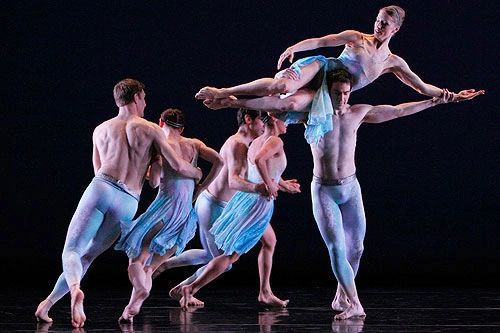
The company in Airs
Oh, Paul Taylor Dance Company, you’ve been too long away. Ten long years since you were last at the Music Center and some seven since you danced in Orange County—it’s too long to keep dance lovers in Southern California out of the loop. We should start campaigning now for its next appearance in the southland. Meanwhile, the company presented three evenings of sheer bliss at the Dorothy Chandler Pavilion, April 11–13.
Among choreographers, there are few in the history of concert dance who can match Taylor’s inventiveness and ever surprising integration of dance and nondance movement. His style is idiosyncratic. Despite a vast range of subject matter and emotional content, his work is immediately identifiable: feet flexed, knees and elbows jutting out, bodies suspended off-center and doing all kinds of things you can’t quite believe are possible. His company doesn’t make it look easy, but the dancers are most certainly unfailingly impressive.
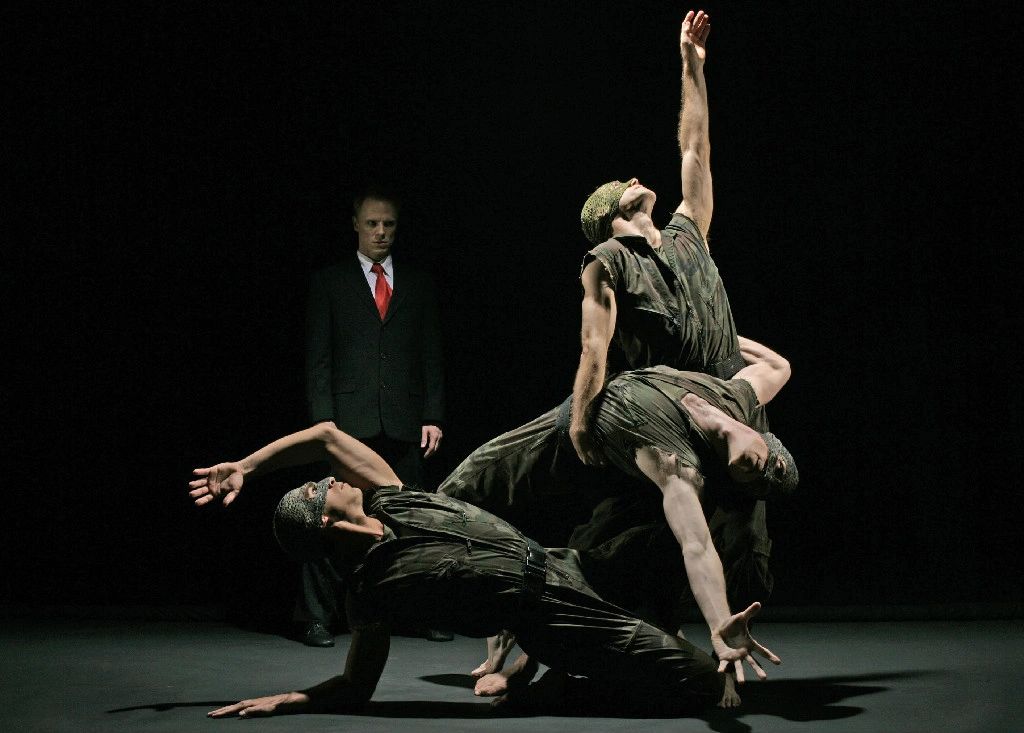
Jeffrey Smith, Michael Trusnovec, Sean Mahoney, and Orion Duckstein in Banquet of Vultures
The program (the same all three nights) comprised works from different periods of Taylor’s output, dating from 1978, 2005, and 2011. The opening work, Airs, got the evening off to an exhilarating start. Dancing in front of a midnight blue backdrop, the three bare-chested men in pale blue tights and the four women in gauzy blue dresses rarely paused for breath. Baroque instrumental music by Handel provided the impetus for this whirlwind of movement that kept the stage in a state of flux. Incorporating ballet, nondance moves, and Taylor’s own signature movement style, the work is still as surprising as it is delightful all these 35 years later.
Moving from the glorious to the inglorious, the program’s second offering, Banquet of Vultures, took the viewer into a black hole seemingly peopled with fireflies desperately flickering about, trying to find...what? Dim shafts of light from above and offstage side gradually revealed black-garbed dancers to be carrying points of light, which were slowly extinguished. Confrontational, belligerent, grappling, struggling moves that were somehow dancelike expended the energies of the dancers. Eventually, a rabble-rouser in black suit and red tie exhorted and bullied the group to more violent action, a last lone point of light was extinguished, and the stage was left with a pile of bodies completely vanquished: a powerful anti-war piece to remind us that art is not just about beauty.
 Lightening the mood after the heavy tone of Banquet of Vultures could not have been done more effectively than with the laugh-out-loud antics of Gossamer Gallants.
Testosterone-charged males in black and electric blue insect attire
buzzed around the stage in aimless bug-like movement until a pair of
lime green females attracted their attention with very come-hither
moves. That galvanized the males, who eventually succumbed to the charms
of a swarm of the green predators, who exulted in their final victory
over their helpless bedazzled conquests.
Lightening the mood after the heavy tone of Banquet of Vultures could not have been done more effectively than with the laugh-out-loud antics of Gossamer Gallants.
Testosterone-charged males in black and electric blue insect attire
buzzed around the stage in aimless bug-like movement until a pair of
lime green females attracted their attention with very come-hither
moves. That galvanized the males, who eventually succumbed to the charms
of a swarm of the green predators, who exulted in their final victory
over their helpless bedazzled conquests.
After 60 years of brilliant dance-making, Paul Taylor isn’t even slowing down. Now if we can just get him back before another decade goes by!
Bottom photo: Heather McGinley and Michael Novak in Gossamer Gallants, photo by Tom Caravaglia
Paul Taylor Dance Company
Glorya Kaufman Presents Dance at the Music Center, Dorothy Chandler Pavilion
Reviewed by Helen Peppard

The company in Airs
Oh, Paul Taylor Dance Company, you’ve been too long away. Ten long years since you were last at the Music Center and some seven since you danced in Orange County—it’s too long to keep dance lovers in Southern California out of the loop. We should start campaigning now for its next appearance in the southland. Meanwhile, the company presented three evenings of sheer bliss at the Dorothy Chandler Pavilion, April 11–13.
Among choreographers, there are few in the history of concert dance who can match Taylor’s inventiveness and ever surprising integration of dance and nondance movement. His style is idiosyncratic. Despite a vast range of subject matter and emotional content, his work is immediately identifiable: feet flexed, knees and elbows jutting out, bodies suspended off-center and doing all kinds of things you can’t quite believe are possible. His company doesn’t make it look easy, but the dancers are most certainly unfailingly impressive.

Jeffrey Smith, Michael Trusnovec, Sean Mahoney, and Orion Duckstein in Banquet of Vultures
Photo by Tom Caravaglia
The program (the same all three nights) comprised works from different periods of Taylor’s output, dating from 1978, 2005, and 2011. The opening work, Airs, got the evening off to an exhilarating start. Dancing in front of a midnight blue backdrop, the three bare-chested men in pale blue tights and the four women in gauzy blue dresses rarely paused for breath. Baroque instrumental music by Handel provided the impetus for this whirlwind of movement that kept the stage in a state of flux. Incorporating ballet, nondance moves, and Taylor’s own signature movement style, the work is still as surprising as it is delightful all these 35 years later.
Moving from the glorious to the inglorious, the program’s second offering, Banquet of Vultures, took the viewer into a black hole seemingly peopled with fireflies desperately flickering about, trying to find...what? Dim shafts of light from above and offstage side gradually revealed black-garbed dancers to be carrying points of light, which were slowly extinguished. Confrontational, belligerent, grappling, struggling moves that were somehow dancelike expended the energies of the dancers. Eventually, a rabble-rouser in black suit and red tie exhorted and bullied the group to more violent action, a last lone point of light was extinguished, and the stage was left with a pile of bodies completely vanquished: a powerful anti-war piece to remind us that art is not just about beauty.
 Lightening the mood after the heavy tone of Banquet of Vultures could not have been done more effectively than with the laugh-out-loud antics of Gossamer Gallants.
Testosterone-charged males in black and electric blue insect attire
buzzed around the stage in aimless bug-like movement until a pair of
lime green females attracted their attention with very come-hither
moves. That galvanized the males, who eventually succumbed to the charms
of a swarm of the green predators, who exulted in their final victory
over their helpless bedazzled conquests.
Lightening the mood after the heavy tone of Banquet of Vultures could not have been done more effectively than with the laugh-out-loud antics of Gossamer Gallants.
Testosterone-charged males in black and electric blue insect attire
buzzed around the stage in aimless bug-like movement until a pair of
lime green females attracted their attention with very come-hither
moves. That galvanized the males, who eventually succumbed to the charms
of a swarm of the green predators, who exulted in their final victory
over their helpless bedazzled conquests.After 60 years of brilliant dance-making, Paul Taylor isn’t even slowing down. Now if we can just get him back before another decade goes by!
April 17, 2014
Bottom photo: Heather McGinley and Michael Novak in Gossamer Gallants, photo by Tom Caravaglia
Dance Review
Giselle
Royal New Zealand Ballet, Glorya Kaufman Presents at the Music Center’s Dorothy Chandler Pavilion
Reviewed by Helen Peppard
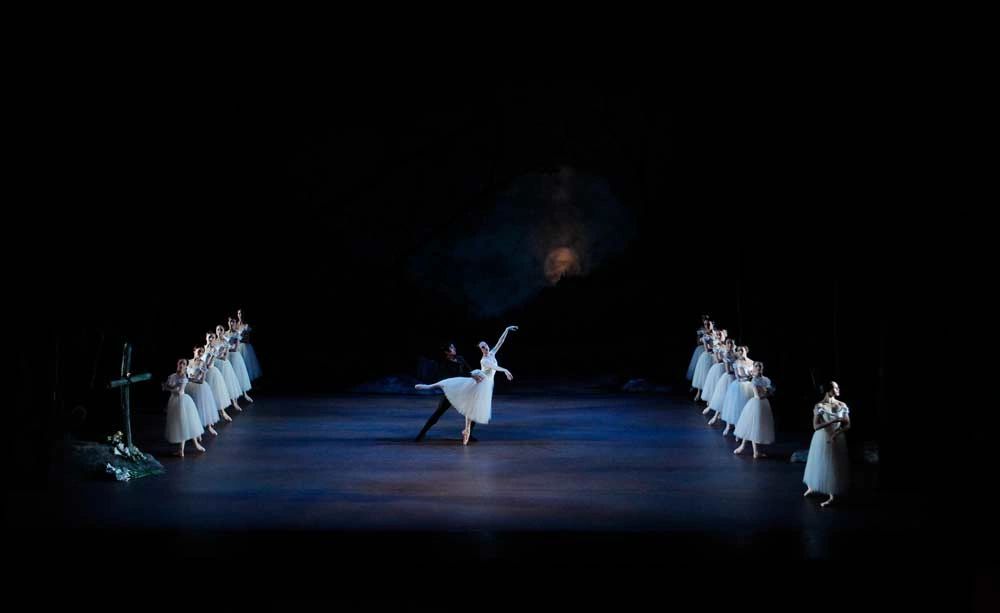
Straight from down under with all of the panache and elegance of a premiere European troupe, the Royal New Zealand Ballet brought its polished and satisfyingly Romantic production of Giselle to the Dorothy Chandler Pavilion for four performances over the weekend. This is the company’s first appearance in the US for more than two decades, and the first time we have seen them since the brilliant US dancer Ethan Stiefel assumed artistic directorship of the company, seemingly a match made in heaven.
An interesting mix of Asian and Caucasian faces, noticeably tall blokes and slender, more-petit bodies, the company nevertheless blends into a cohesive and well-disciplined ensemble, expressive and dramatically compelling. Having performed this new production created by Stiefel and Johan Kobborg extensively, including a film adaptation now in international release, the company has had ample time to perfect the new ideas incorporated into the classic choreography. Most notable of these—though not affecting the dancers—are a prologue and epilogue in which an aged Albrecht recalls with regret his dissembling courtship of the innocent village girl.
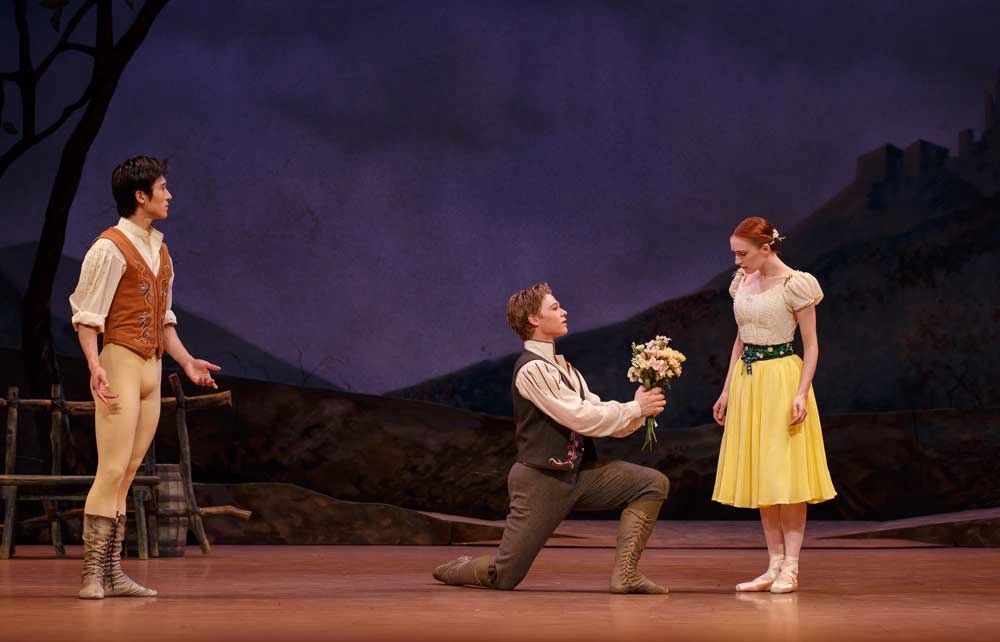
Friday night’s Giselle was principal guest artist Gillian Murphy, more familiar in the States as a leading dancer with ABT, though her work in the RNZB film of Giselle will undoubtedly identify her more firmly as a member of this company as well. Not a dancer one would consider a typical Giselle, the tall and quite strong Murphy brings an appealing lightness and a free-spirited quality to the role that work beautifully in this production. Her artistry and command of the stage are in ample display. Her Albrecht was an impressively powerful Qi Huan, whose dazzling pyrotechnics and seemingly effortless partnering wowed a cheering audience. While not always dramatically believable, his prowess as a dancer makes that kind of a niggling complaint—who cares, so to speak!
Hilarion, the village boy who loves Giselle, was admirably danced and acted by Jacob Chown in an expanded version of the traditionally nondancing role. Abigail Boyle’s interpretation of Myrtha, Queen of the Willis, was appropriately icy, one might even say steely.
The usual setting of the village green was enhanced by the depiction of a lovely tree on the stage curtain, which, after raining down its flowers, slipped down to the roots, framing the stage in an appropriately dark warning of the tale about to be told (set courtesy of Howard C. Jones). The unusually large pick-up orchestra added drama and pathos, as well as a firm musical foundation, under the expert direction of music director Nigel Gaynor. A well-earned standing ovation rewarded all the participants.
Giselle
Royal New Zealand Ballet, Glorya Kaufman Presents at the Music Center’s Dorothy Chandler Pavilion
Reviewed by Helen Peppard

Photo by Maarten Holl
Straight from down under with all of the panache and elegance of a premiere European troupe, the Royal New Zealand Ballet brought its polished and satisfyingly Romantic production of Giselle to the Dorothy Chandler Pavilion for four performances over the weekend. This is the company’s first appearance in the US for more than two decades, and the first time we have seen them since the brilliant US dancer Ethan Stiefel assumed artistic directorship of the company, seemingly a match made in heaven.
An interesting mix of Asian and Caucasian faces, noticeably tall blokes and slender, more-petit bodies, the company nevertheless blends into a cohesive and well-disciplined ensemble, expressive and dramatically compelling. Having performed this new production created by Stiefel and Johan Kobborg extensively, including a film adaptation now in international release, the company has had ample time to perfect the new ideas incorporated into the classic choreography. Most notable of these—though not affecting the dancers—are a prologue and epilogue in which an aged Albrecht recalls with regret his dissembling courtship of the innocent village girl.

Photo by Evan Li
Friday night’s Giselle was principal guest artist Gillian Murphy, more familiar in the States as a leading dancer with ABT, though her work in the RNZB film of Giselle will undoubtedly identify her more firmly as a member of this company as well. Not a dancer one would consider a typical Giselle, the tall and quite strong Murphy brings an appealing lightness and a free-spirited quality to the role that work beautifully in this production. Her artistry and command of the stage are in ample display. Her Albrecht was an impressively powerful Qi Huan, whose dazzling pyrotechnics and seemingly effortless partnering wowed a cheering audience. While not always dramatically believable, his prowess as a dancer makes that kind of a niggling complaint—who cares, so to speak!
Hilarion, the village boy who loves Giselle, was admirably danced and acted by Jacob Chown in an expanded version of the traditionally nondancing role. Abigail Boyle’s interpretation of Myrtha, Queen of the Willis, was appropriately icy, one might even say steely.
The usual setting of the village green was enhanced by the depiction of a lovely tree on the stage curtain, which, after raining down its flowers, slipped down to the roots, framing the stage in an appropriately dark warning of the tale about to be told (set courtesy of Howard C. Jones). The unusually large pick-up orchestra added drama and pathos, as well as a firm musical foundation, under the expert direction of music director Nigel Gaynor. A well-earned standing ovation rewarded all the participants.
February 6, 2014
Dance Review
Matthew Bourne’s Sleeping Beauty
Center Theatre Group at Ahmanson Theatre
Reviewed by Dany Margolies
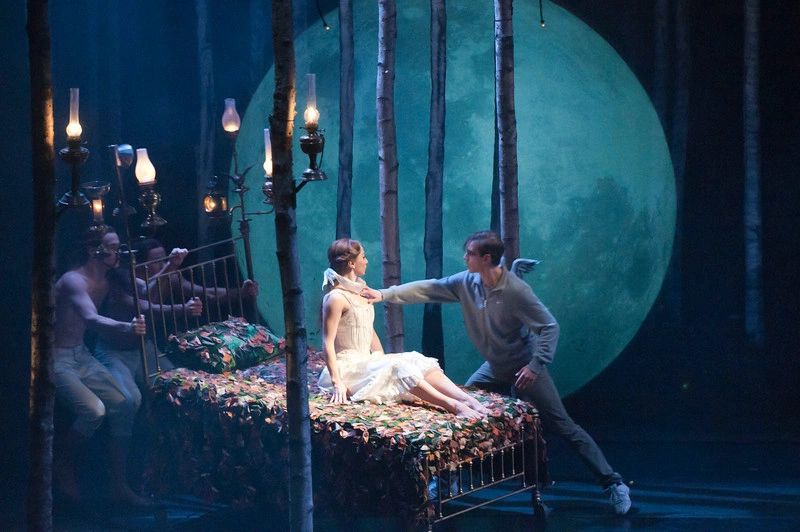
In the good old days, Sleeping Beauty was a ballet choreographed, in its first incarnation, by Marius Petipa. In it, we meet Princess Aurora, first in a prologue when she is a baby—represented by a doll, or more likely a bundle of cloth—swaddled beyond recognition and housed in a froufrou cradle upstage, then, in Act One, as a 16-year-old who meets and by Act Three marries Prince Désiré. In between, the ballet included a curse, a pricked finger, a hundred years of sleep, appearances by fairies good and evil, lots of court dances, and lots of “entertainment” by other fairytale characters.
Well, it’s the better new days now, and the genius soul of Matthew Bourne has reconceived Sleeping Beauty for new audiences. Happily, most of the original elements remain: curses, fingers, sleep, and fairies. Even more happily, however, this Aurora is a woman of modern times—at least in Western culture.
As the curtain rises on Bourne’s ballet, she is a baby. She is vivified here (via theater magic). She crawls coyly, she climbs the curtains, she is curious about the world and unafraid of anyone. As the fairies dance around her—much as they do in Petipa’s version—she conducts their music and tries to grab their wings. And as Aurora grows up (Hannah Vassallo), she stays sassy and feisty and fearless.
Also as the curtain rises, we realize the music is canned and the Ahmanson’s still-problematic sound system might blight the whole evening. But the production’s many charms and delights swiftly banish our awareness of the issue. And fortunately, Bourne selected an excellent recording (ArtsInLA.com recommends Richard Bonynge’s and Ernest Ansermet’s) that takes many of the dances at pleasingly swift tempos.
Bourne’s version starts in 1890, the year Petipa’s fantastically programmatic choreography to Tchaikovsky’s sumptuous, evocative, bittersweet score was first performed. In Bourne’s version, the evil fairy Carabosse (Adam Maskell) has somehow provided the previously childless king and queen (Edwin Ray, Daisy May Kemp) with their baby, Aurora. The royal couple fails to show gratitude to Carabosse, so she curses the baby, now destined to prick her finger and die. The good fairy, Lilac, however, softens the curse so that Aurora merely falls into a sleep, from which she can be awakened only by the kiss of a prince.
This Aurora comes of age, in Act One, in 1911. It’s a virulently protocol-conscious era. Proper comportment is all. Aurora is courted by Edwardian aristos in their tennis outfits. Servants stand at the ready; when Tchaikovsky’s music calls for a ritardando, a footman (pun probably intended) kicks a seemingly recalcitrant phonograph player.
But this Aurora cares for none of the viscounts and lords at the party and would probably rather be marching with Emmeline Pankhurst. She far prefers, indeed is in young love with, her childhood friend, Leo (Dominic North), who is, ahem, a prince of a guy. To add suspense until the ballet’s final moments—and make better use of the menacing bits of music—Bourne introduces a new character, evil fairy Carabosse’s evil son Caradoc (Maskell).
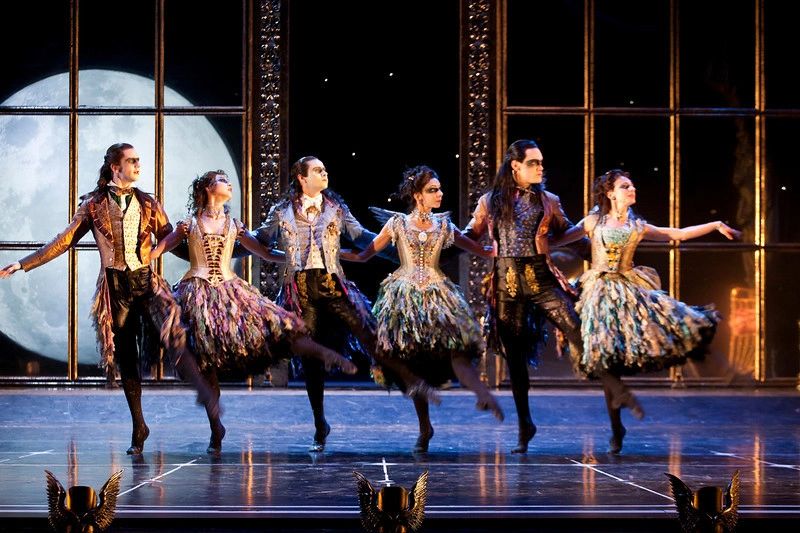
Bourne may have updated the story, but he has preserved the intents and flavors of the dances he kept. The choreography is his own style. Still, he incorporates tiny iconic bits of Petipa—the grands ronds de jambe of the Lilac Fairy, the grands jetés of Aurora as she first emerges at her birthday.
He has kept the dances of the fairies, though whether the fairies are still “good” is questionable. Their dancing, however, is more than good. The variation of the first fairy, Candide, now called Ardor (Kate Lyons), is swirling and expansive. The second fairy, Coulante, here Hibernia (Katy Lowenhoff), dances a spinning variation. The Breadcrumb Fairy, here Autumnus (Joe Walkling), moves with abandon, playing with levels, like a leaf falling through wind. The Goldfinch Fairy, here Feral (Ashley Shaw), is still fluttery, and Violente, here Tantrum (Liam Mower), still does the signature finger jabs, which must look strange to those “new audiences” who don’t know the original.
The Lilac Fairy is now called Count Lilac (the reason is made clear as the Act One curtain drops), danced with seemingly unsurpassable technique and intensity by Christopher Marney. But soon it’s apparent his dancing is matched, perhaps surpassed, by North as Leo and Maskell as Caradoc, who are tirelessly strong and immensely skilled. The same must be said for the Aurora of the lovely Vassallo, an earthier Gelsey Kirkland. Indeed, watching the company, one is likely to forget this is dance and become completely hypnotized by the storytelling.
Bourne includes popular dances of the 1890s, Edwardian era, and modern times. The Act One waltz is danced by the Edwardian court and includes buoyant bits of cakewalks and Charlestons. The Act Three ballroom scene—here taking place in a club in 2011, Aurora having slept for the story’s 100 years—includes bits of, well, whatever the kids are doing these days. Across the eras, lighting designer Paule Constable’s work is painterly, dramatic, mysterious.
What might seem, to the Petipa aficionado, to be missing? The Act Three cats have become a solo for Leo. Caradoc gets the only “precious” variation included, dancing to the otherwise rarely performed Sapphire music. The bluebirds are excised completely. The mazurka, instead of introducing a grand court, introduces the seamy world—a cult, perhaps—where Caradoc is the celeb du jour. And apparently “apotheosis” means something else today: Instead of Petipa’s pristine marriage vows watched over by family and fairies at the ballet’s very end, a very modern-day couple hops into the sack.
Maybe the fairies did Aurora a favor by allowing her to live in modern times. Should we care if Aurora still needs a man to rescue her? Perhaps, but then this wouldn’t be Sleeping Beauty at all.
In his program notes, Bourne indicates his hope that Tchaikovsky would forgive him. Considering the composer’s complete lack of confidence, the tepid reactions of his first audiences, and the trashing the contemporary critics gave his work, chances are this version would make the composer ecstatic.
Note the production is double-cast.
Matthew Bourne’s Sleeping Beauty
Center Theatre Group at Ahmanson Theatre
Reviewed by Dany Margolies

Photos by Simon Annand
In the good old days, Sleeping Beauty was a ballet choreographed, in its first incarnation, by Marius Petipa. In it, we meet Princess Aurora, first in a prologue when she is a baby—represented by a doll, or more likely a bundle of cloth—swaddled beyond recognition and housed in a froufrou cradle upstage, then, in Act One, as a 16-year-old who meets and by Act Three marries Prince Désiré. In between, the ballet included a curse, a pricked finger, a hundred years of sleep, appearances by fairies good and evil, lots of court dances, and lots of “entertainment” by other fairytale characters.
Well, it’s the better new days now, and the genius soul of Matthew Bourne has reconceived Sleeping Beauty for new audiences. Happily, most of the original elements remain: curses, fingers, sleep, and fairies. Even more happily, however, this Aurora is a woman of modern times—at least in Western culture.
As the curtain rises on Bourne’s ballet, she is a baby. She is vivified here (via theater magic). She crawls coyly, she climbs the curtains, she is curious about the world and unafraid of anyone. As the fairies dance around her—much as they do in Petipa’s version—she conducts their music and tries to grab their wings. And as Aurora grows up (Hannah Vassallo), she stays sassy and feisty and fearless.
Also as the curtain rises, we realize the music is canned and the Ahmanson’s still-problematic sound system might blight the whole evening. But the production’s many charms and delights swiftly banish our awareness of the issue. And fortunately, Bourne selected an excellent recording (ArtsInLA.com recommends Richard Bonynge’s and Ernest Ansermet’s) that takes many of the dances at pleasingly swift tempos.
Bourne’s version starts in 1890, the year Petipa’s fantastically programmatic choreography to Tchaikovsky’s sumptuous, evocative, bittersweet score was first performed. In Bourne’s version, the evil fairy Carabosse (Adam Maskell) has somehow provided the previously childless king and queen (Edwin Ray, Daisy May Kemp) with their baby, Aurora. The royal couple fails to show gratitude to Carabosse, so she curses the baby, now destined to prick her finger and die. The good fairy, Lilac, however, softens the curse so that Aurora merely falls into a sleep, from which she can be awakened only by the kiss of a prince.
This Aurora comes of age, in Act One, in 1911. It’s a virulently protocol-conscious era. Proper comportment is all. Aurora is courted by Edwardian aristos in their tennis outfits. Servants stand at the ready; when Tchaikovsky’s music calls for a ritardando, a footman (pun probably intended) kicks a seemingly recalcitrant phonograph player.
But this Aurora cares for none of the viscounts and lords at the party and would probably rather be marching with Emmeline Pankhurst. She far prefers, indeed is in young love with, her childhood friend, Leo (Dominic North), who is, ahem, a prince of a guy. To add suspense until the ballet’s final moments—and make better use of the menacing bits of music—Bourne introduces a new character, evil fairy Carabosse’s evil son Caradoc (Maskell).

Bourne may have updated the story, but he has preserved the intents and flavors of the dances he kept. The choreography is his own style. Still, he incorporates tiny iconic bits of Petipa—the grands ronds de jambe of the Lilac Fairy, the grands jetés of Aurora as she first emerges at her birthday.
He has kept the dances of the fairies, though whether the fairies are still “good” is questionable. Their dancing, however, is more than good. The variation of the first fairy, Candide, now called Ardor (Kate Lyons), is swirling and expansive. The second fairy, Coulante, here Hibernia (Katy Lowenhoff), dances a spinning variation. The Breadcrumb Fairy, here Autumnus (Joe Walkling), moves with abandon, playing with levels, like a leaf falling through wind. The Goldfinch Fairy, here Feral (Ashley Shaw), is still fluttery, and Violente, here Tantrum (Liam Mower), still does the signature finger jabs, which must look strange to those “new audiences” who don’t know the original.
The Lilac Fairy is now called Count Lilac (the reason is made clear as the Act One curtain drops), danced with seemingly unsurpassable technique and intensity by Christopher Marney. But soon it’s apparent his dancing is matched, perhaps surpassed, by North as Leo and Maskell as Caradoc, who are tirelessly strong and immensely skilled. The same must be said for the Aurora of the lovely Vassallo, an earthier Gelsey Kirkland. Indeed, watching the company, one is likely to forget this is dance and become completely hypnotized by the storytelling.
Bourne includes popular dances of the 1890s, Edwardian era, and modern times. The Act One waltz is danced by the Edwardian court and includes buoyant bits of cakewalks and Charlestons. The Act Three ballroom scene—here taking place in a club in 2011, Aurora having slept for the story’s 100 years—includes bits of, well, whatever the kids are doing these days. Across the eras, lighting designer Paule Constable’s work is painterly, dramatic, mysterious.
What might seem, to the Petipa aficionado, to be missing? The Act Three cats have become a solo for Leo. Caradoc gets the only “precious” variation included, dancing to the otherwise rarely performed Sapphire music. The bluebirds are excised completely. The mazurka, instead of introducing a grand court, introduces the seamy world—a cult, perhaps—where Caradoc is the celeb du jour. And apparently “apotheosis” means something else today: Instead of Petipa’s pristine marriage vows watched over by family and fairies at the ballet’s very end, a very modern-day couple hops into the sack.
Maybe the fairies did Aurora a favor by allowing her to live in modern times. Should we care if Aurora still needs a man to rescue her? Perhaps, but then this wouldn’t be Sleeping Beauty at all.
In his program notes, Bourne indicates his hope that Tchaikovsky would forgive him. Considering the composer’s complete lack of confidence, the tepid reactions of his first audiences, and the trashing the contemporary critics gave his work, chances are this version would make the composer ecstatic.
Note the production is double-cast.
November 25, 2013
Dance Review
Martha Graham Dance Company
Wallis Annenberg Center for the Performing Arts
Reviewed by Dany Margolies
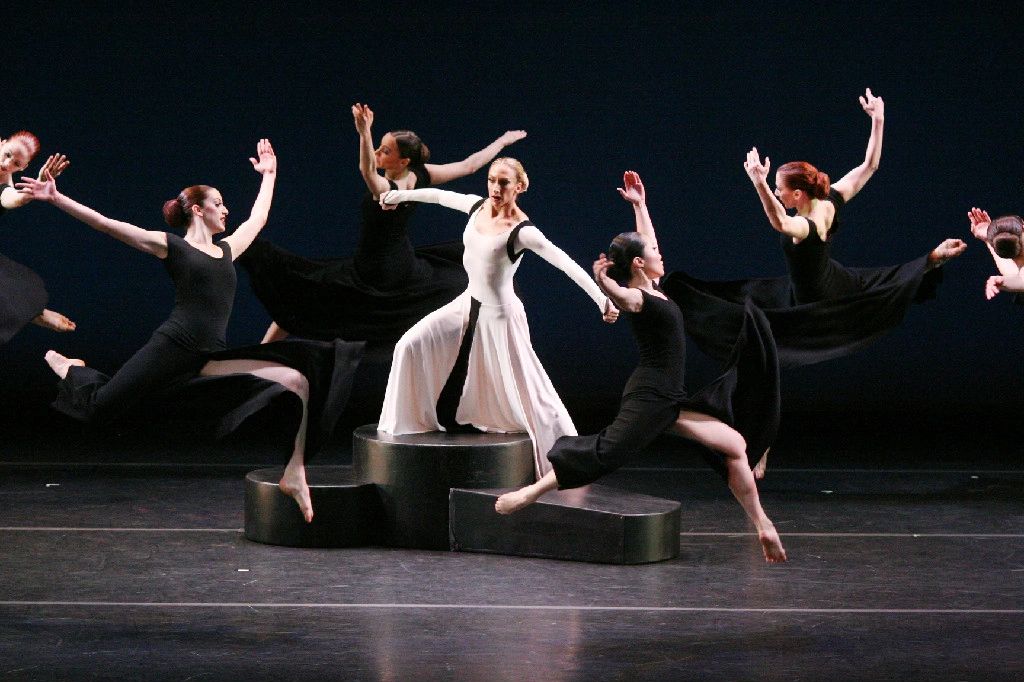
The company in Chronicle
This is our legacy. This is dance history. This is what geniuses do when they want to escape status quo. This is Martha Graham.
And although Graham is gone (she died, at age 96, in 1991), clearly her legendary presence continues to guide the ethics of Martha Graham Dance Company. The dancers’ precision, unity, power, and adherence to her style remain astonishing. The company inaugurated the Wallis Annenberg Center for the Performing Arts, built in—primarily under—the historic US Post Office building in Beverly Hills. If the quality, artistry, and significance of the choice of Martha Graham’s company represent what the Center will continue to produce, the Southland is guarantied an upcoming season of stirring performances.
Among the many smart, elegant aspects of the presentation, Graham company artistic director Janet Eilber introduced each piece, with clear, relevant information. Her narration appropriately presumed the audience knew who Martha Graham was but may not have known the backstories behind each of the works.
Every one of her dancers committed absolutely to the Graham style; here, the “make it your own” school of performance is apparently not tolerated. Cupped hands, stag leaps, contractions: Graham’s vocabulary continues to be spoken here, and the dancers speak with emotional purpose and a warmly welcoming mien. The difference these days, however, is that all her dancers have “crotch-sprung” extensions, as Graham’s friend Agnes de Mille described Graham’s then-rare ability to battement her leg to nearly 180 degrees. We’ll never know what works Graham could have built using the facility of today’s dancers.
The Wallis performance opened with a selection of dances under the umbrella title Prelude and Revolt. A trio of solo works—by Graham’s first teachers, Ted Shawn and Ruth St. Denis, and by Graham—show Graham’s early style. Excerpts from the choreographers’ The Incense (1906), Gnossienne (1919), and Tanagra (1926) were danced simultaneously by three soloists. The pieces reveal the era’s fascination with “the exotic,” presumably re-creating dances of the East Indian world (Katherine Crockett), ancient Crete (Tadej Brdnik), and somewhere akin to the upper eastern Mediterranean shores (Xiaochuan Xie). Serenata Morisca (1916) mixes that early style of choreography and performance with Iberian pyrotechnics and Graham’s characteristic attention to the costume’s fabric (danced by Mariya Dashkina Maddux).
Neither age nor the current glut of “anyone can dance” television has diminished the emotional impact of the most well-known of Graham’s works, Lamentation. Given intensity and stunningly crisp dynamics by Crockett, clad in the iconic “tube” of a costume, the work continues to thrill, for its historic significance and for the dancer’s technique. The last piece in Prelude and Revolt, titled Ritual to the Sun, displays daily exercises of the Graham Technique studied by most modern dancers, but these dancers’ joy turned these everyday exercises into pure exuberance.
Maple Leaf Rag (1990), the last work Graham choreographed, at age 96, provided charming laughs, mostly at her own expense. “Louis,” she says in a recording at the very beginning of the dance, speaking to Louis Horst, her reputed mentor/lover/accompanist, “play me the ‘Maple Leaf Rag,’ ” referring to Scott Joplin’s bouncy piano piece. Someone indeed plays it (the performance included only prerecorded music), delightfully, and the company launches into what’s best-described as Graham’s pastiche of herself. Her dancers frolic, Graham style: bounding onto and off of a springy “barre,” hurling themselves, striking quirky positions, occasionally being a little naughty. One dancer, however, cuts through the frivolity: a tall woman (Crockett again) fiercely clinging to pure traditional Graham.
With its all-female cast, Chronicle (1936) reminds its audience of the women left behind during and after war. The dancers, though, demonstrated the strength and stamina of most male dancers.
Despite being this abstract, Graham’s dances produce astonishing emotional reactions in her audiences. Her dancers’ apparent respect for tradition—her tradition of course, as she was an iconoclast—also produce tremendous respect in the audience. This production, with its old-school values, certainly revealed the ideals and intent of this newest, state-of-the-arts performance center.
Martha Graham Dance Company
Wallis Annenberg Center for the Performing Arts
Reviewed by Dany Margolies

The company in Chronicle
Photo by Costas
This is our legacy. This is dance history. This is what geniuses do when they want to escape status quo. This is Martha Graham.
And although Graham is gone (she died, at age 96, in 1991), clearly her legendary presence continues to guide the ethics of Martha Graham Dance Company. The dancers’ precision, unity, power, and adherence to her style remain astonishing. The company inaugurated the Wallis Annenberg Center for the Performing Arts, built in—primarily under—the historic US Post Office building in Beverly Hills. If the quality, artistry, and significance of the choice of Martha Graham’s company represent what the Center will continue to produce, the Southland is guarantied an upcoming season of stirring performances.
Among the many smart, elegant aspects of the presentation, Graham company artistic director Janet Eilber introduced each piece, with clear, relevant information. Her narration appropriately presumed the audience knew who Martha Graham was but may not have known the backstories behind each of the works.
Every one of her dancers committed absolutely to the Graham style; here, the “make it your own” school of performance is apparently not tolerated. Cupped hands, stag leaps, contractions: Graham’s vocabulary continues to be spoken here, and the dancers speak with emotional purpose and a warmly welcoming mien. The difference these days, however, is that all her dancers have “crotch-sprung” extensions, as Graham’s friend Agnes de Mille described Graham’s then-rare ability to battement her leg to nearly 180 degrees. We’ll never know what works Graham could have built using the facility of today’s dancers.
The Wallis performance opened with a selection of dances under the umbrella title Prelude and Revolt. A trio of solo works—by Graham’s first teachers, Ted Shawn and Ruth St. Denis, and by Graham—show Graham’s early style. Excerpts from the choreographers’ The Incense (1906), Gnossienne (1919), and Tanagra (1926) were danced simultaneously by three soloists. The pieces reveal the era’s fascination with “the exotic,” presumably re-creating dances of the East Indian world (Katherine Crockett), ancient Crete (Tadej Brdnik), and somewhere akin to the upper eastern Mediterranean shores (Xiaochuan Xie). Serenata Morisca (1916) mixes that early style of choreography and performance with Iberian pyrotechnics and Graham’s characteristic attention to the costume’s fabric (danced by Mariya Dashkina Maddux).
Neither age nor the current glut of “anyone can dance” television has diminished the emotional impact of the most well-known of Graham’s works, Lamentation. Given intensity and stunningly crisp dynamics by Crockett, clad in the iconic “tube” of a costume, the work continues to thrill, for its historic significance and for the dancer’s technique. The last piece in Prelude and Revolt, titled Ritual to the Sun, displays daily exercises of the Graham Technique studied by most modern dancers, but these dancers’ joy turned these everyday exercises into pure exuberance.
Maple Leaf Rag (1990), the last work Graham choreographed, at age 96, provided charming laughs, mostly at her own expense. “Louis,” she says in a recording at the very beginning of the dance, speaking to Louis Horst, her reputed mentor/lover/accompanist, “play me the ‘Maple Leaf Rag,’ ” referring to Scott Joplin’s bouncy piano piece. Someone indeed plays it (the performance included only prerecorded music), delightfully, and the company launches into what’s best-described as Graham’s pastiche of herself. Her dancers frolic, Graham style: bounding onto and off of a springy “barre,” hurling themselves, striking quirky positions, occasionally being a little naughty. One dancer, however, cuts through the frivolity: a tall woman (Crockett again) fiercely clinging to pure traditional Graham.
With its all-female cast, Chronicle (1936) reminds its audience of the women left behind during and after war. The dancers, though, demonstrated the strength and stamina of most male dancers.
Despite being this abstract, Graham’s dances produce astonishing emotional reactions in her audiences. Her dancers’ apparent respect for tradition—her tradition of course, as she was an iconoclast—also produce tremendous respect in the audience. This production, with its old-school values, certainly revealed the ideals and intent of this newest, state-of-the-arts performance center.
November 12, 2013
Interview
Changing Lives Through Art
For decades, the legendary Lula Washington has inspired dancers and audiences.
by Dany Margolies
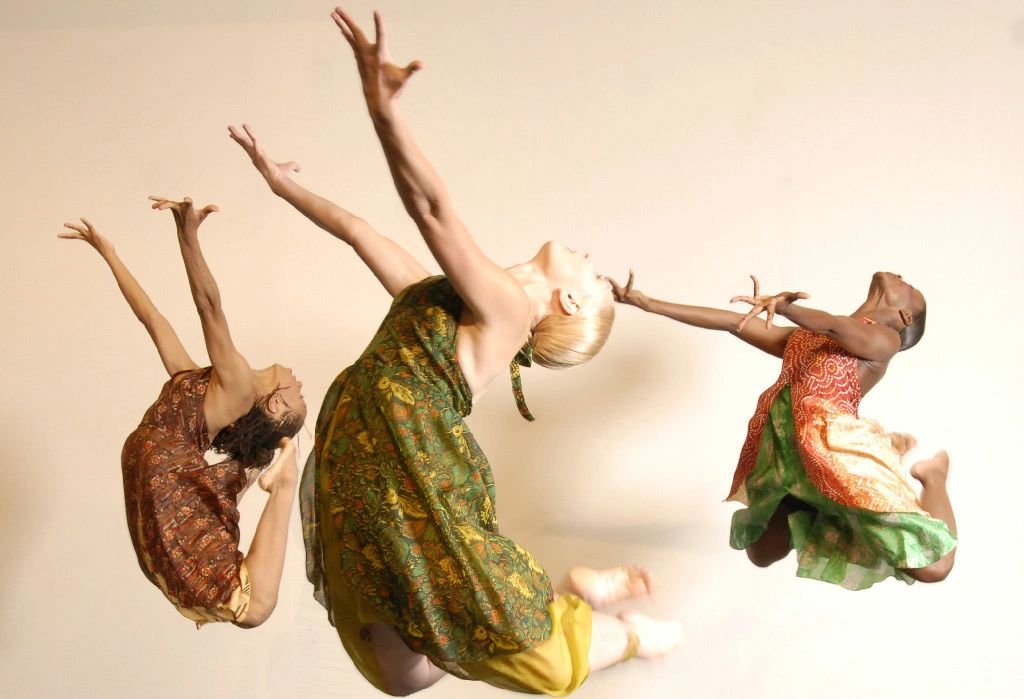
Lula Washington Dance Theatre
Lula Washington and her dance company have been a major part of the landscape of dance in LA since 1980, when she and her husband, Erwin Washington, founded The Lula Washington Contemporary Dance Foundation to provide “a creative outlet for young Southern California dance artists.” Since then, Lula Washington has taught technique, groomed discipline, and inspired generations of dancers.
She earned a master’s degree in dance from UCLA in 1984 and has been an active and activist teacher, choreographer, and businesswoman. The Washingtons founded their company and school in LA’s “inner city” to bring dance to African-American children and developing artists, many of whom have since danced in national companies, on screen, and on Broadway. Washington was the first recipient of Maria Shriver’s Minerva Award, “given to women who make a significant impact on women, girls, and families in California.”
Lula Washington Dance Theatre appears this weekend at The Ford Amphitheatre. Washington spoke with ArtsInLA.com about her start in dance, her inspirations, and the discipline of a dancer.
Legend has it, you discovered your path when you found a dance class in a park.

 Really good dance teachers taught in a park, in the 1970s. I went to the
park, with my husband, who was playing basketball. Down the hall from
the gym, there was music and the sound of, “5, 6, 7, 8!” I got curious. I
wandered down there. Thelma Robinson
was teaching a jazz class. I stood there, looking in the room, for a few
minutes. She asked if I’d like to come in and try it with them. That
was one of the initial beginnings. She was an original dancer with
Katherine Dunham [dance company]. Later in my life,
as I pursued dance, I hired Thelma Robinson to teach in my studio. She
had taught Alvin Ailey. Alvin Ailey and I
became very good friends because his mother’s name was Lula. He would
mentor myself and my husband. So I have a history with Katherine
Dunham and with Alvin Ailey and Dance Theatre of Harlem dancers.
Really good dance teachers taught in a park, in the 1970s. I went to the
park, with my husband, who was playing basketball. Down the hall from
the gym, there was music and the sound of, “5, 6, 7, 8!” I got curious. I
wandered down there. Thelma Robinson
was teaching a jazz class. I stood there, looking in the room, for a few
minutes. She asked if I’d like to come in and try it with them. That
was one of the initial beginnings. She was an original dancer with
Katherine Dunham [dance company]. Later in my life,
as I pursued dance, I hired Thelma Robinson to teach in my studio. She
had taught Alvin Ailey. Alvin Ailey and I
became very good friends because his mother’s name was Lula. He would
mentor myself and my husband. So I have a history with Katherine
Dunham and with Alvin Ailey and Dance Theatre of Harlem dancers.
That’s Arthur Mitchell’s company.
Yes. One of his leading male dancers, Gerald McCall, taught ballet with us—one of the first people to help cultivate, get ballet started at my studio, introduce African-American girls and boys to it. They hated it. Gerald and I would coach and talk to them until they had a love of ballet. Karl Shook, Arthur, and Gerald McCall put together the standards and teaching foundation for Dance Theatre of Harlem.
Later we had Lowell Smith, from Dance Theatre of Harlem, who taught at my studio. Finally we were able to give him an award, from the International Association of Blacks in Dance. And he came and taught master classes. Stephanie Powell, from Dance Theatre of Harlem, taught.
At your school, do you accept all young students who apply?
We don’t turn anybody away. I started my school because I wanted to give an opportunity to African-American boys and girls to dance.
What if a child is a behavioral problem?
We don’t turn people away because of behavior in class. We don’t let people be disruptive or out of line. They have to follow our behavior. We’ve not had serious problems. We had a couple of problems, but that’s because the parents want their kids to be on meds. We don’t give it, we don’t know about it.
When you teach or coach children, what’s your overriding focus?
We have different levels. We have kids that want to experience the art of ballet, and they’ve gone elsewhere and were told they can’t do it. We teach discipline, good posture, a good foundation in what they’re doing. Someplace along their life, they may discover they like dance. We teach basic principles, how to be in a basic beginning class. Then we have others ready to go beyond that, so the structure gets a little tighter. But most of our work is in jazz.
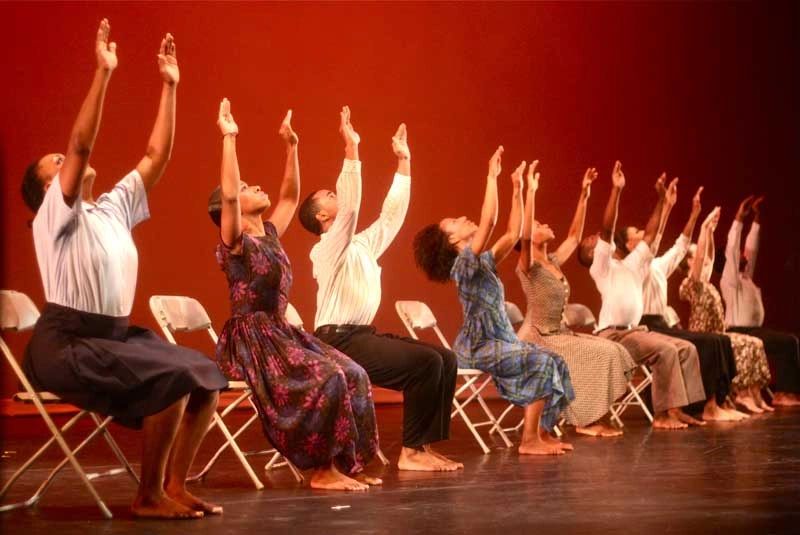
What do you tell your young dancers about the life of a dancer?
First, that they have to get a basic foundation, and that would be starting with classical ballet. Then have passion, be committed to going to their classes on a regular basis, understand it’s not going to be easy and will take a long time and a lot of hard work.
In that case, do you try to keep your students from watching reality television?
We talk about the reality of dance, how every body is different, to give them an honest assessment of the dance world. They see bodies are different when they walk in the door. But we teach them all the same: They have to have the discipline. Whether they’re 100 pounds or 150 pounds, they still have to learn to turn out at their hips, understand the terminology, do a correct tendu [a movement of the foot into a fully pointed position, one of the most basic building blocks of dance].
How do you run your choreography sessions and rehearsals? Do you like input from your dancers?
It depends on the work we’re doing and the group of dancers I have. If I have a group of dancers who buy into what I’m doing and I give them something and they play around with it and do it a little different, I tell them I like it. I don’t enforce, unless that’s exactly what I want. Ninety percent of the choreography is set the way I really like it to be, but if it’s a solo artist, I allow them to bring something into the work. If they tell me they have a hard time doing a step, I say, “Let me see it first.” If it looks like trouble, I don’t make them do it. That’s unproductive.
Have you had dancers whom you doubted but who proved themselves able to improve beyond expectations?
I have a policy: I usually have hope for everybody, that this person is going to get it. I just gotta keep working with them. But I realize even though I as a choreographer see the potential and believe in my heart that this person can do something, they may not. I don’t want to spend a thousand hours to boost them up to do it. I have come to the conclusion, I’m going to give them a certain amount of time to do it, I’m going to coach, my associate director is going to coach, my dance captain is going to coach and mentor. But at a certain time, I’m going to give the part to another person. I teach the part to several people, and we mentor and bring them all along at the same time.
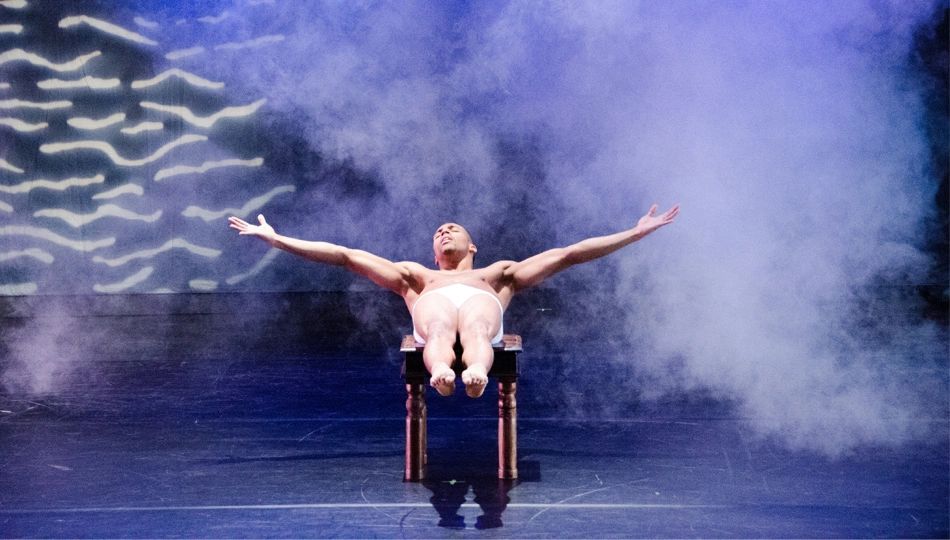
This is a corny question, and yet it isn’t: Of all your dancers, whose life have you changed the most?
I’ve changed a lot of dancers’ lives. Every dancer, their lives have been changed. Some have improved so much, they’ve gone on to Broadway. They write to me and say, “Thank you for making me learn everybody’s part. It made me better.” Or, “Thank you for letting me learn how to teach and give corrections, because I learned a process for teaching and how to break the most complicated step down.”
I go to the supermarket, and someone says to me, “You’re Lula! My daughter was in your class in 2010, and her self-esteem was so greatly improved, she decided to run for class president in her high school, and that wouldn’t have happened if she wasn’t in your studio.”
“Turning the Page,” one of the pieces in your upcoming concert, is about our County Supervisor Zev Yaroslavsky and his early job turning pages of music at a performance. That’s quite an unusual source of inspiration.
I get inspiration from many things and forces. My husband, Erwin, gave me this idea. We were talking to Zev when we went to the [county] board [of supervisors], and Erwin was asking him about his connection to the arts. He shared the story that, as a young boy, he turned the page, he’d watch the classical ballet dancers dancing. This was when they were reopening and improving the facilities at the Ford [Theatre]. Whatever a child is exposed to as a young person goes with him throughout his life. He was turning the music page. This piece, like my 9/11 piece, what happens so instantly that changes the lives of so many people all over the world had to manifest itself in the work I was doing.
The Trayvon Martin legacy and his life came along at the time I was doing “Turning the Page.” His innocence and the African-American youth who die every day of the year—it’s not that you’re going to see a person killed by a gun, it’s that a person with a hood could generate so much fear, with no thought of how that person could be feeling. It was very painful and is still painful today. Many of my dancers were traumatized, emotionally distraught. It just so happened that with this piece, we were able to find a little peace, quietness, a place to release it. Lots of young people release their frustration through attempting to cause destruction, and we are not that. We use the arts to create change, to change lives through art. That piece is about people’s feelings—the loss and the pain that is felt every time something happens that we feel is unjust. It’s a part of healing—quieting oneself down to come to a place where you can help change the system.
Changing Lives Through Art
For decades, the legendary Lula Washington has inspired dancers and audiences.
by Dany Margolies

Lula Washington Dance Theatre
Photo by Ian Foxx
Lula Washington and her dance company have been a major part of the landscape of dance in LA since 1980, when she and her husband, Erwin Washington, founded The Lula Washington Contemporary Dance Foundation to provide “a creative outlet for young Southern California dance artists.” Since then, Lula Washington has taught technique, groomed discipline, and inspired generations of dancers.
She earned a master’s degree in dance from UCLA in 1984 and has been an active and activist teacher, choreographer, and businesswoman. The Washingtons founded their company and school in LA’s “inner city” to bring dance to African-American children and developing artists, many of whom have since danced in national companies, on screen, and on Broadway. Washington was the first recipient of Maria Shriver’s Minerva Award, “given to women who make a significant impact on women, girls, and families in California.”
Lula Washington Dance Theatre appears this weekend at The Ford Amphitheatre. Washington spoke with ArtsInLA.com about her start in dance, her inspirations, and the discipline of a dancer.
Legend has it, you discovered your path when you found a dance class in a park.
 Really good dance teachers taught in a park, in the 1970s. I went to the
park, with my husband, who was playing basketball. Down the hall from
the gym, there was music and the sound of, “5, 6, 7, 8!” I got curious. I
wandered down there. Thelma Robinson
was teaching a jazz class. I stood there, looking in the room, for a few
minutes. She asked if I’d like to come in and try it with them. That
was one of the initial beginnings. She was an original dancer with
Katherine Dunham [dance company]. Later in my life,
as I pursued dance, I hired Thelma Robinson to teach in my studio. She
had taught Alvin Ailey. Alvin Ailey and I
became very good friends because his mother’s name was Lula. He would
mentor myself and my husband. So I have a history with Katherine
Dunham and with Alvin Ailey and Dance Theatre of Harlem dancers.
Really good dance teachers taught in a park, in the 1970s. I went to the
park, with my husband, who was playing basketball. Down the hall from
the gym, there was music and the sound of, “5, 6, 7, 8!” I got curious. I
wandered down there. Thelma Robinson
was teaching a jazz class. I stood there, looking in the room, for a few
minutes. She asked if I’d like to come in and try it with them. That
was one of the initial beginnings. She was an original dancer with
Katherine Dunham [dance company]. Later in my life,
as I pursued dance, I hired Thelma Robinson to teach in my studio. She
had taught Alvin Ailey. Alvin Ailey and I
became very good friends because his mother’s name was Lula. He would
mentor myself and my husband. So I have a history with Katherine
Dunham and with Alvin Ailey and Dance Theatre of Harlem dancers.That’s Arthur Mitchell’s company.
Yes. One of his leading male dancers, Gerald McCall, taught ballet with us—one of the first people to help cultivate, get ballet started at my studio, introduce African-American girls and boys to it. They hated it. Gerald and I would coach and talk to them until they had a love of ballet. Karl Shook, Arthur, and Gerald McCall put together the standards and teaching foundation for Dance Theatre of Harlem.
Later we had Lowell Smith, from Dance Theatre of Harlem, who taught at my studio. Finally we were able to give him an award, from the International Association of Blacks in Dance. And he came and taught master classes. Stephanie Powell, from Dance Theatre of Harlem, taught.
At your school, do you accept all young students who apply?
We don’t turn anybody away. I started my school because I wanted to give an opportunity to African-American boys and girls to dance.
What if a child is a behavioral problem?
We don’t turn people away because of behavior in class. We don’t let people be disruptive or out of line. They have to follow our behavior. We’ve not had serious problems. We had a couple of problems, but that’s because the parents want their kids to be on meds. We don’t give it, we don’t know about it.
When you teach or coach children, what’s your overriding focus?
We have different levels. We have kids that want to experience the art of ballet, and they’ve gone elsewhere and were told they can’t do it. We teach discipline, good posture, a good foundation in what they’re doing. Someplace along their life, they may discover they like dance. We teach basic principles, how to be in a basic beginning class. Then we have others ready to go beyond that, so the structure gets a little tighter. But most of our work is in jazz.

What do you tell your young dancers about the life of a dancer?
First, that they have to get a basic foundation, and that would be starting with classical ballet. Then have passion, be committed to going to their classes on a regular basis, understand it’s not going to be easy and will take a long time and a lot of hard work.
In that case, do you try to keep your students from watching reality television?
We talk about the reality of dance, how every body is different, to give them an honest assessment of the dance world. They see bodies are different when they walk in the door. But we teach them all the same: They have to have the discipline. Whether they’re 100 pounds or 150 pounds, they still have to learn to turn out at their hips, understand the terminology, do a correct tendu [a movement of the foot into a fully pointed position, one of the most basic building blocks of dance].
How do you run your choreography sessions and rehearsals? Do you like input from your dancers?
It depends on the work we’re doing and the group of dancers I have. If I have a group of dancers who buy into what I’m doing and I give them something and they play around with it and do it a little different, I tell them I like it. I don’t enforce, unless that’s exactly what I want. Ninety percent of the choreography is set the way I really like it to be, but if it’s a solo artist, I allow them to bring something into the work. If they tell me they have a hard time doing a step, I say, “Let me see it first.” If it looks like trouble, I don’t make them do it. That’s unproductive.
Have you had dancers whom you doubted but who proved themselves able to improve beyond expectations?
I have a policy: I usually have hope for everybody, that this person is going to get it. I just gotta keep working with them. But I realize even though I as a choreographer see the potential and believe in my heart that this person can do something, they may not. I don’t want to spend a thousand hours to boost them up to do it. I have come to the conclusion, I’m going to give them a certain amount of time to do it, I’m going to coach, my associate director is going to coach, my dance captain is going to coach and mentor. But at a certain time, I’m going to give the part to another person. I teach the part to several people, and we mentor and bring them all along at the same time.

This is a corny question, and yet it isn’t: Of all your dancers, whose life have you changed the most?
I’ve changed a lot of dancers’ lives. Every dancer, their lives have been changed. Some have improved so much, they’ve gone on to Broadway. They write to me and say, “Thank you for making me learn everybody’s part. It made me better.” Or, “Thank you for letting me learn how to teach and give corrections, because I learned a process for teaching and how to break the most complicated step down.”
I go to the supermarket, and someone says to me, “You’re Lula! My daughter was in your class in 2010, and her self-esteem was so greatly improved, she decided to run for class president in her high school, and that wouldn’t have happened if she wasn’t in your studio.”
“Turning the Page,” one of the pieces in your upcoming concert, is about our County Supervisor Zev Yaroslavsky and his early job turning pages of music at a performance. That’s quite an unusual source of inspiration.
I get inspiration from many things and forces. My husband, Erwin, gave me this idea. We were talking to Zev when we went to the [county] board [of supervisors], and Erwin was asking him about his connection to the arts. He shared the story that, as a young boy, he turned the page, he’d watch the classical ballet dancers dancing. This was when they were reopening and improving the facilities at the Ford [Theatre]. Whatever a child is exposed to as a young person goes with him throughout his life. He was turning the music page. This piece, like my 9/11 piece, what happens so instantly that changes the lives of so many people all over the world had to manifest itself in the work I was doing.
The Trayvon Martin legacy and his life came along at the time I was doing “Turning the Page.” His innocence and the African-American youth who die every day of the year—it’s not that you’re going to see a person killed by a gun, it’s that a person with a hood could generate so much fear, with no thought of how that person could be feeling. It was very painful and is still painful today. Many of my dancers were traumatized, emotionally distraught. It just so happened that with this piece, we were able to find a little peace, quietness, a place to release it. Lots of young people release their frustration through attempting to cause destruction, and we are not that. We use the arts to create change, to change lives through art. That piece is about people’s feelings—the loss and the pain that is felt every time something happens that we feel is unjust. It’s a part of healing—quieting oneself down to come to a place where you can help change the system.
Lula Washington spoke with ArtsInLA.com on August 1, 2013
Review
En Aparté
Compagnie Étant Donné at Theatre Raymond Kabbaz
Reviewed by Dany Margolies
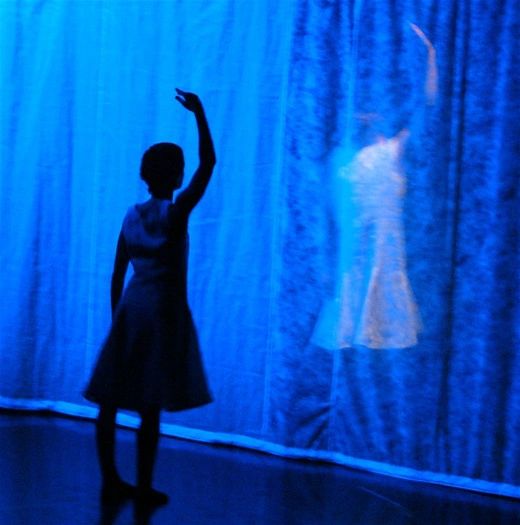 Frédérike Unger (in silhouette) and Jérôme Ferron (as her mirror image)
Frédérike Unger and Jérôme Ferron are charming, well-schooled dancers, and their choreography of duets and solos that make up En Aparté provokes thought and appeals to the eye.
At least what can be seen of it appeals to the eye. The two introduce themselves to the audience by heel-toeing a Crawl to music that sounds suspiciously like “Honky Tonk Woman” on xylophone. Then they get down to the business of an ordinary day, as they reveal the joys and quirks of sitting, eating, showering, dressing, bickering, and trying to sleep.
These French dancers’ choice of and use of music is elegant and appropriate. Bach’s Prelude No. 1 accompanies the couple’s entrance through their front door, as a video projection creates chalk drawings of doors and later of a full kitchen. A transcription for piano of Beethoven’s Symphony No. 6 underscores Unger as she “dresses.”
Thank goodness for these aural pleasures, because too much of the work is obscured under dim lighting or behind sheer curtains and flats. Someone overdirected this piece, not letting the dance tell its own story. Ferror engages in a small battle in trying to don and remove his sweater, but he does so in the dimmest of lighting. That duskiness should have been limited to Unger’s efforts to sleep, her restless night turning into hilariously gymnastic feats.
The one section that belongs behind a screen is Unger’s shower, in which she washes herself, everywhere, to comedic effect. But the couple bickering across a dinner table, performed behind a sheer curtain, conceals the dancers’ expressive faces.
The piece’s most effective, most enjoyable moment, as it happens, plays out in the brighter lighting. Unger wears a crisp white dress, as she admires herself in a “mirror.” We assume she’s trying it on in a store, using a three-way mirror; certainly no self-respecting French woman would appear in public in that dress while wearing black socks. She tussles to reach the zipper. Soon, Ferron becomes her “mirror image.” One can imagine her distress at seeing a much larger image reflecting back at her. She and her image play, they frolic à la Marx brothers, and then they develop a companionship each will miss when they part.
Another highlight, no pun intended, is a pillow fight, performed in spectacularly good slow motion. Even the pillow seems to cooperate, appearing to move slowly with the dancers.
The production here, lasting 45 minutes, was designated for young audiences (and their families), ages 6 and up. A pleasing number of such viewers attended. In the main, their interest during the performance seemed to ebb and flow. Then again, a little girl in the front row turned to her father the instant the program ended. She clasped him in a spontaneous hug and exclaimed, “I loved it! Thank you!”
En Aparté
Compagnie Étant Donné at Theatre Raymond Kabbaz
Reviewed by Dany Margolies
 Frédérike Unger (in silhouette) and Jérôme Ferron (as her mirror image)
Frédérike Unger and Jérôme Ferron are charming, well-schooled dancers, and their choreography of duets and solos that make up En Aparté provokes thought and appeals to the eye.
At least what can be seen of it appeals to the eye. The two introduce themselves to the audience by heel-toeing a Crawl to music that sounds suspiciously like “Honky Tonk Woman” on xylophone. Then they get down to the business of an ordinary day, as they reveal the joys and quirks of sitting, eating, showering, dressing, bickering, and trying to sleep.
These French dancers’ choice of and use of music is elegant and appropriate. Bach’s Prelude No. 1 accompanies the couple’s entrance through their front door, as a video projection creates chalk drawings of doors and later of a full kitchen. A transcription for piano of Beethoven’s Symphony No. 6 underscores Unger as she “dresses.”
Thank goodness for these aural pleasures, because too much of the work is obscured under dim lighting or behind sheer curtains and flats. Someone overdirected this piece, not letting the dance tell its own story. Ferror engages in a small battle in trying to don and remove his sweater, but he does so in the dimmest of lighting. That duskiness should have been limited to Unger’s efforts to sleep, her restless night turning into hilariously gymnastic feats.
The one section that belongs behind a screen is Unger’s shower, in which she washes herself, everywhere, to comedic effect. But the couple bickering across a dinner table, performed behind a sheer curtain, conceals the dancers’ expressive faces.
The piece’s most effective, most enjoyable moment, as it happens, plays out in the brighter lighting. Unger wears a crisp white dress, as she admires herself in a “mirror.” We assume she’s trying it on in a store, using a three-way mirror; certainly no self-respecting French woman would appear in public in that dress while wearing black socks. She tussles to reach the zipper. Soon, Ferron becomes her “mirror image.” One can imagine her distress at seeing a much larger image reflecting back at her. She and her image play, they frolic à la Marx brothers, and then they develop a companionship each will miss when they part.
Another highlight, no pun intended, is a pillow fight, performed in spectacularly good slow motion. Even the pillow seems to cooperate, appearing to move slowly with the dancers.
The production here, lasting 45 minutes, was designated for young audiences (and their families), ages 6 and up. A pleasing number of such viewers attended. In the main, their interest during the performance seemed to ebb and flow. Then again, a little girl in the front row turned to her father the instant the program ended. She clasped him in a spontaneous hug and exclaimed, “I loved it! Thank you!”
April 5, 2013
Review
Traverse
Arcosm Co. at Theatre Raymond Kabbaz
Reviewed by Dany Margolies
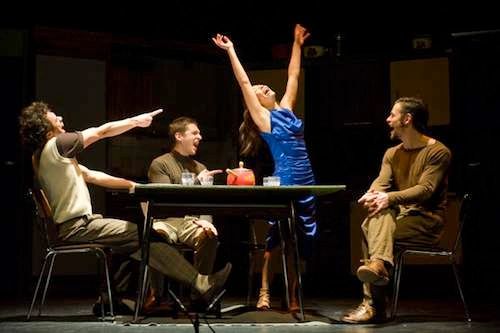 Emilien Gobard, Matthieu Benigno, Anne-Cécile Chane-Tune, and Alexandre Esperet
A bit of the ballet Le Spectre de la Rose haunts this piece by French contemporary dance troupe Arcosm. The lights come up on a man asleep in an armchair. But instead of gently awakening him and inviting him to liltingly waltz, his visitors shake him out of his daily complacency.
The man (Emilien Gobard) goes about his highly structured routine in his modular kitchen. He walks in straight, not curved, paths. He crisply prepares his morning beverage and toast; he obsessively straightens his oven mitt. He lives an orderly life, predicting to the second when his newspaper will arrive.
Suddenly his doorbell announces newness: the arrival of a pretty, friendly woman (Anne-Cécile Chane-Tune). She borrows his pepper mill. His walls shake, his toaster shoots projectile toast, and his kitchen is invaded by strangers.
Choreographed by Thomas Guerry, composed by Camille Rocailleux, this is a story of letting go of strictures and finding enjoyment, whether in one’s sleeping subconscious or in full awareness. The man is visited first by a wild-and-crazy guy (Matthieu Benigno) in a pale pink suit, then by a sort of human dust devil (Alexandre Esperet). Dishes get thrown into the trash, doorways get moved, the man and his life are turned upside down, and all is done with dovetailing rhythms the dancers bang out with household implements against cabinets and countertops.
The man treats the woman shabbily, almost brutishly at first; Chane-Tune and Gobard’s first pas de deux is jerky and disquieting. The man seems to eventually learn how to treat a woman, and the dances become more supporting and frolicsome.
They also become chattier. The woman can’t recall what she wanted to ask for; the mimed conversation turns to voiced gibberish, then to a quartet of “Oh, my God” (yes, the French troupe speaks English words whilst Charles de Gaulle spins) as the man tries to fit in with the crowd. The four eventually dance in unison as the man seemingly absorbs a little fun and a little disorder in his life and finds helpmates in the visitors.
The dancers are exceptionally well-versed in Guerry’s style, which distills everyday activities into nearly unrecognizable yet natural motion. The dancers’ dynamics are strong and clear, and the complex rhythms they drum and stamp feel relaxed yet sound precise. Rocailleux’s playful score is eclectic, including lines for marimba (which Benigno and Esperet expertly mime at an onstage instrument). The lighting plot was surprisingly lavish for this unfortunately one-night-only stop in Los Angeles.
This one-hour work seemed ample for an audience satisfyingly including school-age children. Traverse could also be paired with any of the classic fairy tale ballets, including perhaps—in a wry bit of programming, considering the visits here from the generous fairies of hedonism and sloppiness—the prologue from Sleeping Beauty.
Show closed. For upcoming programming, www.theatreraymondkabbaz.com.
Traverse
Arcosm Co. at Theatre Raymond Kabbaz
Reviewed by Dany Margolies
 Emilien Gobard, Matthieu Benigno, Anne-Cécile Chane-Tune, and Alexandre Esperet
A bit of the ballet Le Spectre de la Rose haunts this piece by French contemporary dance troupe Arcosm. The lights come up on a man asleep in an armchair. But instead of gently awakening him and inviting him to liltingly waltz, his visitors shake him out of his daily complacency.
The man (Emilien Gobard) goes about his highly structured routine in his modular kitchen. He walks in straight, not curved, paths. He crisply prepares his morning beverage and toast; he obsessively straightens his oven mitt. He lives an orderly life, predicting to the second when his newspaper will arrive.
Suddenly his doorbell announces newness: the arrival of a pretty, friendly woman (Anne-Cécile Chane-Tune). She borrows his pepper mill. His walls shake, his toaster shoots projectile toast, and his kitchen is invaded by strangers.
Choreographed by Thomas Guerry, composed by Camille Rocailleux, this is a story of letting go of strictures and finding enjoyment, whether in one’s sleeping subconscious or in full awareness. The man is visited first by a wild-and-crazy guy (Matthieu Benigno) in a pale pink suit, then by a sort of human dust devil (Alexandre Esperet). Dishes get thrown into the trash, doorways get moved, the man and his life are turned upside down, and all is done with dovetailing rhythms the dancers bang out with household implements against cabinets and countertops.
The man treats the woman shabbily, almost brutishly at first; Chane-Tune and Gobard’s first pas de deux is jerky and disquieting. The man seems to eventually learn how to treat a woman, and the dances become more supporting and frolicsome.
They also become chattier. The woman can’t recall what she wanted to ask for; the mimed conversation turns to voiced gibberish, then to a quartet of “Oh, my God” (yes, the French troupe speaks English words whilst Charles de Gaulle spins) as the man tries to fit in with the crowd. The four eventually dance in unison as the man seemingly absorbs a little fun and a little disorder in his life and finds helpmates in the visitors.
The dancers are exceptionally well-versed in Guerry’s style, which distills everyday activities into nearly unrecognizable yet natural motion. The dancers’ dynamics are strong and clear, and the complex rhythms they drum and stamp feel relaxed yet sound precise. Rocailleux’s playful score is eclectic, including lines for marimba (which Benigno and Esperet expertly mime at an onstage instrument). The lighting plot was surprisingly lavish for this unfortunately one-night-only stop in Los Angeles.
This one-hour work seemed ample for an audience satisfyingly including school-age children. Traverse could also be paired with any of the classic fairy tale ballets, including perhaps—in a wry bit of programming, considering the visits here from the generous fairies of hedonism and sloppiness—the prologue from Sleeping Beauty.
Show closed. For upcoming programming, www.theatreraymondkabbaz.com.
